
Taoism (2022–2024)
Flow, Balance, and the Architecture of the Way
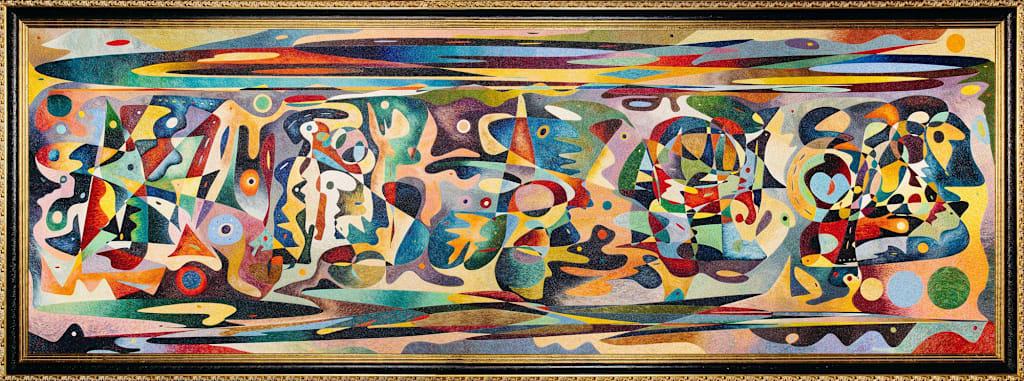
Among the world's enduring philosophical and spiritual traditions, Taoism occupies a unique position through its emphasis on harmony, natural order, and the dynamic balance that sustains existence. Emerging in ancient China through the teachings associated with Laozi and later Taoist thinkers, Taoism proposes that reality unfolds according to the Tao - the ineffable Way that underlies all phenomena. Rather than advocating control over the world, Taoist philosophy encourages alignment with its rhythms, recognizing that wisdom emerges through balance, adaptability, and attentive participation in the flow of life. In Taoism (2022–2024), Gheorghe Virtosu transforms these principles into a monumental abstract composition that investigates the architecture of equilibrium itself.
Measuring 2 by 6 meters, the painting unfolds as a continuous visual field animated by interconnected forms, fluid transitions, and shifting relationships. Rather than depicting historical figures, sacred texts, or ritual practices, Virtosu constructs a symbolic environment through which Taoist ideas become visible as systems of movement, transformation, and coexistence. The work functions not as an illustration of doctrine but as a visual meditation on the structures through which balance emerges.
"Taoism explores belief as alignment rather than authority. Through abstraction, Virtosu constructs a visual system in which opposing forces coexist in dynamic equilibrium, revealing harmony as an active process of continual transformation rather than a fixed condition."
- Daniel Varzari, El Arte Monumental, 10 Religions: The Architecture of Belief, Catalogue Entry: Taoism (2024).
The composition is characterized by extraordinary fluidity. Forms appear to flow into one another without rigid boundaries, creating an environment in which movement becomes the dominant structural principle. Curved geometries, overlapping planes, and evolving relationships produce a visual rhythm that recalls natural processes such as water currents, atmospheric circulation, growth, and transformation. Nothing remains static. Every element participates in a larger system of exchange.
This visual condition reflects one of Taoism's central insights: that reality is defined not by permanence but by continual change. Virtosu translates this concept into abstraction by rejecting centralized hierarchy. No single form governs the composition. Instead, balance emerges through the interaction of diverse visual forces distributed across the entire surface.
Color contributes significantly to this sense of living equilibrium. Deep blues, luminous greens, warm reds, golden yellows, and delicate violets interact through subtle transitions and carefully calibrated contrasts. The palette evokes natural cycles without representing specific landscapes. Color becomes an expression of energetic relationships, suggesting the perpetual movement through which opposing forces achieve temporary states of harmony.
The painting's horizontal structure reinforces this interpretation. Flowing bands traverse the upper and lower sections of the composition, creating visual currents that connect distant areas of the canvas. These elongated forms suggest continuity, movement, and temporal passage. They function as metaphors for the Tao itself: an invisible principle that unifies diverse manifestations without imposing rigid order upon them.
Human profiles, organic shapes, geometric structures, and symbolic fragments appear throughout the work, yet they never solidify into fixed narratives. Instead, they emerge and dissolve within a constantly shifting environment. Identity becomes relational rather than autonomous, reflecting Taoist perspectives that emphasize interdependence over separation.
Particularly notable is the painting's balance between complexity and clarity. While the composition contains an extraordinary density of forms, it never descends into chaos. Visual tensions are continually resolved through rhythm, proportion, and movement. Opposing elements coexist without annihilating one another. This dynamic recalls the Taoist principle that complementary forces generate and sustain reality through their interaction.
At a symbolic level, the work investigates the relationship between opposites. Light and dark, motion and stillness, expansion and contraction, individuality and unity appear throughout the composition as interconnected rather than antagonistic conditions. Virtosu's abstraction visualizes a worldview in which balance arises through relationship rather than domination.
The monumental scale enhances this experience. Extending six meters across, the painting invites prolonged observation. Viewers encounter a visual environment whose internal relationships reveal themselves gradually over time. The work resists immediate interpretation, encouraging the contemplative attention associated with Taoist approaches to perception and understanding.
Within the broader framework of 10 Religions: The Architecture of Belief, Taoism represents a profound exploration of balance as a spiritual structure. While many belief systems emphasize transcendence, revelation, or divine authority, Taoism focuses upon the patterns through which harmony emerges within the world itself. Virtosu translates this orientation into a visual language built upon flow, reciprocity, and transformation.
The painting also resonates strongly with contemporary concerns. In an age characterized by acceleration, conflict, and environmental instability, Taoism proposes an alternative model of existence grounded in adaptability and equilibrium. The work suggests that resilience emerges not through control but through responsiveness to larger systems and conditions.
"The composition derives its coherence from the continual negotiation of visual opposites. Through this structure, Virtosu transforms Taoist philosophy into an abstract architecture of balance, revealing harmony as a dynamic state generated through movement, relationship, and perpetual becoming."
- Daniel Varzari, El Arte Monumental, Curatorial Essay: Taoism (2024).
Ultimately, Taoism succeeds because it transforms an ancient philosophical tradition into a contemporary meditation on interconnectedness, transformation, and the search for equilibrium. Rather than illustrating specific teachings, the painting investigates the underlying structures through which harmony becomes possible.
In doing so, Virtosu expands the possibilities of spiritual abstraction, creating a work that speaks simultaneously to philosophy, ecology, cultural history, and contemporary experience. The painting becomes an architecture of flow - a visual affirmation that balance is not the absence of change, but the ability to move within it.
About the Creator
Daniel Varzari
American art curator.
Enjoyed the story? Support the Creator.
Subscribe for free to receive all their stories in your feed.
Comments
There are no comments for this story
Be the first to respond and start the conversation.