
She Paid for the Show. Then She Made Him Kiss Her 60 Times.
How a financier turned a 50‑episode short drama into a private playground — and why a 23‑year‑old actor couldn’t afford to say no.
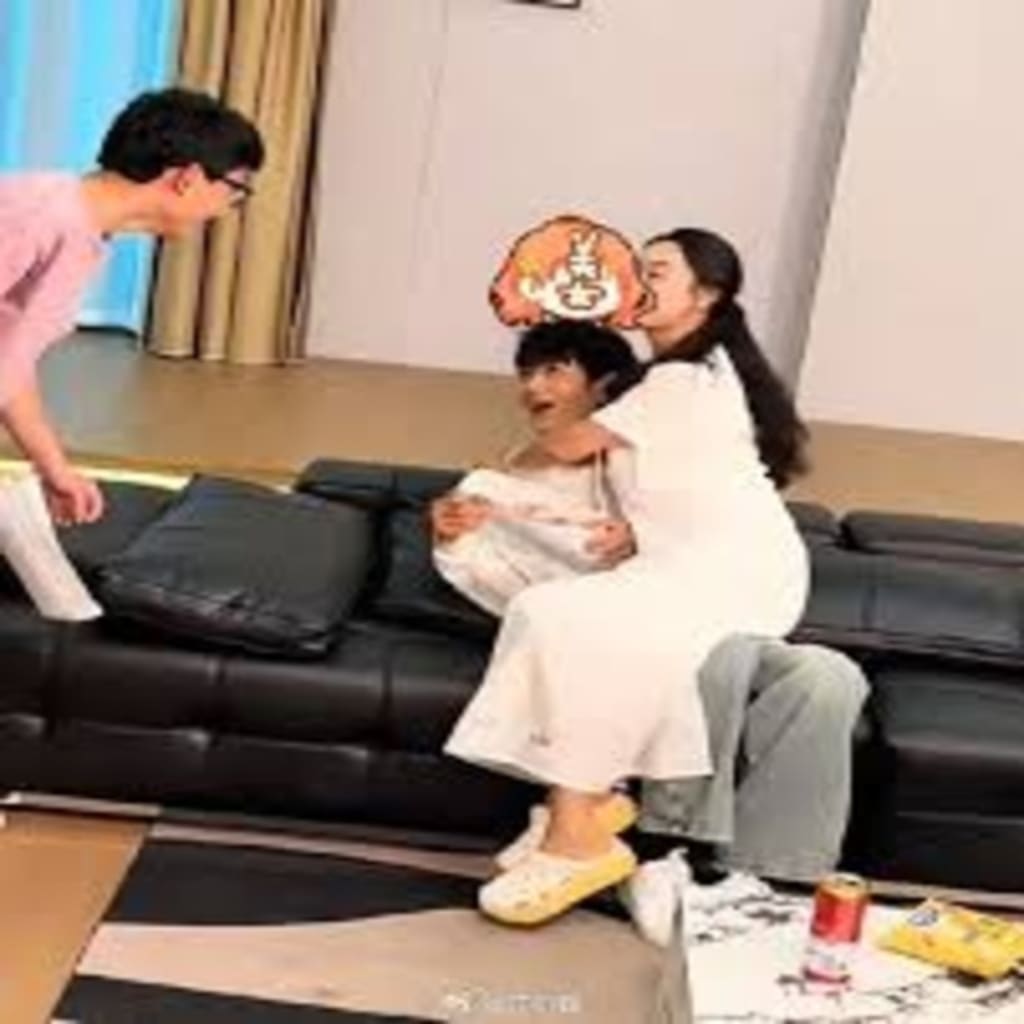
A fifty‑episode series. Over sixty kissing scenes. Every single one was written into the script. Not a single one served the story.
Zhong Yufei said his lips were raw.
Twenty‑three years old. Just starting out. His first proper costume drama, and the female lead was the investor herself. The original script had just over a dozen kissing scenes. After she joined the production, that number swelled past thirty. On set, she kept adding more on the fly, eventually pushing the total past sixty. In a fifty‑episode show, that meant kissing in nearly every installment. Sometimes two steps of dialogue, then a kiss.
He said the early takes stayed within professional boundaries. But later, she would grab the back of his head and force her tongue into his mouth, "delivering saliva nonstop." Repeated retakes. His lips rubbed raw. The director and screenwriter tried to intervene. The investor shot back: "I've watched more short dramas than you've ever shot."
The series was pulled from the platform within days of its launch. The investor withheld a final payment of 30,000 yuan from the director, who then exposed the whole affair. Only then did Zhong Yufei finally speak up.
The title of this production was The Fallen Prince. But who was truly fallen?
I. On This Set, There Was Only One Center of Power — and It Wasn't the Director
On any proper film set in Hengdian, the daily routine begins with a "table read": director, writers, and lead actors gathered in a circle to walk through the day's scenes. Standard protocol dictates that the director holds final authority, with actor boundaries defined jointly by the script and the director's direction.
But the set of The Fallen Prince worked differently.
The investor fully financed the production. She chose the male lead. She rewrote the script. She sat behind the monitor. The director and screenwriter's objections carried no weight, because in the face of capital, professional judgment has no price tag. Her logic was brutally simple: my money, my show. How I act, how many scenes I add, how long we kiss — I decide.
In a video posted after the fact, Zhong Yufei spoke with restrained composure. No inflammatory language. But every word carried weight: "Acting is my job. I perform whatever the script calls for — kissing scenes, intimate scenes, I can handle all of that. But could you please not put your tongue in my mouth?"
Read closely: the first half is a young actor claiming his profession. The second half is a human being drawing a boundary around his own body. The problem was, on that closed set, within that lopsided power structure, he didn't dare draw it. She was both his leading lady and the person signing his paychecks. He was new. He couldn't afford to offend her.
"Couldn't afford to offend." Those four words cut deeper than sixty kissing scenes.
II. Adding Scenes Was Never About the Script. It Was About Power Made Physical.
Many tried to frame this as a "sugar mommy" story. Zhong Yufei and his agent appeared on camera on August 7 to shut down those rumors directly. But the gossip itself was a distraction.
At no point was this fundamentally about a transactional exchange of sex for money — there's zero evidence Zhong Yufei accepted any benefit beyond his contracted work. He accepted a job. The job went sour during execution.
Where was the line crossed?
The moment her hand gripped the back of his head. Before that, the kisses were scripted text, professional performance, the "make‑believe" part of make‑believe. After that, physical contact detached from narrative necessity and became something else: a superior's bodily appropriation of a subordinate. The added scenes were a pretext. The real objective was the physical transgression enabled by that pretext.
Sixty‑plus kissing scenes scattered across fifty episodes. The original script's narrative spine was systematically dismantled. Plot progression no longer relied on character arcs or turning points; it ran on "walk two steps and kiss." This wasn't creation. This was turning the set into a closed space where one person could legally touch another.
Zhong Yufei's raw, chafed lips were the most honest piece of evidence in this entire affair.
III. This Wasn't an Isolated Case — It Was the Industry Swimming Naked
The short‑drama sector exploded in 2022. By 2026, it's already in its third wave of consolidation. The industry's defining traits: ultra‑low barriers to entry, lightning‑fast returns, and a flood of amateur capital. Many investors can't even sketch out a three‑act structure, yet they feel qualified to direct on set.
"I've watched more short dramas than you've ever shot" — translated, this means: the consumer believes they understand production better than the producer. That logic works in the restaurant business — diners do know their own taste preferences better than chefs. But screenwriting isn't customizing a dish. The architecture of a script — its rising action, character‑driven emotional progression, the function of intimate scenes within the larger arc — none of this is acquired simply by bingeing content.
When an investor rewrites a script to suit personal whims, she isn't "optimizing content." She's converting a public product into a private diary. The show wasn't launched for the audience; it was launched for herself. The platform's takedown was a market response to "content distortion." But market responses can only address outcomes — they can't undo what happened on set.
The deeper issue: the short‑drama industry still lacks basic on‑set conduct protocols.
Hollywood has intimacy coordinator systems, explicit physical‑boundary agreements, and "red card" mechanisms that allow actors to halt scenes at any time. China's long‑form drama industry, after years of maturation, has developed relatively robust professional ethics. Short dramas, however, are treated as disposable goods — so everything moves fast. Greenlit fast. Shot fast. Launched fast. Pulled fast. So fast that "human protection" got left out of the process entirely.
Zhong Yufei wasn't the first actor to be violated on a short‑drama set. He was simply the first to say it out loud.
IV. Why Did He Wait Until Now to Speak?
The incident occurred in October 2025. The show was pulled after its brief run. The payment dispute that broke the story open surfaced in 2026. Zhong Yufei finally spoke after the director's exposé. That timeline matters.
Why didn't he refuse on set? "Just starting out. Couldn't afford to offend."
Why didn't he speak up immediately after the takedown? Because speaking up carries an exorbitant cost. A newcomer accusing an investor of sexual harassment doesn't first receive legal support; he receives a firestorm of polarized public opinion. Salacious "kept man" rumors spread faster than the truth. His agency might advise him to let it go. Fellow actors would warn him: cross a financier in this industry, and you're done.
And indeed, all of this happened. The rumors saturated every platform. He was branded a "sugar baby." When he and his agent appeared on camera to refute the lies, the barrage of comments still asked, "Then why didn't you just say no?" Within the industry, no one publicly stood with him.
"Couldn't afford to offend" sits atop a finely tuned system of silence: those with capital hold the resources; those without need opportunities; and opportunities are never allocated by talent alone. When entry‑level professionals must trade bodily autonomy for work, it's not a personal tragedy — it's a failure of industry infrastructure.
This can't be reduced to "backstage rules." That phrase implies a mutually consensual arrangement. Zhong Yufei's account contains no consent. Only fear.
V. After the Takedown, What Remains Unremoved?
The show is gone from the platform. But the investor hasn't been held accountable. The 30,000 yuan is still unpaid. Zhong Yufei's lips have healed. The silence hasn't.
Legally, the path is clear: Article 1010 of China's Civil Code defines sexual harassment explicitly — "unwelcome physical acts against another person's will." The unwanted tongue contact during filming falls squarely within this provision. Withholding the director's payment is a breach of contract. The production company's failure to provide a safe working environment is a dereliction of duty.
But legal action requires evidence, lawyers, time, and courage. For a 23‑year‑old newcomer, all four are scarce commodities. An industry guild or association with a rapid‑response mechanism could lower the barrier. There is none.
The comment sections blazed for three days. The next trending topic will bury this one. Then what?
AI‑generated short dramas are accelerating into the market. No scandals. No unwanted tongue. No unpaid wages. Generate ten thousand kissing scenes, and they'll comply without complaint. If live‑action short dramas continue to define their ecosystem by "can't afford to offend," the exodus of audiences won't be AI's victory — it will be human creators voluntarily ceding the field.
In his final word during the rumor‑debunking video, Zhong Yufei said something to this effect: people who spread malicious lies pay no price.
Perhaps those who pay no price are not limited to the rumor‑mongers.
Those sixty‑plus kissing scenes were never about love. They were about power.
Power doesn't need to be seen. It only needs to be executed. On that closed set, it executed itself through a hand gripping the back of a head, through retake after retake, through a single sentence: "I've watched more than you've shot."
The short‑drama industry is young. So young that many rules haven't yet been written down. But some things don't need rules to be obvious. One of them: a person's lips should not be touched when they don't want to be touched.
That principle is simpler than every script ever written.
About the Creator
Jin
Writer of reamstories
https://reamstories.com/jin
Enjoyed the story? Support the Creator.
Subscribe for free to receive all their stories in your feed. You could also become a paid subscriber, letting them know you appreciate their work.
Comments
There are no comments for this story
Be the first to respond and start the conversation.