
Satanism (2023–2025)
Rebellion, Individual Will, and the Architecture of Opposition
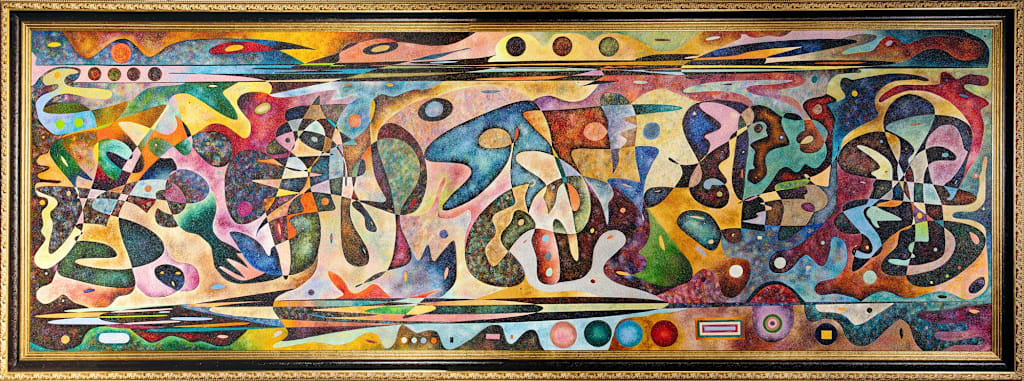
Throughout history, systems of belief have not only emerged through devotion and spiritual consensus but also through resistance, dissent, and the questioning of established authority. Among the most controversial and misunderstood belief structures is Satanism, a tradition that occupies a complex position within the cultural history of religion, philosophy, and identity. While its interpretations vary widely across historical, symbolic, philosophical, and contemporary contexts, Satanism often functions as a framework through which individuals examine autonomy, personal responsibility, skepticism toward authority, and the construction of self-determined meaning. In Satanism (2023–2025), Gheorghe Virtosu transforms these themes into a monumental abstract composition that investigates the architecture of opposition as a force within human consciousness.
Measuring 2 by 6 meters, the painting presents an expansive visual field of tension, transformation, and energetic interaction. Rather than illustrating theological narratives or symbolic figures directly associated with Satanic traditions, Virtosu explores the deeper structures through which rebellion, individuality, and ideological confrontation become visible. The work examines the psychological and philosophical dimensions of opposition rather than its mythology.
"Satanism investigates belief as an act of confrontation. Through abstraction, Virtosu constructs a visual architecture in which authority and resistance, order and autonomy, coexist as opposing yet interdependent forces within the formation of human identity."
— Daniel Varzari, El Arte Monumental, 10 Religions: The Architecture of Belief, Catalogue Entry: Satanism (2025).
The composition is characterized by extraordinary visual density. Interlocking forms, fragmented geometries, and continuously shifting relationships create an environment of perpetual negotiation. Shapes appear to challenge one another, overlap, transform, and resist stabilization. No single element dominates the field. Instead, meaning emerges through confrontation and interaction.
This structural instability reflects one of the central philosophical themes often associated with Satanic thought: the rejection of unquestioned authority. Virtosu translates this principle into visual form by eliminating compositional hierarchy. Rather than guiding the viewer toward a singular focal point, the painting disperses visual power throughout the entire surface, creating a field in which multiple forces compete for attention.
Color plays a decisive role in shaping the emotional atmosphere of the work. Deep blues, radiant reds, luminous golds, purples, blacks, and greens interact through highly charged contrasts. The palette generates a sense of psychological intensity without descending into chaos. Light and darkness continuously intermingle, producing an environment in which certainty remains elusive and transformation appears constant.
The painting’s horizontal structure introduces another layer of meaning. Flowing bands traverse the composition, creating currents that both unite and divide the pictorial space. These visual pathways suggest systems of ideology, cultural transmission, and historical continuity. Against these structures, individual forms emerge, challenge established patterns, and create alternative configurations. The result is a dynamic tension between collective systems and personal autonomy.
Throughout the work, abstract human profiles, symbolic fragments, geometric constructions, and organic shapes appear and disappear within the visual field. These forms never resolve into stable identities. Instead, they remain suspended within a process of continual becoming. Identity is presented not as a fixed essence but as an evolving condition shaped through confrontation with external structures and internal contradictions.
Particularly significant is the painting’s exploration of duality. Opposing forces recur throughout the composition: order and disorder, freedom and limitation, unity and fragmentation, belief and skepticism. Yet these oppositions are not represented as mutually exclusive conditions. Rather, they exist within a larger system of reciprocal interaction. Each force derives meaning through its relationship with the other.
This approach resonates with broader philosophical interpretations of Satanism that emphasize individual responsibility and self-determination. Virtosu does not present rebellion as destruction alone. Instead, opposition becomes a creative force capable of generating new perspectives, identities, and forms of understanding. Conflict functions as a catalyst for transformation rather than merely an instrument of negation.
The monumental scale intensifies this experience. Extending six meters across, the painting immerses viewers within a complex environment of competing energies and shifting relationships. The work resists immediate interpretation, requiring sustained engagement to reveal its internal structures. Through this process, viewers become participants in the act of questioning and discovery that the painting itself embodies.
Within the broader framework of 10 Religions: The Architecture of Belief, Satanism occupies a distinctive position because it examines belief through the lens of opposition rather than affirmation. While many spiritual traditions focus upon transcendence, obedience, or communal identity, Satanism introduces the question of how individuals negotiate power, authority, and personal freedom. Virtosu transforms these concerns into an abstract investigation of ideological architecture itself.
The painting also speaks directly to contemporary culture. Modern societies are increasingly shaped by competing narratives, contested truths, and evolving conceptions of identity. In this context, Satanism becomes less a study of a specific belief system than an examination of humanity’s enduring relationship with dissent. The work asks how resistance contributes to cultural evolution and how opposition functions within the creation of meaning.
"The composition derives its energy from unresolved tensions rather than stable certainties. Through this structure, Virtosu transforms rebellion into a visual principle, revealing opposition not merely as resistance to authority but as a fundamental mechanism through which consciousness expands and redefines itself."
— Daniel Varzari, El Arte Monumental, Curatorial Essay: Satanism (2025).
Ultimately, Satanism succeeds because it approaches one of history’s most controversial symbolic frameworks through philosophical and artistic inquiry rather than ideological judgment. The painting investigates the structures of autonomy, confrontation, and transformation that have accompanied human civilization across cultures and historical periods.
In doing so, Virtosu expands the scope of spiritual abstraction, creating a work that examines the relationship between authority and freedom, conformity and individuality, belief and skepticism. The painting becomes an architecture of opposition—a visual exploration of the forces through which human beings challenge, redefine, and reconstruct the systems that shape their existence.
About the Creator
Daniel Varzari
American art curator.
Enjoyed the story? Support the Creator.
Subscribe for free to receive all their stories in your feed.
Comments
There are no comments for this story
Be the first to respond and start the conversation.