
Peter Brötzmann: The Visual Force of Free Jazz
Brötzmann’s Untamed Graphics
Peter Brötzmann is usually introduced through sound: the blast of his tenor saxophone. But his visual art was never a side project. It came from the same restless impulse as his music—an urge toward intensity, freedom, and forms that resist easy interpretation.
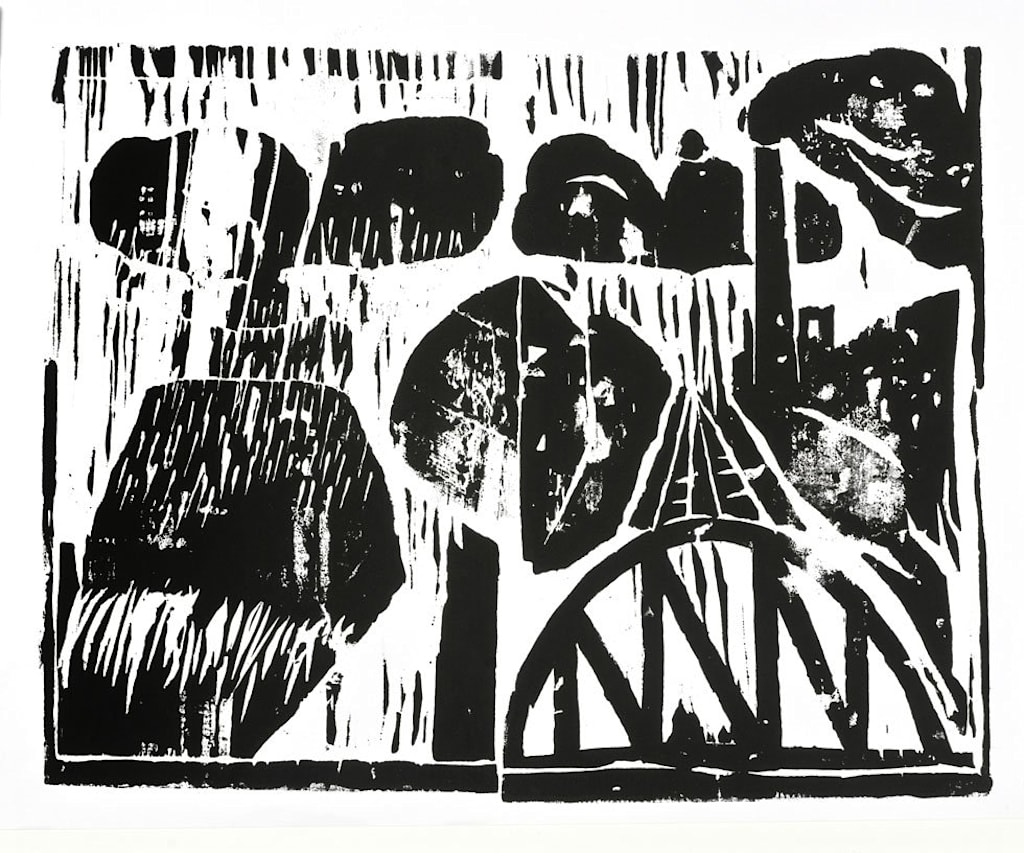
He worked across painting, watercolor, woodblock printing, assemblage, graphic design, record sleeves, and posters. These works do not simply illustrate his music. They occupy a parallel space, with their own physical force and independence. Brötzmann’s art has no interest in being conventionally beautiful. It is heavy, abrasive, and alert to the expressive possibilities of damage, pressure, and roughness.
Before Music
A fuller understanding of this approach begins with his formative years in Wuppertal. Before music became his main focus, Brötzmann studied painting and applied graphic arts at the Werkkunstschule. In the early 1960s, he encountered the experimental circles around Fluxus and assisted Nam June Paik with installations and exhibitions, including Paik’s presentation at Galerie Parnass. Brötzmann later resisted being described simply as a member of Fluxus, but those encounters nevertheless shaped his understanding of what art could be: active rather than passive, open to chance, and willing to bring noise, disruption, and ordinary materials into the work.
Objects, Damage, and Improvisation
That perspective can be seen in his small constructions. Brötzmann often used wooden boxes as both frames and supports, filling them with tin cans, lids, and rusted industrial fragments. The materials bring weight and resistance into the room. They make the work feel less like a picture than a physical event. A wooden box is not merely a frame, and a rusted piece of metal is not just a poetic found object. Each carries traces of use, damage, and labor. Brötzmann does not close down those associations; he leaves them open.
What may look spontaneous is built through an active tension between control and accident. Edges press against one another, surfaces remain unresolved, and structure seems to emerge from instability. This is where the connection to free jazz becomes most convincing. The work does not imitate the sound of a saxophone. Instead, its elements behave like improvisers in conflict—pushing, interrupting, and testing the limits of the form.
A Visual Language for Improvised Music
The same energy appears in his record sleeves, posters, and flyers. Over several decades, this graphic work created a raw visual language for improvised music. Heavy lettering, sharp contrasts, and jagged printed forms communicate urgency before the first note is heard. These images do more than announce a concert. They suggest that something difficult, excessive, and alive is about to happen.
That intensity, however, is not always loud in the conventional sense. Brötzmann’s watercolors and other works on paper introduce transparency, fragility, and restraint. They do not reveal a hidden gentle side so much as broaden the meaning of intensity. A quiet image can be just as disruptive when it refuses the expectations built around the artist’s reputation.
Machine Gun: Music, Art, and Violence
This tension also surrounds Machine Gun, his landmark 1968 album. The title came from Don Cherry’s nickname for Brötzmann, a reference to the saxophonist’s rapid, forceful playing. At the same time, the phrase inevitably carried the political associations of the period, particularly in the context of the Vietnam War. The cover, based on Brötzmann’s collage Schiesscheibe, presents an American GI with a machine gun. The image does not merely package the record; it places the music within a world of violence, machinery, and historical unease.
Brötzmann’s visual art is therefore no footnote to his musical legacy. It is the same radical commitment translated into another medium: exposed, physical, and unwilling to settle into a single interpretation. Like his free jazz, it treats freedom not as a mood but as a method—a continuing willingness to risk form.
This article is an expanded and revised version of an earlier essay I published in Critical Daily and on Medium, incorporating additional material on Brötzmann’s formative years at the Werkkunstschule, his encounters with Fluxus, and his work with Nam June Paik.
About the Creator
Marco Vanoppen
Marco Vanoppen is a musician/deconstructivist from Belgium. His field of work includes avant-garde music, improvisation, industrial music, experimental music, ... . His research and writing focus on avant-garde and underground music.
Enjoyed the story? Support the Creator.
Subscribe for free to receive all their stories in your feed.
Comments
There are no comments for this story
Be the first to respond and start the conversation.