
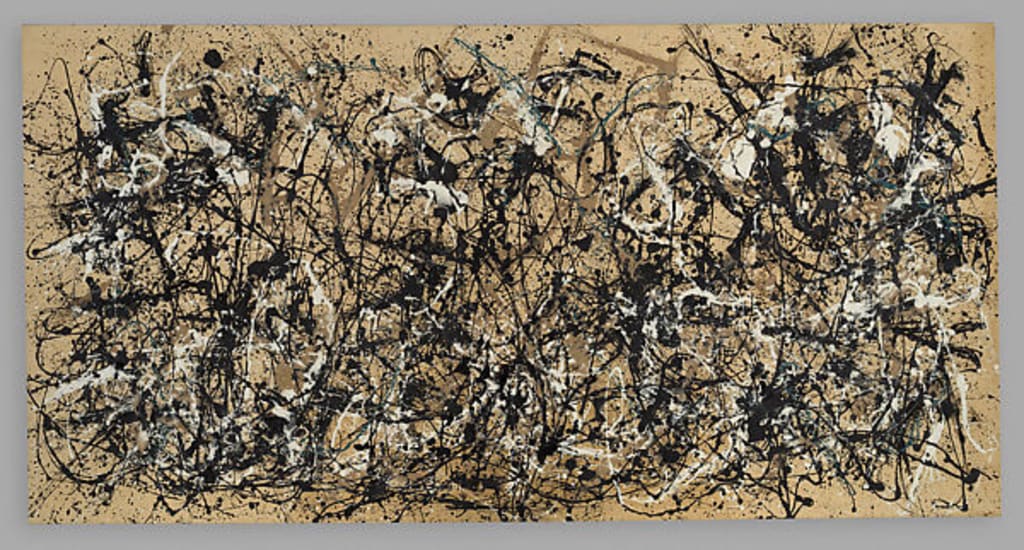
One Work: Autumn Rhythm (30)
After Mona Lisa: The Art of Missing the Point

I fucking love Jackson Pollock.
I know he was a troubled man. Divisive. Controversial. Much like Bukowski.
Even when I knew little to nothing about art, I loved the objective brilliance of Pollock blowing convention to fucking smithereens.
People have looked at his work for decades and dismissed it as a mess. Or, even worse, shrugged and said, "My kid could do that."
Not only is that incredibly dismissive of Pollock's legacy, it's also just lazy. It demonstrates a level of artistic illiteracy that, even as someone with no formal art education, I find difficult to understand.
Could a child take a bunch of house paint and splash it around on a canvas laid out on the floor?
Of course they could.
They regularly do.
Could they paint Autumn Rhythm?
Absolutely not. Fuck's sake. Why would anyone say that with a straight face.
So why have Pollock's paintings sold for millions?
Are the buyers just fucking stupid?
Well... that's another argument entirely.
But you need to understand something.
Art—in all its forms—is subjective.
Taste is subjective.
As for the millions?
Supply and demand, baby.
A Pollock painting sells for millions because it's a fucking Pollock.
Not because it contains paint splatters.
Your child's doodle of their cat and a fucking Minion isn't suddenly worth millions because they also threw paint around the room.
It reminds me of people who don't understand—or simply don't enjoy—the more niche subgenres of music.
To them, it sounds like noise.
But to the people creating it, and to the people listening with intent, it's so much more.
A band like Full of Hell or Napalm Death may sound like an unbearable wall of noise to an untrained or disengaged ear.
To others, it's a glorious aural feast.
Pollock's paintings work in much the same way.
His work wasn't trying to paint things.
It was trying to paint movement.
Emotion.
Chaos.
Memory.
Anxiety.
Life.
They're called action paintings for a reason. The finished canvas wasn't the whole artwork. The act of painting—the movement, the rhythm, the physicality—was part of it too. Every flick, drip, step and gesture mattered. His struggles with alcoholism, mental health and the turbulence of his life inevitably found their way into those movements.
Leonardo da Vinci perfected what people look like.
Pollock perfected art that shows what it feels like to be imperfect and alive.
One painted the external world with astonishing precision.
The other painted the internal one with astonishing honesty.
People still stand in front of a Pollock and say,
"My kid could do that."
Maybe.
But they didn't.
And neither did you.
*
Thanks for reading!
This is for Ray's excellent One Work art connections unofficial challenge and community project.
Linking back to my own piece on the Mona Lisa.
About the Creator
Paul Stewart
Award-Winning Writer, Poet, Scottish-Italian, Subversive.
The Accidental Poet - Poetry Collection out now!
Streams and Scratches in My Mind coming soon!
Enjoyed the story? Support the Creator.
Subscribe for free to receive all their stories in your feed. You could also become a paid subscriber, letting them know you appreciate their work.
Comments
There are no comments for this story
Be the first to respond and start the conversation.