
New and Old World Order (2016)
A Symbolic Architecture of Geopolitical Transition, Historical Continuity, and Fragmented Power
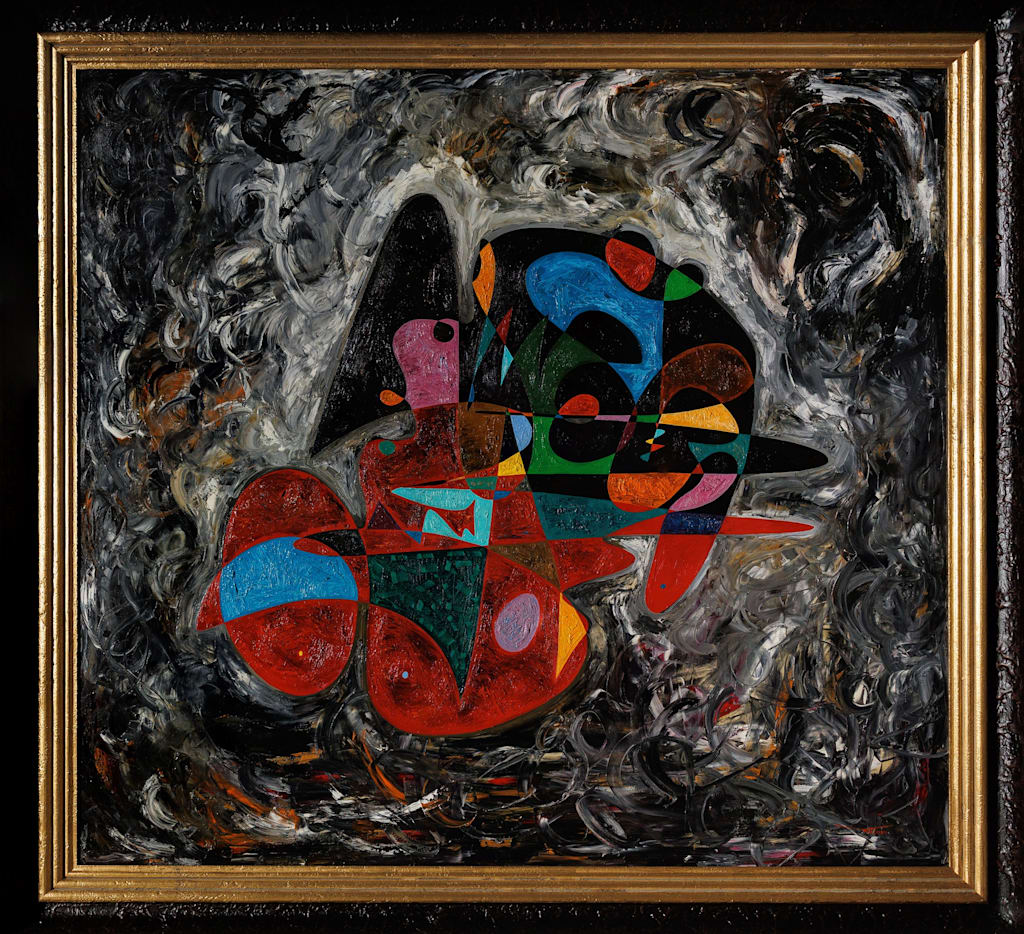
In New and Old World Order (2016), geopolitical transformation is visualized as a collision between dissolving historical structures and emerging systems of power. Through a dense interplay of abstraction, symbolic fragmentation, and turbulent painterly movement, the painting constructs a psychological landscape in which competing ideological orders overlap, confront, and reconstruct one another. Rather than illustrating political transition literally, the work examines the instability that arises when established systems lose coherence while new structures remain unresolved.
The composition is organized around a vibrant central symbolic formation suspended within a vast field of swirling black, gray, and white gestural turbulence. The central structure appears simultaneously architectural, anatomical, mechanical, and ceremonial. Intersecting geometric divisions, elliptical forms, fragmented facial suggestions, and chromatic interruptions create a visual organism caught between formation and collapse. The image seems less like a stable composition than an active field of geopolitical mutation.
The surrounding environment plays a crucial role in establishing the painting’s psychological atmosphere. Thick gestural brushwork envelops the central structure in a vortex-like field of instability. Sweeping black and white strokes create the impression of smoke, dissolution, historical debris, or ideological turbulence consuming the edges of the composition. This unstable environment contrasts sharply with the concentrated chromatic intensity of the central form, reinforcing the sensation that systems of order exist precariously within broader conditions of historical uncertainty.
At the center of the composition, vivid reds dominate the lower structural mass, introducing immediate associations with conflict, ideological struggle, state power, revolution, and political urgency. These red forms are intersected by cool blues, greens, pinks, oranges, and black geometric divisions that fragment the image into competing symbolic zones. The composition never fully resolves into harmony; instead, it sustains a constant tension between integration and disintegration.
Several forms within the work evoke fragmented human profiles and symbolic mechanisms of perception. Curved black structures resembling masks, ocular fragments, or surveillance devices emerge briefly before dissolving back into the composition. This instability of identity becomes central to the painting’s conceptual framework. Political systems are not represented as fixed structures but as fluid symbolic architectures constructed through competing narratives, perceptions, and ideological projections.
“Through abstraction and symbolic construction, Virtosu transforms geopolitical transition into a visual architecture of historical succession and evolving influence. Rather than illustrating specific events, the painting explores how systems of authority adapt, interact, and reorganize across time, presenting world order as a dynamic process shaped by continuity, transformation, conflict, and renewal.”
— Daniel Varzari, Catalogue Entry – New and Old World Order (2016), El Arte Monumental | The Architecture of Power
One of the painting’s most striking visual features is the large dark arch-like form occupying the upper central area. Resembling a void, portal, or collapsing institutional structure, this shape functions as both spatial opening and psychological abyss. It appears to engulf portions of the central symbolic organism while simultaneously framing its emergence. This duality introduces the possibility that every new order emerges from the fragmentation of an older one, yet remains haunted by the structures it seeks to replace.
The horizontal divisions cutting through the composition create additional instability. These sharp linear interruptions fragment the symbolic body into overlapping systems that appear partially synchronized yet fundamentally incompatible. The sensation is one of geopolitical simultaneity — multiple ideological orders existing within the same unstable historical moment without fully reconciling.
Materially, the painting demonstrates a powerful contrast between controlled geometric articulation and expressive painterly violence. Certain passages are highly structured and architectonic, while surrounding gestures dissolve into chaotic turbulence and textured instability. This oscillation between order and entropy reflects the broader thematic concern of the work: the fragile balance between institutional control and historical collapse.
The painting also engages with traditions of modern abstraction, particularly Cubist fragmentation, symbolic surrealism, and postwar gestural expressionism. Yet these historical languages are not merely referenced; they are transformed into tools for examining contemporary geopolitical instability. The work feels simultaneously historical and immediate, suggesting that the cycles of ideological reconstruction embedded within modern history continue to shape the present.
At 1.38 × 1.50 meters, New and Old World Order possesses an immersive and confrontational physical presence. The viewer is drawn into a symbolic environment where systems appear to collide under immense psychological and historical pressure. The painting functions less as a depiction of political reality than as an experiential architecture of transformation itself.
What ultimately distinguishes the work is its refusal to privilege either the “new” or the “old” order as stable or complete. Both appear fragmented, provisional, and psychologically unstable. The painting suggests that transitions between systems of power are never clean ruptures but turbulent processes in which fragments of past ideologies persist within emerging structures.
“Throughout history, world orders have emerged through the interaction of continuity and disruption. Empires, states, institutions, economic systems, and cultural networks evolve through processes of adaptation rather than simple replacement. Virtosu approaches this historical condition through abstraction, transforming geopolitical transition into a symbolic architecture in which inherited structures remain present even as new forms of organization begin to take shape.”
— Daniel Varzari, Curatorial Essay – New and Old World Order (2016), El Arte Monumental
Rather than offering certainty or resolution, New and Old World Order visualizes history as a continuous field of negotiation, collapse, reconstruction, and symbolic struggle. Power within the work is never permanent; it exists as a shifting arrangement of unstable forms suspended within the turbulence of historical change.
About the Creator
Daniel Varzari
American art curator.
Enjoyed the story? Support the Creator.
Subscribe for free to receive all their stories in your feed.
Comments
There are no comments for this story
Be the first to respond and start the conversation.