
Jainism (2020–2022)
Nonviolence, Multiplicity, and the Architecture of Consciousness
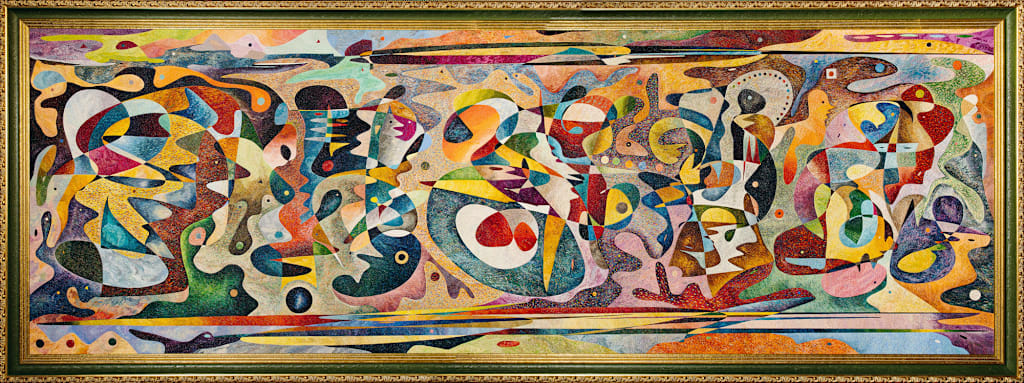
Among the world's oldest surviving spiritual traditions, Jainism occupies a unique position through its profound commitment to nonviolence, self-discipline, and philosophical pluralism. Rooted in the principles of ahimsa (nonviolence), anekantavada (the multiplicity of viewpoints), and spiritual self-realization, Jain thought proposes a vision of existence in which all living beings participate within an interconnected ethical universe. In Jainism (2020–2022), Gheorghe Virtosu approaches this remarkable tradition through abstraction, constructing a monumental visual field that investigates consciousness, coexistence, and the pursuit of spiritual liberation.
Measuring 2 by 6 meters, the oil painting unfolds across an expansive horizontal format whose complexity rewards prolonged observation. Rather than illustrating religious narratives, sacred figures, or doctrinal symbols, Virtosu develops an intricate architecture of relationships. Organic forms, geometric structures, symbolic fragments, and chromatic passages intertwine across the canvas, creating a dynamic environment in which multiplicity and unity coexist without contradiction.
"Jainism examines belief as an ethical architecture founded upon coexistence, restraint, and the recognition of multiple truths. Through abstraction, Virtosu constructs a visual field in which consciousness emerges through relationships rather than domination, revealing spiritual development as a process of continual refinement and awareness."
- Daniel Varzari, El Arte Monumental, 10 Religions: The Architecture of Belief, Catalogue Entry: Jainism (2022).
At first encounter, the composition appears animated by extraordinary diversity. Numerous forms occupy the pictorial space simultaneously, each maintaining its own visual identity while participating in broader systems of relation. No singular image dominates the work. Instead, meaning emerges through interaction, balance, and reciprocity. The painting resists hierarchy, encouraging viewers to perceive the entire composition as an interconnected organism rather than a collection of isolated elements.
This organizational structure resonates strongly with one of Jainism's most distinctive philosophical contributions: the recognition that reality cannot be fully understood from a single perspective. Throughout the painting, forms overlap, intersect, and transform without resolving into fixed conclusions. Viewers encounter multiple pathways of interpretation simultaneously, mirroring a worldview in which truth remains multifaceted rather than absolute.
The chromatic organization reinforces this principle. Luminous yellows, rich reds, soft pinks, greens, blues, violets, earth tones, and whites circulate throughout the composition with remarkable fluidity. Colors remain distinct yet interconnected, generating visual relationships that evolve continuously across the canvas. The result is a pictorial environment characterized by harmony without uniformity, complexity without conflict.
Particularly significant is the recurring presence of human profiles and biomorphic structures embedded throughout the work. These forms emerge from larger systems rather than existing independently. Faces appear momentarily before dissolving into surrounding configurations, suggesting that identity itself is relational rather than isolated. The composition emphasizes interdependence over individuality, connection over separation.
The painting's spatial structure further contributes to its contemplative character. Boundaries between forms remain permeable, and distinctions between foreground and background shift constantly. This fluidity creates a sense of continual transformation while preserving overall coherence. Movement exists throughout the composition, yet it is governed by balance rather than disruption.
Horizontal bands positioned near the upper and lower edges of the canvas establish rhythmic frameworks that guide visual movement. These elongated forms create a sense of continuity extending beyond the limits of the picture plane. Their presence introduces temporal and cosmological dimensions to the composition, suggesting cycles of existence, spiritual progression, and the ongoing flow of consciousness.
Virtosu's decision to avoid direct religious iconography is particularly meaningful. Instead of illustrating specific doctrines or historical events, he investigates the underlying philosophical structures through which Jainism understands reality. Abstraction allows the artist to engage with concepts that exceed narrative representation, transforming the painting into a field of contemplation rather than instruction.
Art historically, Jainism occupies a distinctive position within contemporary spiritual abstraction. While traces of symbolic modernism, sacred geometry, and abstract expression can be perceived throughout the composition, Virtosu's primary concern lies with the visualization of ethical and philosophical systems. The painting functions simultaneously as image, meditation, and conceptual architecture.
The monumental dimensions intensify this experience. At six meters in length, the work surrounds viewers with a complex environment of visual relations. New structures emerge through sustained observation, encouraging a slow and reflective mode of engagement. Rather than offering immediate resolution, the composition invites continual discovery.
Within the broader framework of 10 Religions: The Architecture of Belief, Jainism represents an investigation into one of humanity's most rigorous ethical traditions. The painting explores a worldview grounded not in conquest or authority but in restraint, compassion, and self-awareness. Through abstraction, Virtosu translates these principles into a visual language capable of expressing complexity without contradiction.
"The composition derives its coherence from the continual interaction of independent yet interconnected forms. Every structure remains part of a larger network of relations, creating a visual condition in which plurality becomes a source of harmony rather than division. Through this dynamic, Virtosu transforms abstraction into a meditation on nonviolence, coexistence, and the architecture of consciousness itself."
- Daniel Varzari, El Arte Monumental, Curatorial Essay: Jainism (2022).
Ultimately, Jainism succeeds because it addresses one of the most challenging questions in spiritual thought: how diversity can exist without conflict and how individuality can coexist with universal interconnectedness. Rather than providing symbolic answers, the painting constructs an experiential environment through which these questions can be explored.
In doing so, Virtosu expands the possibilities of contemporary spiritual art beyond representation and doctrine. The work becomes a meditation on ethical awareness itself, revealing belief not as a fixed system of certainty but as an evolving architecture of perception, responsibility, and conscious coexistence.
About the Creator
Daniel Varzari
American art curator.
Enjoyed the story? Support the Creator.
Subscribe for free to receive all their stories in your feed.
Comments
There are no comments for this story
Be the first to respond and start the conversation.