
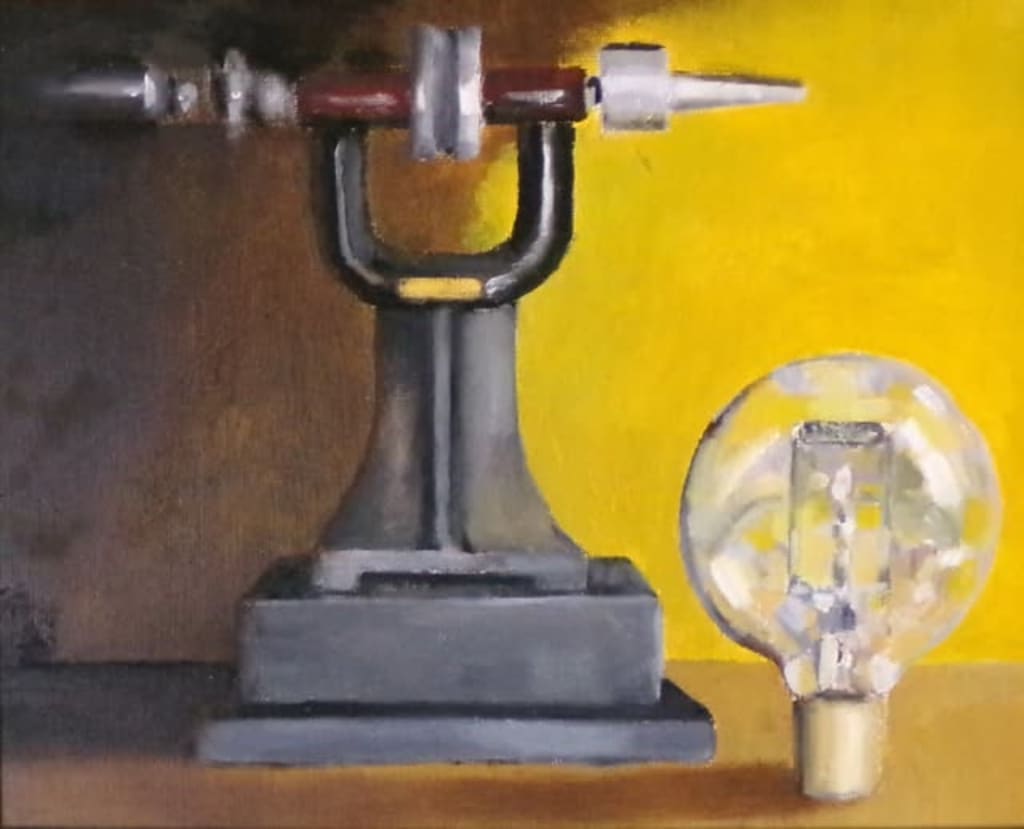
This work presents a study in compositional equilibrium, achieved through a stark juxtaposition of mass, fragility and luminance. Occupying the central-left register is an industrial lathe, a specimen of mechanical density that anchors the pictorial space. To its right a single lightbulb provides a delicate counterpoint to the machine’s heavy verticality. The painting is defined by a sophisticated spatial compression, where the background is divided into two distinct tonal realms: a deep, scumbled abyss of shadow on the left and a vibrant, saturated yellow on the right. This transition is not merely decorative; it establishes tension between the "darkness of the past" and a heralded technological future.
The directional lighting functions as a primary narrative driver. The saturated yellow field acts less as a background and more as a suggestion that the bulb itself is the source of pictorial energy. This light creates a sharp "rim lighting" effect along the right-facing edges of the lathe’s vertical support and base, where slivers of pale impasto define the machine's form against the surrounding void. Conversely, the far-left side of the canvas is submerged in a murky chiaroscuro, where the machinery nearly dissolves into the shadows. This contrast emphasizes the physical volume of the lathe while simultaneously elevating the bulb as a focal point of intellectual and energetic "illumination."
This work reimagines the traditional "Still Life" genre by treating industrial artifacts with the same reverence a 17th-century Dutch master would accord a silver goblet or a lemon peel. There is a profound thematic tension at play: the lathe represents the archaic power of the machine age—physical force and the manipulation of matter—while the lightbulb heralds the modern era of energetic potential and innovation.
The transition from the dark left to the yellow right suggests a temporal shift, moving from the "void" of manual toil into the "illumination" of the electrical age. The artist suggests that the light of human intellect, represented by the bulb, is what ultimately gives purpose to the heavy tools of labor. By elevating these common tools to the status of icons, the painting becomes a portrait of technological evolution.
The visual argument of this painting rests upon a tense but deliberate balance between shadow and light. The artist utilizes the heavy, grounded presence of the lathe as a foil to the luminous fragility of the lightbulb, creating a composition that is both structurally sound and thematically resonant. Through the sophisticated use of colour blocking and a varied application of paint, the work elevates the implements of industry into symbols of significant historical and philosophical weight, celebrating the intersection of mechanical strength and the brilliance of modern discovery.
About the Creator
Mick Smith
Mick is an artist based in the N.E. of England with an interest in exploring our Industrial Heritage through painting and sculpture. Mick delivers art classes at all levels and is often involved in Community Projects.
Enjoyed the story? Support the Creator.
Subscribe for free to receive all their stories in your feed.
Comments
There are no comments for this story
Be the first to respond and start the conversation.