
Hunter (2017) — Critical Analysis
A Symbolic Architecture of Pursuit, Instinct, and Fragmented Identity
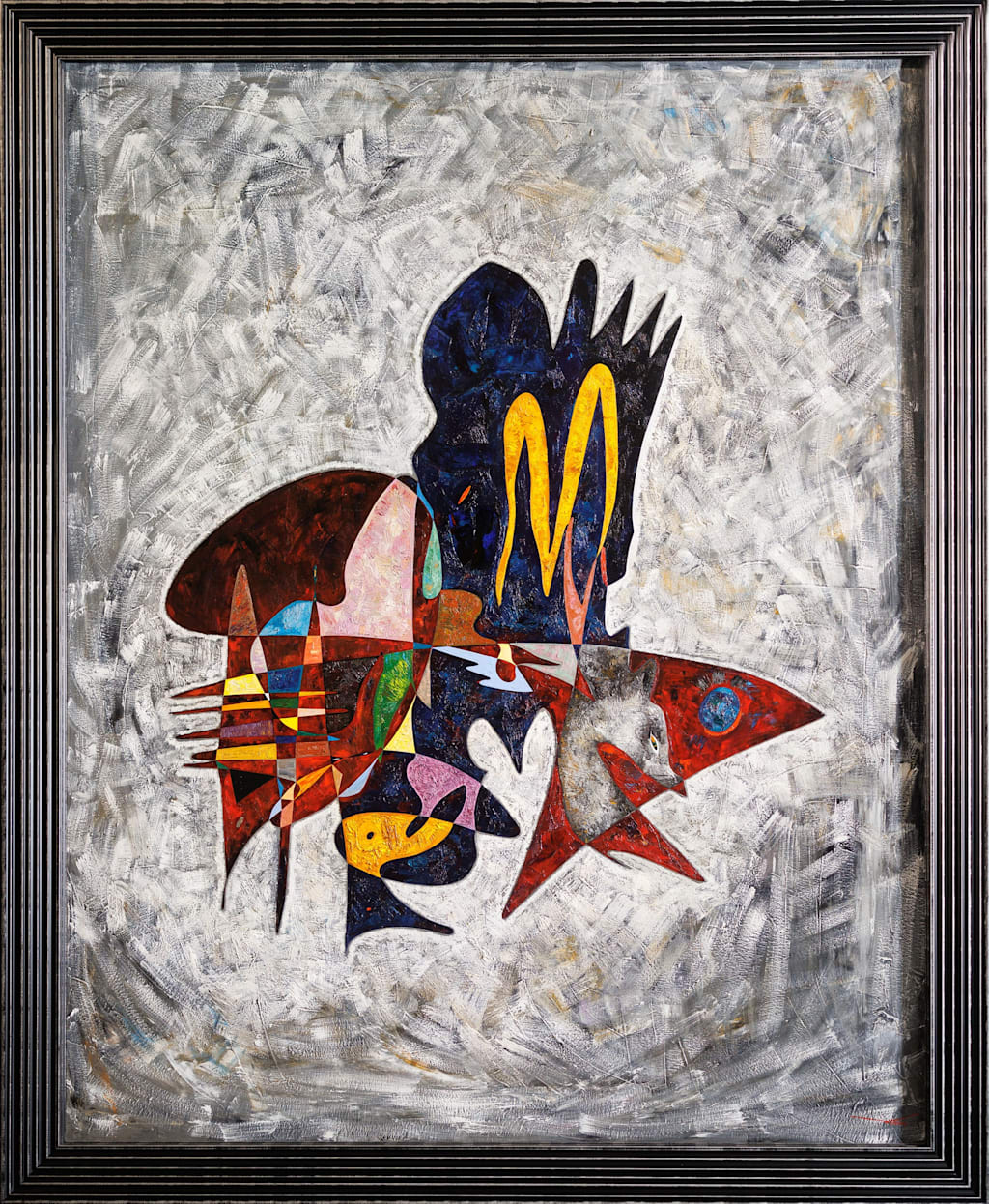
In Hunter (2017), the act of pursuit is transformed into a symbolic and psychological condition rather than a literal narrative event. Through fractured abstraction, hybridized forms, and an atmosphere of suspended tension, the painting explores themes of instinct, survival, domination, and perception. The work approaches the figure of the hunter not as an individual subject, but as an archetype embedded within systems of desire, power, and existential confrontation.
The composition is organized around a vertically dominant central structure that appears simultaneously human, animal, and totemic. Fragmented geometric planes intersect with biomorphic contours to create a composite entity suspended between construction and disintegration. The figure does not occupy space naturally; it emerges from it like an apparition or psychic residue. This ambiguity becomes central to the painting’s conceptual force.
Against the expansive gray-white background, the concentrated chromatic intensity of the central form acquires heightened symbolic presence. Deep blues, crimson reds, ochres, black, and flashes of yellow generate a visual field charged with tension and internal movement. The restrained background functions almost like a void or frozen atmosphere, isolating the figure within an environment stripped of geographical certainty. This spatial emptiness amplifies the painting’s psychological intensity.
The dominant dark vertical structure evokes both a mask and a predatory silhouette. Elongated yellow forms resembling eyes, signals, or energetic frequencies interrupt the darkness, creating an impression of heightened alertness or surveillance. Throughout the composition, sharp linear intrusions and directional geometries suggest penetration, pursuit, and confrontation. Yet the painting avoids literal depiction. Hunting here becomes symbolic — an expression of human instinct, territoriality, fear, and psychological fragmentation.
One of the work’s most compelling aspects is its internal duality. The composition oscillates between aggression and vulnerability, structure and collapse, visibility and concealment. Fish-like forms, fragmented facial profiles, and abstract anatomical suggestions emerge and dissolve across the surface, preventing any stable reading of the image. The viewer is forced into a state of interpretive pursuit that mirrors the thematic condition of the work itself.
Materially, the painting demonstrates a sophisticated tension between gestural spontaneity and calculated architectural organization. Certain passages are sharply controlled and geometrically precise, while others dissolve into painterly turbulence and textured improvisation. This contrast gives the work a dynamic rhythm, reinforcing the sense that the image is continuously forming and unraveling simultaneously.
The painting also engages with broader traditions of modern abstraction. Elements of Cubism, biomorphic surrealism, and postwar gestural painting intersect without becoming subordinate to historical quotation. Rather than referencing modernist abstraction nostalgically, Hunter reactivates these visual languages to examine contemporary psychological and existential conditions.
At nearly two meters in height, the work possesses a monumental physical presence. The scale transforms the central form into something confrontational and immersive, positioning the viewer not as a distant observer but as a participant within the painting’s symbolic field. The sensation is less that of viewing an image and more that of encountering a psychological structure.
What ultimately distinguishes Hunter is its refusal to define the hunter or the hunted with certainty. The painting destabilizes traditional binaries of predator and prey, suggesting that systems of pursuit inevitably implicate both sides within the same psychological architecture. Power, perception, survival, and fear become inseparable conditions within the composition.
The work succeeds precisely because it remains unresolved. Rather than illustrating a narrative, Hunter constructs an atmosphere of perpetual tension where identity itself appears fragmented by the act of pursuit.
For further curatorial and research context:
About the Creator
Daniel Varzari
American art curator.
Enjoyed the story? Support the Creator.
Subscribe for free to receive all their stories in your feed.
Comments
There are no comments for this story
Be the first to respond and start the conversation.