
Hinduism (2015–2017)
Cosmology, Multiplicity, and the Architecture of Sacred Continuity
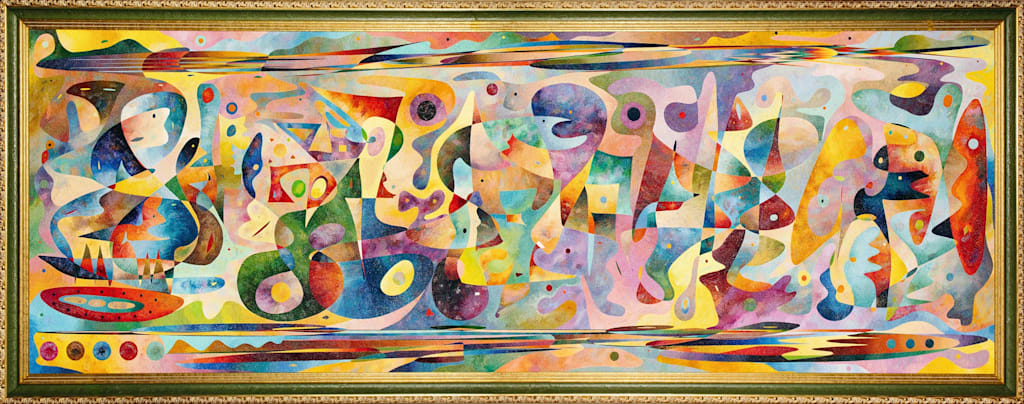
Among the world's oldest living religious traditions, Hinduism presents a vision of existence distinguished by its extraordinary complexity, philosophical depth, and capacity for continual transformation. Rather than functioning as a singular doctrinal system, it encompasses a vast constellation of metaphysical concepts, ritual practices, symbolic narratives, and cosmological frameworks that have evolved over millennia. In Hinduism (2015–2017), Gheorghe Virtosu approaches this expansive spiritual tradition through abstraction, constructing a monumental visual field that explores the relationship between multiplicity and unity, diversity and continuity, the individual and the cosmic whole.
Measuring 2 by 6 meters, the oil painting unfolds across an elongated horizontal format that immediately evokes associations with sacred narratives, cosmological diagrams, and ceremonial processions. Yet rather than illustrating specific religious stories or iconographic figures, Virtosu creates an immersive architecture of relationships. The composition becomes a symbolic environment in which forms emerge, intersect, dissolve, and regenerate, mirroring the cyclical and interconnected understanding of existence that has long characterized Hindu philosophical thought.
"Hinduism examines belief not as a fixed doctrine but as a living cosmological system through which multiplicity and unity remain in continual dialogue. Through abstraction, Virtosu constructs a visual architecture of sacred continuity, revealing spiritual experience as a dynamic process of transformation, interconnection, and renewal."
— Daniel Varzari, El Arte Monumental, 10 Religions: The Architecture of Belief, Catalogue Entry: Hinduism (2017).
At first encounter, the painting appears animated by an extraordinary abundance of forms. Biomorphic shapes, geometric structures, symbolic fragments, and fluid chromatic transitions occupy the entire surface. No single image dominates the composition. Instead, visual significance is distributed throughout the pictorial field, encouraging viewers to navigate a network of interconnected elements rather than a centralized narrative.
This absence of hierarchy is one of the painting's most significant characteristics. Throughout Hindu philosophical traditions, reality is often understood as simultaneously diverse and unified, composed of innumerable manifestations that nevertheless participate within larger structures of cosmic order. Virtosu translates this principle into visual form. Individual elements maintain distinct identities while remaining inseparable from the larger composition that contains them.
Color functions as a primary organizing force. Luminous blues, radiant yellows, soft violets, vibrant reds, greens, oranges, and whites interact across the canvas with remarkable fluidity. Rather than occupying isolated chromatic zones, colors migrate through the composition, generating connections between distant forms and creating a sense of continual circulation. The resulting chromatic environment conveys movement without instability, complexity without fragmentation.
The painting's spatial organization reinforces this perception. Forms overlap and interpenetrate, producing a condition in which boundaries remain fluid rather than fixed. Figures seem to emerge from surrounding structures only to dissolve back into larger systems of relation. This dynamic suggests a universe governed not by separation but by continual exchange and transformation. Identity appears as a process rather than a permanent state.
Particularly striking are the horizontal bands positioned near the upper and lower edges of the composition. These elongated structures establish rhythmic frameworks that guide movement across the painting while simultaneously suggesting cycles, flows, and recurring patterns. Their presence introduces a temporal dimension to the work, reinforcing the idea of existence as an ongoing process of renewal rather than a linear progression toward a fixed conclusion.
Throughout the composition, viewers may perceive references to celestial forms, sacred symbols, architectural structures, ritual gestures, and organic systems. Yet these associations remain intentionally unstable. Virtosu avoids direct representation in favor of a symbolic language capable of operating across multiple levels of interpretation. The painting invites contemplation rather than recognition, encouraging engagement with underlying structures of belief rather than specific religious imagery.
This strategy distinguishes Hinduism from conventional religious painting. Rather than illustrating theological narratives, the work seeks to visualize modes of thought. The painting explores how spiritual systems organize perception, create meaning, and establish relationships between the visible and the invisible. Abstraction becomes a means of approaching concepts that exceed literal representation.
Art historically, the work occupies a distinctive position within contemporary spiritual abstraction. While echoes of Kandinsky's metaphysical ambitions, Klee's symbolic vocabularies, and certain traditions of sacred ornamentation can be detected, Virtosu develops a visual language uniquely suited to the philosophical complexity of his subject. The composition functions simultaneously as image, environment, and conceptual system.
The monumental dimensions intensify this effect. At six meters in length, the painting surrounds viewers with a field of continual activity. Relationships between forms unfold gradually through sustained observation, revealing new structures and correspondences over time. The experience of viewing becomes analogous to the process of spiritual inquiry itself: open-ended, cumulative, and continually evolving.
Within the broader framework of 10 Religions: The Architecture of Belief, Hinduism occupies a foundational position. The work investigates a tradition whose philosophical and symbolic systems have shaped countless forms of cultural expression across centuries. Yet rather than focusing on historical description, Virtosu addresses the deeper structures through which belief organizes experience and sustains continuity across time.
"The composition derives its vitality from the continual interaction between differentiation and integration. Forms remain distinct while participating in larger networks of visual relation, creating a condition in which unity emerges through multiplicity rather than despite it. Through this dynamic, Virtosu transforms abstraction into a meditation on cosmic continuity, spiritual transformation, and the interconnected architecture of belief."
— Daniel Varzari, El Arte Monumental, Curatorial Essay: Hinduism (2017).
Ultimately, Hinduism succeeds because it translates a profoundly complex spiritual tradition into a visual language capable of expressing both diversity and coherence. Rather than reducing belief to symbolic illustration, the painting investigates the relational structures through which meaning, continuity, and transcendence become possible.
In doing so, Virtosu expands the possibilities of contemporary spiritual art beyond representation and doctrine. The work becomes a meditation on cosmological interconnectedness itself, revealing belief not as a static system of answers but as an evolving architecture of perception, transformation, and sacred continuity.
About the Creator
Daniel Varzari
American art curator.
Enjoyed the story? Support the Creator.
Subscribe for free to receive all their stories in your feed.
Comments
There are no comments for this story
Be the first to respond and start the conversation.