
From Wakanda to a Grazing Field: How a $6 Billion Crypto‑City Left Behind Just One Building
A plaque, an unfinished concrete shell, and cows where skyscrapers were supposed to rise — the cautionary tale of Akon’s Afrofuturist dream.
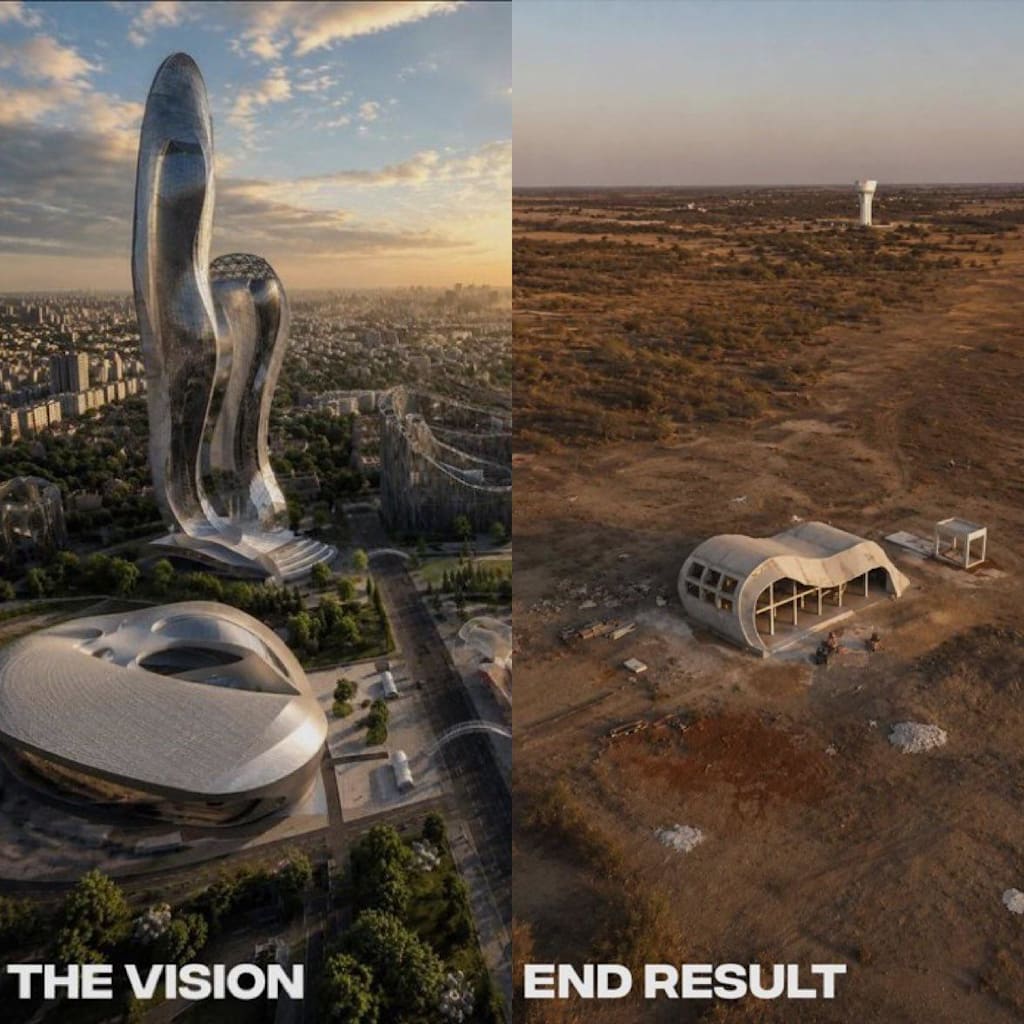
From Wakanda to a Single Unfinished Building: How Akon’s $6 Billion Futuristic City Crumbled on Africa’s Coast
I. Introduction: A Plaque and an Empty Field
About 100 kilometres south of Dakar on Senegal’s Atlantic coast lies an 800‑hectare plot. In September 2020, a high‑profile groundbreaking ceremony took place there. Pop singer Akon, together with officials from Senegal’s tourism development agency Sapco and local dignitaries, unveiled a plaque to mark the start of construction on a $6 billion futuristic city.
Five years later, only one unfinished curved concrete reception building stands on the land. There are no roads, no housing, no power grid. Cattle and goats graze where a commercial centre was planned.
In July 2025, Sapco Director Serigne Mamadou Mboup told the BBC: “The Akon City project no longer exists.”
The Afrofuturist dream that the media had dubbed a “real‑life Wakanda” had officially ended.
II. The Grand Vision: A Singer’s “Wakanda” Dream
In 2018, Marvel’s Black Panther sparked a global phenomenon. The film’s technologically advanced, isolated African kingdom of Wakanda not only captivated hundreds of millions of viewers but also fired the imagination of one singer.
Senegalese‑American singer Akon, born Alioune Badara Thiam, announced he would build a real‑life Wakanda in his ancestral homeland. The city would be named Akon City and was planned to cost $6 billion (roughly £5 billion). Blueprints showed a LEED‑certified solar‑powered smart city covering about 8 square kilometres, with residential areas, a university, a mega‑hospital, beachfront resorts, shopping malls, a police station, a waste treatment centre, solar plants, and even a film studio called “Senewood.” Sleek, curvilinear skyscrapers were designed to rise above the Atlantic.
But the city’s most distinctive feature was its economic system: it would use Akon’s own cryptocurrency, “Akoin,” as its official currency. Akon marketed it as an innovative, forward‑looking hub of human development, a pan‑African landmark that would boost West Africa’s economy.
The project received strong government backing. Then‑President Macky Sall granted the 800 hectares at Mbodiène free of charge. As one of the world’s least developed countries, Senegal hoped to use this “crypto boom” to jump‑start its economy.
Akon repeatedly stressed that the city would run entirely on renewable energy and represent Africa’s future. In a 2022 BBC interview he insisted the project was “100000% moving forward.” According to the original schedule, the first phase — hospitals, shopping centres, schools, and solar plants — would be finished by the end of 2023, and the whole city was to be built between 2026 and 2028.
III. Groundbreaking: A Ceremony With No Follow‑Through
In September 2020, the project broke ground with great fanfare. Akon and Sapco officials unveiled the plaque on the empty land of Mbodiène. Artist’s renderings were released, showing artificial lakes, mid‑rise building clusters, hotels, commercial zones, and two unusually shaped towers. Media and critics immediately compared the planned city to Wakanda.
Then, almost nothing happened.
Pandemic delays, funding problems, and permitting piled up. The first‑phase completion date slipped from 2023 to 2026, and was eventually postponed indefinitely. Akon blamed COVID‑19 and fundraising difficulties, but even after the pandemic receded there was no tangible progress on the site.
By 2024, the site still consisted solely of one unfinished reception hall. Sapco gave Akon an ultimatum: start construction within two weeks or lose the land. Akon had allegedly defaulted on payments owed to Sapco multiple times. In August 2024, the government issued another formal warning: either start building or forfeit the land.
Akon did not start.
IV. Five Years Later: One Building, an Empty Field, and a Mess
In July 2025, the Senegalese government confirmed what many had long suspected: the project had stalled beyond recovery.
The site: On 800 hectares, only one unfinished curved concrete reception building stands. No roads, no housing, no power grid. The hospitals, schools, shopping centres, and solar plants never appeared. Most of the 136 acres originally allocated to Akon in 2020 have been reclaimed by the government.
The residents: The local villagers’ feelings are the most tangible. “We were promised employment and development,” one told the BBC, “but nothing has changed.” Teacher Jean Wally Sene put it bluntly: “For a long time, many people, including Akon, have come here trying to sell us dreams and illusions.” Village chief Marcel Diome added that beyond a basketball court, a youth centre, and a fenced football field that Akon paid for, there was no other substantial construction. Moreover, land compensation owed to villagers was not fully delivered.
The cryptocurrency: The companion Akoin coin also flopped. Trading started in September 2021 at about £0.23, then plunged, falling to roughly $0.003 by 2024 and about $0.002 by October 2025. Akon admitted: “Mismanagement—I take full responsibility for that.”
Legality: The city’s most distinctive feature, using Akoin as its official currency, faced a fundamental legal obstacle from the start. Senegal’s legal tender is the West African CFA franc, issued and regulated by the Central Bank of West African States (BCEAO). The central bank has always opposed private cryptocurrencies. Whether Akoin could legally operate was never resolved.
V. Reasons for Failure: When Celebrity Glamour Meets Gravity
The collapse of Akon City was not caused by a single factor but by several interwoven ones.
Financing: the $6 billion that never arrived. This is the most direct reason. Akon failed to raise the required capital and repeatedly defaulted on payments to Sapco. The project lacked substantive governance planning, which hindered both fundraising and construction.
Cryptocurrency: a concept cannot replace the real economy. The Akoin crash shows that a digital currency without real economic backing and a legal regulatory framework is a house of cards. Ari Redbord, Head of Global Policy and Government Affairs at blockchain intelligence firm TRM Labs, noted that many crypto‑city experiments fail because they chase impossible goals.
Governance: the gap between ambition and execution. Akon’s pattern of ambition paired with disregard for governance is not unique. He was often absent from the site, deepening local scepticism. Critics pointed to the absence of serious planning. His 2022 claim that the project was “100000% moving forward” stood in stark contrast to the empty field.
Macro environment: Senegal’s debt crisis. In recent years, Senegal has fallen into a severe debt crisis. A state audit revealed that former President Sall’s government had accumulated $7 billion in previously undisclosed loans. The International Monetary Fund subsequently froze $1.8 billion in funding. These hidden liabilities cut the country off from global credit markets. Under such fiscal pressure, the government could no longer tolerate a vanity project that showed no progress.
Legal: the non‑substitutability of the CFA franc. The West African central bank’s opposition to cryptocurrencies has never wavered. Whether Akoin could legally function as an official currency was always an unanswered question.
VI. Aftermath: A More “Realistic” Alternative
Though Akon City as originally conceived is officially dead, the Senegalese government hasn’t abandoned the land’s strategic value, especially with the 2026 Dakar Youth Olympic Games approaching and regional tourism expected to grow.
The government announced a more pragmatic plan for the same site: invest about $1.2 billion (665 billion CFA francs) to turn the area into a major tourist destination. Roughly 600 billion CFA francs is expected from private investors and 65 billion from the national treasury.
The new project will include hotels, apartments, a marina, and a seaside promenade, linked to the nearby lagoon. The crypto‑city dream has been shelved in favour of a tourism and leisure‑focused development. Akon will keep only 8 hectares, absorbed into a larger 500‑hectare government‑led scheme.
Sapco officials estimate the first phase could create about 15,000 jobs, bringing economic relief to the Mbodiène area. In the words of Sapco Director Mboup, this is a “more realistic project” that will have the state’s full backing.
VII. Reflection: A Cautionary Tale
The failure of Akon City is one of the most striking recent examples of a celebrity‑led mega‑development collapsing. The lessons are sharp.
A cinematic utopia cannot be transplanted into reality. Wakanda is compelling precisely because it is fictional. Real urban development demands solid planning, stable funding, sound governance, and time — none of which celebrity glamour or cryptocurrency concepts can replace.
Cryptocurrency cannot create economic value out of thin air. The crash of Akoin demonstrates that a digital currency without real economic support and a legitimate regulatory framework is ultimately a pipe dream.
Development requires patience and pragmatism. Senegal, one of the world’s poorest countries, hoped to leap ahead by riding the crypto wave, but genuine economic progress has never been achieved through a grand ribbon‑cutting ceremony alone.
Today, Akon’s unfinished reception building won’t be demolished right away. It will remain, together with the empty fields and grazing cattle, forming a quiet contrast, a contrast to the 2018 press conference, the 2020 groundbreaking, Akon’s “100000% moving forward” declaration to the cameras, and the eight years in which nothing happened.
As local resident Jean Wally Sene put it, Mbodiène now finally has a dream it “dares to believe in,” and that dream is no longer Wakanda but a down‑to‑earth tourism project.
Akon’s “city of the future” dream has ended. What it leaves behind is not only an unfinished reception building and a vast empty field, but a cautionary tale about the chasm between ambition and reality, fantasy and execution.
About the Creator
Jin
Writer of reamstories
https://reamstories.com/jin
Enjoyed the story? Support the Creator.
Subscribe for free to receive all their stories in your feed. You could also become a paid subscriber, letting them know you appreciate their work.
Comments
There are no comments for this story
Be the first to respond and start the conversation.