
Dreams Rider (2008)
Navigating the Invisible Structures of Consciousness
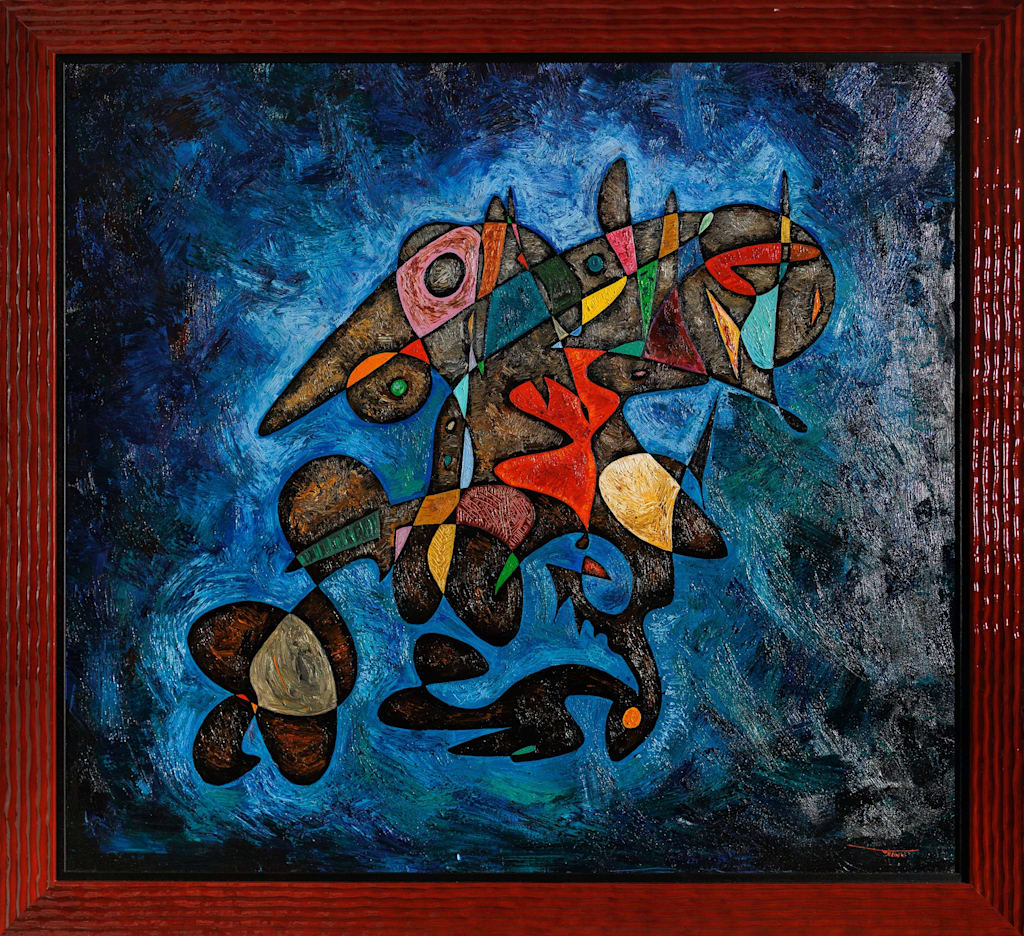
Dreams Rider (2008) is a compelling example of abstract symbolism that successfully balances spontaneity with structural discipline. The painting presents a complex, hybrid form suspended within an expansive field of deep blues, creating the sensation of movement through an undefined psychological or metaphysical space. While the title suggests narrative direction, the work itself resists literal interpretation, inviting viewers to construct their own meanings through visual association.
“Presented today, Dreams Rider reflects a broader contemporary interest in the relationship between inner experience and visual form. The painting demonstrates Virtosu’s ability to transform abstraction into a philosophical instrument, creating a work that speaks not only about dreaming, but also about humanity’s enduring search to understand the invisible structures of consciousness itself.”
— Daniel Varzari, Art Curator, El Arte Monumental, Catalogue: 6 Wars — The Architecture of Conflict, Catalogue Entry: Dreams Rider (2008)
The painting's greatest strength lies in its sophisticated orchestration of form. Virtosu employs a network of geometric fragments, organic curves, and intersecting planes that appear simultaneously assembled and disassembled. This tension between construction and fragmentation generates visual energy and sustains prolonged engagement. The composition reveals new relationships between shapes as the eye moves across the surface, demonstrating a high level of formal intelligence.
Color functions as a critical organizing principle. The dominant blue environment establishes a contemplative atmosphere while also creating depth through variations in texture and tonal modulation. Against this field, accents of red, yellow, turquoise, pink, and green operate as visual catalysts, activating the composition without overwhelming its overall harmony. The chromatic contrasts are deliberate and measured, contributing to a sense of internal rhythm rather than decorative effect.
The work recalls aspects of European modernist abstraction, particularly the biomorphic inventions of Miró and the spiritual abstraction of Kandinsky, yet it avoids direct imitation. Virtosu's visual language is more architectural in its construction. The forms appear interconnected within a larger system, suggesting that the composition functions less as an expression of emotion and more as a map of relationships between symbolic elements.
One of the most intriguing aspects of Dreams Rider is its ambiguity. The central form can be interpreted as a creature, machine, rider, vessel, or constellation of symbols. This openness is both the work's strength and potential limitation. Viewers seeking narrative clarity may find the composition elusive, while those comfortable with abstraction will appreciate its capacity to sustain multiple interpretations simultaneously.
Technically, the painting demonstrates confident handling of oil paint. The textured surface enriches the visual experience, particularly within the blue passages where layered brushwork creates atmospheric depth. The physicality of the paint reinforces the tension between material presence and immaterial subject matter.
Conceptually, the painting succeeds in transforming the dream state into a visual structure. Rather than illustrating dreams, Virtosu constructs a symbolic environment that behaves according to dream logic—fluid, fragmented, and resistant to fixed meaning. The result is a work that encourages contemplation rather than explanation.
Dreams Rider presents dreaming as an evolving structure rather than a passive state. Through abstraction, the work dissolves distinctions between figure, environment, memory, and symbol, revealing each as part of a larger system of psychic transformation. What remains is not an image of a dream, but an examination of the forces through which dreams are imagined, inhabited, and transformed into visual consciousness.
“Dreams Rider presents dreaming as an evolving structure rather than a passive state. Through abstraction, the work dissolves distinctions between figure, environment, memory, and symbol, revealing each as part of a larger system of psychic transformation. What remains is not an image of a dream, but an examination of the forces through which dreams are imagined, inhabited, and transformed into visual consciousness.”
— From Dreams Rider (2008), Research Essays, El Arte Monumental
Critical Assessment
Dreams Rider is a mature and visually persuasive abstract composition that demonstrates strong command of color, structure, and symbolic ambiguity. Its success lies not in communicating a singular message but in creating a space where perception, memory, and imagination intersect. While the work remains deliberately enigmatic, its formal coherence prevents it from descending into arbitrariness. It stands as a thoughtful exploration of consciousness and transformation, rewarding sustained viewing through its layered complexity and psychological depth.
Rating (Independent Critical Perspective): 8.5/10
Strengths:
Strong compositional architecture
Sophisticated color relationships
Rich symbolic ambiguity
Effective balance between spontaneity and control
Sustained visual engagement
Areas of Debate:
Highly abstract language may limit accessibility for some audiences
Symbolic content remains intentionally unresolved
Emotional impact relies heavily on viewer participation and interpretation
Overall, Dreams Rider is a successful abstract work whose primary achievement lies in its ability to transform the invisible processes of thought and imagination into a coherent visual experience. It rewards viewers willing to engage with abstraction as a language of inquiry rather than representation.
About the Creator
Daniel Varzari
American art curator.
Enjoyed the story? Support the Creator.
Subscribe for free to receive all their stories in your feed.
Comments
There are no comments for this story
Be the first to respond and start the conversation.