
Divine DNA (2010–2016)
Identity, Multiplicity, and the Architecture of Human Continuity
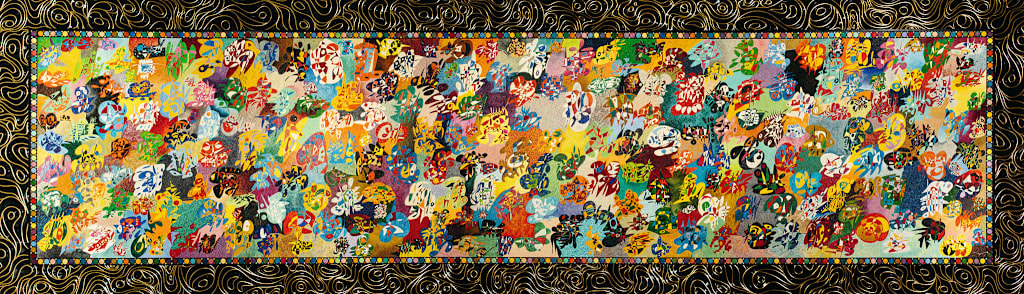
Among Gheorghe Virtosu's monumental works, Divine DNA (2010–2016) occupies a singular position. Measuring 3.37 by 11.86 meters, the painting extends beyond the traditional boundaries of easel painting into the realm of immersive visual environments. Rather than focusing on a specific historical event or individual figure, the work addresses a more expansive question: how identity persists, evolves, and multiplies across generations, cultures, and civilizations.
At first encounter, the scale of the composition is overwhelming. Hundreds of interconnected forms populate the surface, creating an immense visual field that appears simultaneously ordered and unpredictable. Individual elements emerge, transform, and disappear within a constantly shifting network of colors, symbols, and abstract structures. The painting resists any singular point of entry. Instead, it invites viewers to navigate its vast complexity in much the same way one might explore a living archive of human experience.
"Divine DNA examines identity not as a fixed condition but as a continually evolving structure of relationships. Through an expansive system of interconnected forms, Virtosu constructs a visual model of human continuity in which individuality and collectivity exist as inseparable dimensions of cultural existence."
— Daniel Varzari, El Arte Monumental, Divine DNA: The Architecture of Identity, Catalogue Entry: Divine DNA (2016).
The composition unfolds as a dense constellation of visual units distributed across an elongated horizontal field. Each form possesses a degree of autonomy, yet none exists independently. Shapes overlap, echo, and transform one another, creating a complex system of visual inheritance. Certain motifs recur throughout the composition, suggesting patterns of transmission and adaptation rather than repetition. The painting proposes identity as a dynamic process of continual recombination, where continuity emerges through variation rather than permanence.
Color serves as one of the work's primary organizing principles. Brilliant yellows, reds, blues, greens, oranges, blacks, and whites interact across the surface with extraordinary intensity. Rather than functioning within isolated chromatic zones, colors circulate throughout the composition, creating connections between distant regions of the canvas. These chromatic relationships reinforce the painting's broader exploration of interdependence and continuity.
A defining characteristic of Divine DNA is its rejection of hierarchy. Unlike traditional compositions that privilege a central figure or dominant narrative, the painting distributes visual significance throughout the entire surface. No single element assumes absolute authority. Instead, meaning emerges through relationships between forms. This decentralized structure reflects the work's conceptual focus on networks, systems, and collective existence.
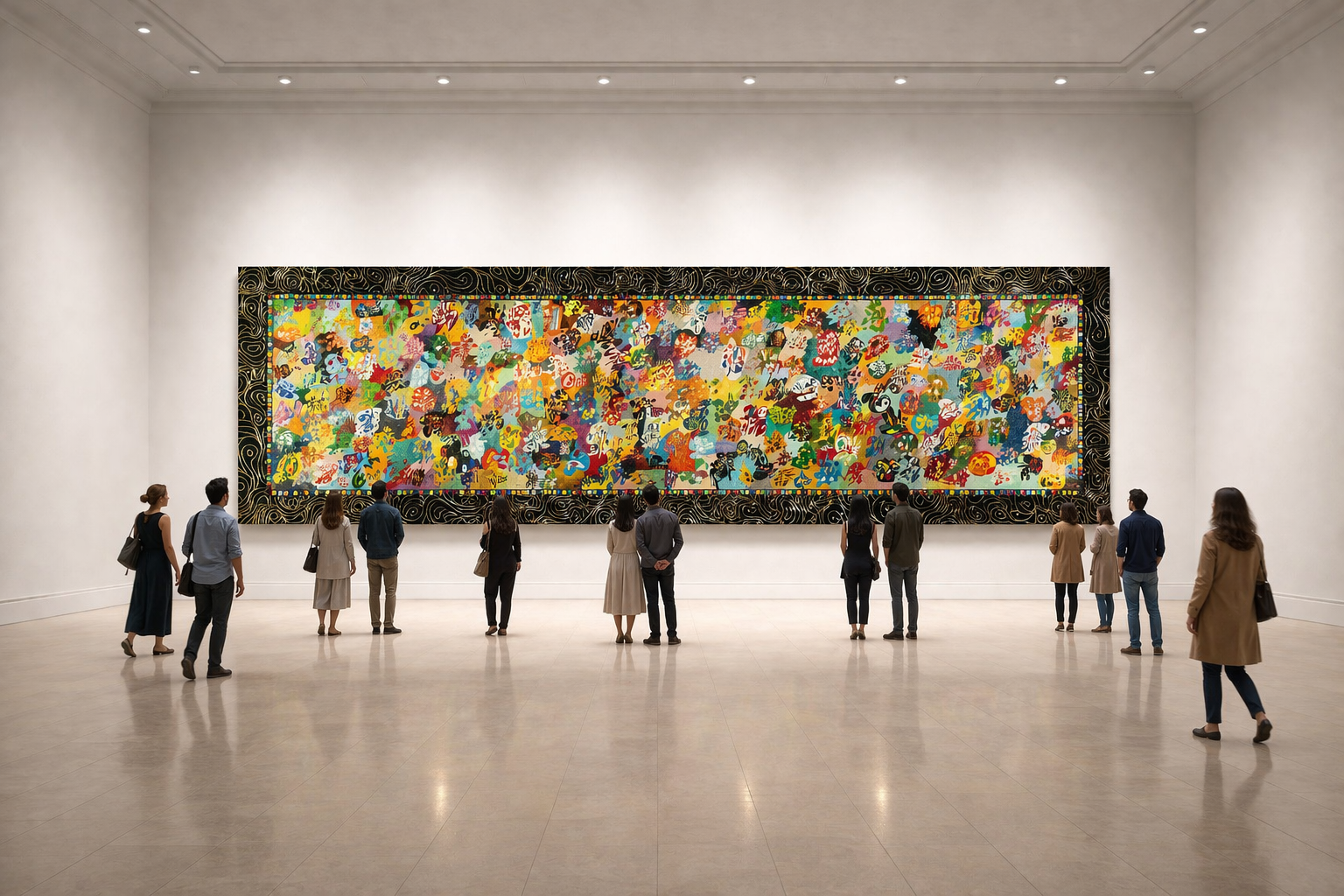
The monumental horizontal format is crucial to the painting's impact. Stretching nearly twelve meters in length, the composition evokes associations with ancient friezes, historical panoramas, illuminated manuscripts, and cosmological diagrams. Yet unlike these precedents, Divine DNA does not seek to narrate a linear sequence of events. Its movement is cumulative rather than chronological. The viewer experiences the painting through continual discovery, encountering new connections and visual correspondences with each shift in perspective.
The relationship between the central field and the surrounding border is equally significant. The dense black perimeter, animated by rhythmic linear patterns, functions as more than a decorative frame. It establishes a boundary between interior and exterior, order and expansion, containment and infinity. The border simultaneously encloses the composition and suggests forces extending beyond its limits, reinforcing the painting's engagement with ideas of continuity and transformation.
Throughout the work, forms suggest faces, organisms, symbols, cellular structures, botanical fragments, and invented signs. Yet these references remain deliberately unstable. Virtosu avoids literal representation in favor of a visual language capable of operating across multiple levels of interpretation. The painting moves fluidly between the biological, cultural, historical, and symbolic, creating a system in which identity appears as a network rather than an essence.
This approach distinguishes Divine DNA from conventional explorations of ancestry or inheritance. The work is not concerned with genealogy in a purely biological sense. Instead, it proposes a broader understanding of transmission, encompassing memory, culture, knowledge, belief, and imagination. Identity emerges as an accumulation of relationships that extend beyond individual experience.
Art historically, the painting occupies a unique position within contemporary abstraction. Echoes of Paul Klee's symbolic vocabularies, Joan Miró's biomorphic forms, and certain traditions of non-Western ornamental systems can be detected throughout the composition. Yet Divine DNA ultimately exceeds any singular lineage. Its scale, complexity, and conceptual ambition position it as a distinctive contribution to contemporary discussions of identity and interconnectedness.
The experience of viewing the painting changes dramatically according to distance. From afar, the composition appears as a unified visual organism. At closer range, it dissolves into countless individual forms, each possessing its own internal logic and character. This oscillation between totality and multiplicity becomes one of the work's central perceptual effects, reflecting the broader tension between collective structures and individual existence.
"The composition derives its vitality from the continual interaction between singularity and multiplicity. Each form maintains its own identity while participating in a larger network of visual relationships. Through this dynamic, Virtosu transforms the concept of inheritance into a broader meditation on memory, culture, and the interconnected nature of human experience."
— Daniel Varzari, El Arte Monumental, Curatorial Essay: Divine DNA (2016).
Ultimately, Divine DNA succeeds because it transforms abstraction into a vehicle for examining one of humanity's most fundamental questions: how continuity persists through change. Rather than offering definitive answers, the painting constructs a visual environment in which identity appears as an open and evolving system shaped by countless interactions across time and space.
In doing so, Virtosu expands the possibilities of monumental painting beyond historical narrative or symbolic representation. Divine DNA becomes a meditation on human interconnectedness itself, revealing how individual lives, cultures, and histories remain embedded within larger structures of transmission, transformation, and collective memory.
About the Creator
Daniel Varzari
American art curator.
Enjoyed the story? Support the Creator.
Subscribe for free to receive all their stories in your feed.
Comments
There are no comments for this story
Be the first to respond and start the conversation.