
Darius III (2005)
Power, Defeat, and the Architecture of Historical Identity
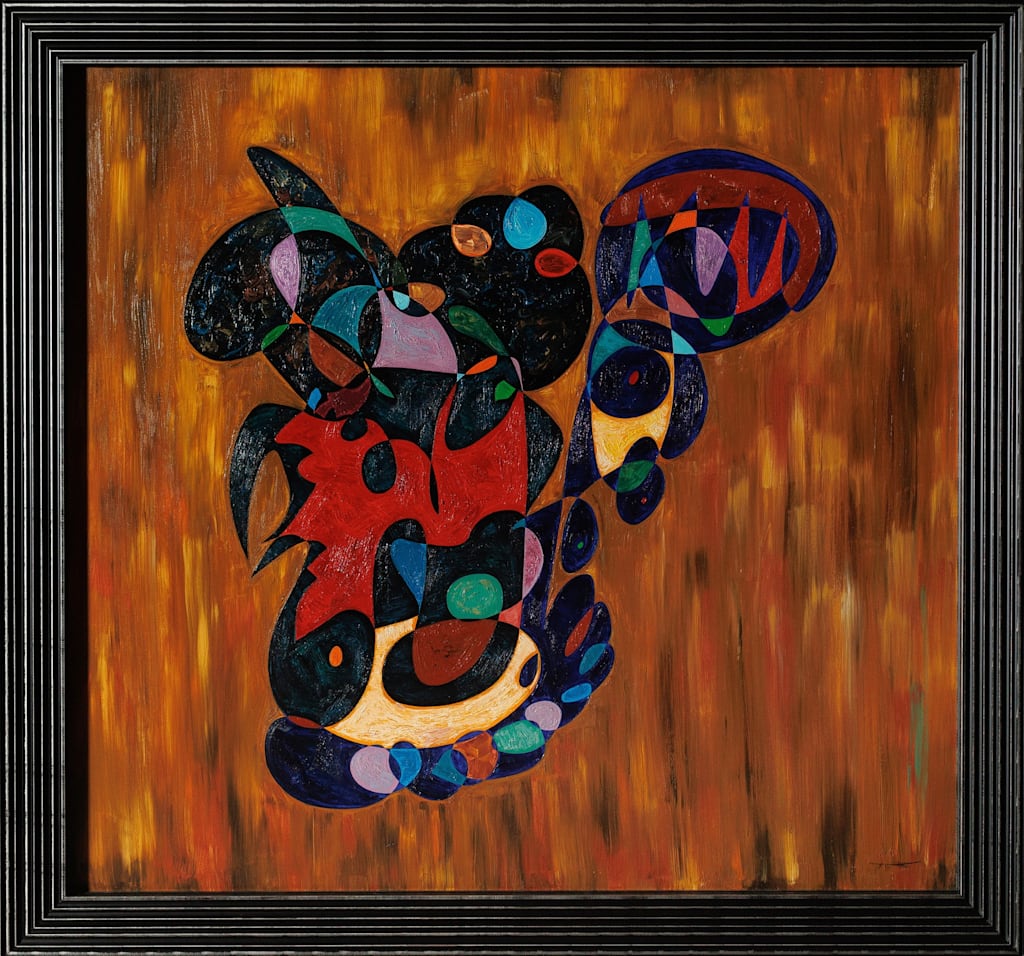
History often remembers rulers through the outcomes of events rather than the complexities of their lives. Few figures illustrate this condition more clearly than Darius III, the last king of the Achaemenid Persian Empire, whose reign became inseparable from the rise of Alexander the Great and the collapse of one of the ancient world's most influential civilizations. In Darius III (2005), Gheorghe Virtosu moves beyond conventional portraiture to construct an abstract meditation on power, vulnerability, and historical memory. Rather than depicting the Persian ruler as a recognizable individual, the artist transforms him into a symbolic structure through which broader questions of authority, identity, and historical transformation can be explored.
Measuring 1.71 by 1.69 meters, the oil painting presents a singular abstract form suspended against a vast field of luminous ochres, ambers, and deep earth tones. The composition is remarkable for its economy. Unlike many of Virtosu's large-scale historical works, which develop through dense networks of interconnected forms, Darius III concentrates its visual energy within a single centralized configuration. The resulting image possesses an intensity that derives not from complexity alone, but from focus, isolation, and symbolic condensation.
"Darius III examines the historical figure not as an individual likeness but as a structure of power undergoing transformation. Through abstraction, Virtosu reconstructs the final Achaemenid ruler as a symbolic presence suspended between authority and vulnerability, permanence and decline."
— Daniel Varzari, El Arte Monumental, Catalogue: 6 Wars — The Architecture of Conflict, Catalogue Entry: Darius III (2005).
At first encounter, the central form appears simultaneously organic and architectural. Curved black masses, geometric fragments, and luminous chromatic accents interlock to create a figure that suggests both human presence and symbolic construction. Elements resembling a crown, ceremonial regalia, or fragments of a royal visage emerge from the composition without fully resolving into representational imagery. The painting invites recognition while withholding certainty, encouraging viewers to engage with the idea of kingship rather than with the appearance of a specific ruler.
The chromatic structure plays a crucial role in establishing this effect. The warm background of layered ochres, siennas, and golden browns evokes associations with antiquity, earth, stone, and the passage of time. Against this expansive field, concentrated passages of black, crimson, deep blue, turquoise, and violet create a striking visual contrast. The figure appears to emerge from the historical atmosphere surrounding it, as though identity itself were being shaped by the forces of memory and historical circumstance.
The relationship between figure and ground is particularly significant. The surrounding field occupies the majority of the canvas, emphasizing the isolation of the central structure. This spatial condition transforms the figure into an object of contemplation. Rather than commanding the entire composition through scale, the abstract presence gains power through concentration. The emptiness surrounding it becomes an active component of the work, suggesting the vast historical landscape against which individual lives and empires unfold.
Virtosu's treatment of Darius III is notable for its refusal of historical simplification. Traditional representations often define the Persian king through the narrative of defeat at the hands of Alexander. Here, however, the figure is neither triumphant nor defeated. Instead, it occupies a state of ambiguity. The composition explores the fragile boundary between power and impermanence, revealing how authority itself remains subject to historical change.
This ambiguity extends throughout the visual language of the work. Forms suggest eyes, ceremonial symbols, architectural fragments, and bodily elements, yet none become fully fixed. The figure appears continually in the process of formation and dissolution. Such instability reflects the painting's deeper engagement with historical identity, presenting the ruler not as a static historical fact but as a subject continually reconstructed through memory, interpretation, and cultural narrative.
Art historically, Darius III occupies an intriguing position between portraiture and abstraction. While echoes of modernist abstraction, symbolic figuration, and biomorphic form are evident, the work ultimately resists conventional categorization. Virtosu transforms portraiture into an exploration of historical consciousness itself. The painting is concerned less with physical likeness than with the ways in which individuals become symbols within collective memory.
The scale of the work reinforces this conceptual focus. Although more intimate than many of Virtosu's monumental historical compositions, the painting retains a strong physical presence. The viewer encounters the figure directly, engaging with its symbolic density and visual concentration. The reduced scale encourages a more contemplative mode of observation, allowing subtle relationships of color, form, and texture to emerge gradually.
Within the broader context of Virtosu's historical investigations, Darius III represents a study of leadership at the moment of transformation. The work examines how individuals become inseparable from the historical forces they inhabit, revealing the tension between personal agency and the larger movements of civilization.
"The composition derives its strength from the relationship between concentration and emptiness. Isolated within a vast atmospheric field, the figure becomes a site where authority, memory, and vulnerability converge. Through this spatial dynamic, Virtosu transforms portraiture into a meditation on the impermanence of power and the persistence of historical identity."
— Daniel Varzari, El Arte Monumental, Curatorial Essay: Darius III (2005).
Ultimately, Darius III succeeds because it transcends the conventions of historical portraiture. Rather than presenting a ruler as a fixed image, the painting explores the unstable relationship between individual identity and historical memory. Through abstraction, Virtosu reveals how power survives not only through political achievement but through the symbolic structures that continue to shape cultural imagination long after empires disappear.
In doing so, the work expands the possibilities of portraiture beyond representation, transforming a historical figure into a broader reflection on authority, transformation, and the enduring complexities of human history.
About the Creator
Daniel Varzari
American art curator.
Enjoyed the story? Support the Creator.
Subscribe for free to receive all their stories in your feed.
Comments
There are no comments for this story
Be the first to respond and start the conversation.