
Cut From The Same Cloth: Architecture, Fashion, and the Long Reign of Hotel du Cap-Eden-Roc
How a Napoleon III villa on a rocky Riviera peninsula became fashion's most enduring backdrop — and why, 155 years on, it still dresses better than almost anyone who checks in.
A conversation held in stone and silk
Fashion and architecture have always been in quiet conversation. A building sets a silhouette; clothes answer it. A façade decides the light; a wardrobe learns to catch it. A staircase invents a descent, and someone, eventually, is photographed making it. This is not a metaphor so much as a mechanism — the reason certain places produce iconic images decade after decade while others, no less beautiful, produce merely nice ones. The great backdrops of fashion are not backdrops at all. They are collaborators.
Nowhere on earth has that collaboration run longer, or more fluently, than at the southern tip of the Cap d'Antibes — where a butter-yellow château has spent a century and a half teaching everyone who arrives how to dress for the occasion of simply being there. You do not go to Hôtel du Cap-Eden-Roc and decide what to wear. The hotel decides for you, in advance, through the pale of its stone and the angle of its light and the weight of everyone who walked its gravel before you. To check in is to accept a dress code written in 1870 and never once revised.
This is the story of how that happened: how a failed writers' retreat became the most photographed hotel in the world, how its architecture quietly authored an entire school of dressing, and how — on one golden day this summer — the machine proved, once again, that it still runs exactly as designed.
The house that light built
The story starts, fittingly, with a creative brief.
In the early 1860s, the pine-clad promontory of the Cap d'Antibes — a rustic peninsula halfway between Antibes and Juan-les-Pins, where the Mediterranean splashes over bare rock — was being colonised by a certain kind of nineteenth-century visitor: aristocrats and gentry, captivated by the light, throwing up magnificent Belle Époque villas among the umbrella pines. One of them was a man with the improbable name of Hippolyte de Villemessant, founder of the French newspaper Le Figaro. He was struck less by the beauty of the place than by its particular quality of light — the specific, forgiving, gold-and-blue Mediterranean luminescence that painters would spend the next century chasing up and down this coast.
Villemessant's dream was not a hotel at all. It was a refuge. He wanted to build an elegant sanctuary where burned-out writers and artists could come to think, to recover, to be inspired away from the demands of Paris. He would call it Villa Soleil — the House of Sun — and it would exist for no commercial reason whatsoever. It was, in the truest sense, a folly: a building conceived to serve the imagination.
He ran out of money before he could realise it. Fortune, generous at the outset, deserted him, and the half-formed dream passed to a circle of Russian aristocrats — part of the entourage of the ailing tsarevich, sent south in hope of a cure. It was a former captain of the Russian Imperial Guard, Alexis de Pletscheyeff, who in 1870, with a group of French aristocrats and investors, finally completed the magnificent Napoleon III–style building that opened its doors as the Grand Hôtel du Cap.
And then — almost immediately — disaster. The Franco-Prussian War and the Long Depression fell across Europe, and the grand new house on the Cap emptied. For seventeen years it sat largely abandoned, a beautiful shell with nobody to fill it, waiting for the world to become rich and restless enough to want it. The railways did the rest: the new lines linking Paris and Menton, and St Petersburg with Nice, cracked open the Riviera as a destination for the leisured classes. In 1887 a young hotelier from the Piedmont, Antoine Sella, fell under the building's spell and dedicated two years to restoring it. In January 1889 the Grand Hôtel du Cap opened, properly this time, and the legend began in earnest.
That improbable origin — a writers' retreat that nobody used, a war that emptied it, a railway that saved it — matters, because it set the hotel's essential character forever. This was never a building designed to sell rooms. It was a building designed to hold light and inspire people, which happened, eventually, to sell rooms. The distinction has never stopped mattering.
The architecture as a system of instructions
Consider, in detail, what the Cap actually built — because every single element of it is now visual shorthand, and shorthand, repeated for a century, becomes a language.
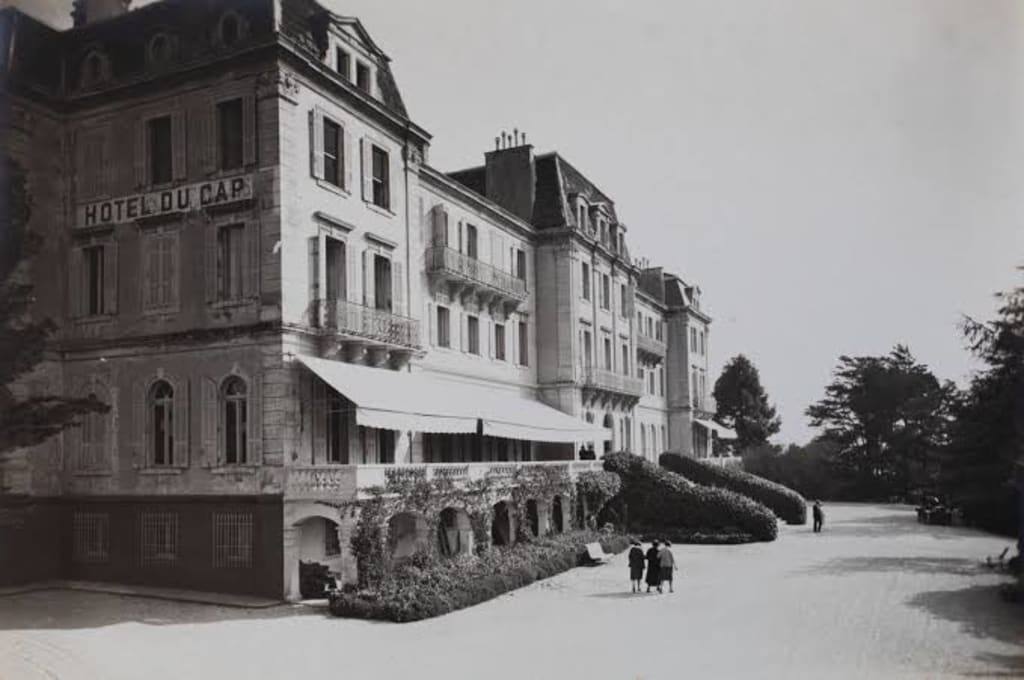
The main house. Belle Époque grandeur held in restraint. The 1870 building is symmetrical, pale, formal — a mansard-roofed silhouette in the Napoleon III manner that reads as aristocratic rather than nouveau, confident rather than loud. It is the colour of cream gone slightly gold in sun, the colour that photographs as timeless in any decade. Its proportions are those of a private château pretending, not very hard, that it is not a hotel. The marble lobby, the light boiserie walls, the striped wallpaper and gilded mirrors, the antique furniture and the chandeliers: all of it insists, gently, that you are a guest in a great house rather than a customer in a business.
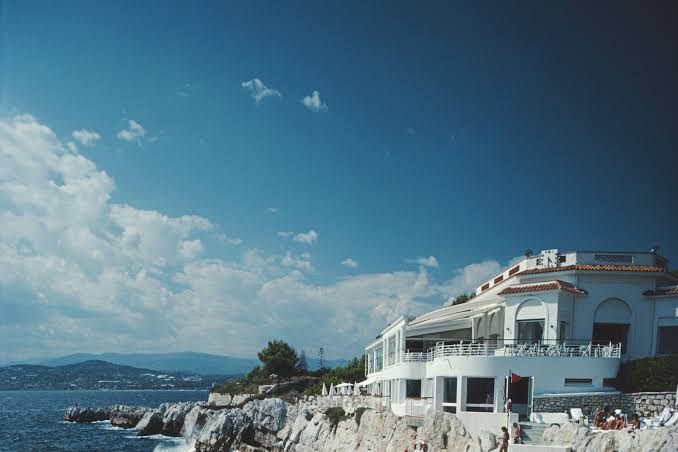
The Eden-Roc pavilion. In 1914, Sella added the piece that would define the hotel's image for the next hundred years — a second structure set some 400 yards from the main house, out on the very edge of the rock where the land runs out into the sea. And with it came the detail that no photograph of this place is ever without: a swimming pool blasted directly into the seaside bedrock, saltwater against raw stone, suspended above the deep Mediterranean blue. It was, and remains, an act of architectural bravado — not a pool laid beside the sea but one carved into the cliff that meets it, so that the boundary between the built and the natural, the man-made and the elemental, effectively dissolves. That dissolution is the whole aesthetic of the place in a single gesture.
The Grande Allée. Running the length of the grounds is the pine-lined boulevard originally laid out by Comte Paul de Fersen — 179 metres of processional gravel, straight as a ruled line, framed by umbrella pines and, ultimately, by the pale face of the château itself. It was conceived as an approach, a way of arriving. It has become, as we shall see, the most consequential catwalk in fashion — and one so protected that, over the years, every proposal to build upon it has been refused. It needs to remain set in its history, the hotel says. And it does.
The grounds. Twenty-two acres of fragrant pine forest hold the whole composition in place — a private Eden of maritime pines and manicured hedge, cut through with paths that lead, always, down to the rock and the sea. The palette is fixed and deliberate: the deep green of the flora, the shifting blues and greens of the water, the pale gold of the stone. When the Brazilian architect Patricia Anastassiadis was brought in to refresh the dining spaces for the 150th anniversary, she described the project as an exercise in affective memory — the blues and greens of the Riviera imprinted since childhood, the poetic instant where rock meets sea. She was not inventing a scheme. She was reading one already written into the place.
Now stack these elements together — pale stone, gold light, sea-cut pool, endless gravel processional, dark pines — and notice what they do to a human being placed inside them. They flatter certain colours and punish others. They reward a certain formality and forgive a certain ease. They compose, automatically, around anyone who stands still long enough. A building this legible, this internally consistent, is not passive scenery. It is a set of instructions. And the first instruction is about what to wear.
The wardrobe the architecture demands
Here is the quiet thesis at the centre of this whole story: at Hôtel du Cap-Eden-Roc, the architecture wrote the dress code first, and fashion has spent a century catching up to it.
Think about the specific demands of the setting. Pale limestone and a low, golden sun flatter the undyed and the unbleached — ivory, cream, taupe, sand, oatmeal, bone. These are the colours of raw linen and unwashed silk, of cashmere the colour of the stone it stands against. The formality of the Napoleon III façade rewards tailoring; the Mediterranean heat and the informality of a pine forest forgive that tailoring just enough to want it oversized, unstructured, thrown on — the jacket a size too big, the trainers white, the whole ensemble assembled as if by beautiful accident. Slicked-back hair reads cleaner against pale stone than anything voluminous. A single piece of gold does more, in this light, than a fistful of diamonds ever could.
None of this is coincidence, and none of it is new. It is precisely why the vocabulary the industry now calls "quiet luxury" or "old money" dressing keeps being photographed here, of all places — because this is where that vocabulary was effectively born. The hotel did not adopt the aesthetic; the aesthetic was reverse-engineered, over decades, from what looked right against the hotel.
The great houses understood this with the instinct of people whose entire trade is knowing what looks right where. F. Scott Fitzgerald, who wintered here in the 1920s with Zelda, absorbed the place so completely that he modelled the Hôtel des Étrangers of Tender Is the Night directly upon it — fixing its glamour into literature before the fashion world had quite caught up. But the hotel's specifically fashion mythology was sealed in 2010, when Karl Lagerfeld chose the Grande Allée as the runway for Chanel's Cruise 2011–12 collection. He did not build a set. He used the boulevard exactly as it stood, framed by the hotel's historic building, and sent the collection down the hotel's own processional gravel.
And the clothes themselves were a direct love letter to precisely the aesthetic the architecture had been teaching for a hundred and forty years: not red-carpet excess but the relaxed opulence of mid-century film stars caught off-duty — pyjama-style trousers, fluid evening dresses, softly tailored jackets worn with flat sandals. The palette was pearlescent white, soft gold, deep black: the exact interplay of sea, sky, and evening light along that coast. Lagerfeld, the most literate reader of visual culture the industry has ever produced, looked at the Cap and simply transcribed what it had always been saying.
Dior found the same backdrop irresistible, staging fragrance campaigns here with Jude Law and Natalie Portman, sending its hero off down the drive in a sports car and out onto the water in one of the hotel's classic Riva boats. The relationship has since been formalised in stone: the property now folds a Dior spa into itself, two of the great French maisons effectively cohabiting on the same rock. The circle closes. The building that taught fashion how to dress now houses the houses it taught.
The ledger of who was allowed in
If the architecture writes the dress code, the guest book enforces the social standing — and no ledger in hospitality is heavier.
After the First World War, the American expatriates Sara and Gerald Murphy — the golden couple around whom the Lost Generation orbited — did something that tells you everything about the place: they rented the entire complex, out of season, and filled it with the most glamorous names of the century. The Windsors came. Rudolph Valentino came. Marlene Dietrich came. Their most frequent guests were Zelda and Scott Fitzgerald, and the whole shimmering set effectively invented the idea of the Riviera summer in the process — the notion that one might go south not for one's health, as the Victorians had, but for pure, sunlit pleasure. Hemingway and Gertrude Stein passed through. Picasso came for the same light that had first seduced Villemessant; Chagall too. The screen goddesses followed, and the Cannes directors after them, and the Kennedys, and John and Yoko, and the whole rolling procession of twentieth-century fame.
The hotel guarded its exclusivity with an eccentricity that has itself become legend. It accepted only cash — no credit cards — right up until 2006, a policy that functioned as a quiet filter: if you had to ask, you could not stay. It refused to install televisions until 2012, on the grounds that its guests had better things to look at; for years, if you insisted, you could rent one for a hundred euros, an arrangement designed to make you feel faintly ashamed of wanting it. And it has, more than once, banished well-heeled guests permanently for the sin of being rude to its staff — a rule that draws the hotel's real social line not around wealth but around grace. Money gets you through the gate. Only behaviour keeps you inside it.
That thread has never broken. Every May, when the Cannes Film Festival fills the Croisette a short speedboat ride away, the Hôtel du Cap-Eden-Roc becomes the festival's unofficial headquarters — stars off the red carpet and back on the rock within minutes, rooms and suites full, couture and tuxedos kept immaculate. And the crown of that season is the annual amfAR gala, hosted over the decades by a rotating cast of the famous — Sharon Stone, Queen Latifah, Demi Moore — and universally acknowledged as the single hardest ticket on the Riviera. Guests pay thousands for a table; the opening cocktail is held on that fiercely protected Grande Allée; the evening's fashion show, curated in recent years by Carine Roitfeld, sends one-of-a-kind looks from Louis Vuitton, Chanel, Dior, Givenchy, Balenciaga, Versace and every other house that matters down a runway explicitly built to rival the Met Gala. Robert De Niro has auctioned his father's art from the floor; single editions have gone for hundreds of thousands of euros; the night routinely raises tens of millions.
To be photographed on those steps, in that light, is a form of social currency that cannot be bought on the open market. You can buy the room. You cannot buy the invitation, and you certainly cannot buy the history you walk into the moment you set foot on the gravel — the butterflies-in-the-stomach sense, as one writer put it, that you have become a small footnote in a very long and very glamorous book.
Even the recent renovations honour the ledger rather than erasing it. When the hotel refreshed its rooms for its 150th year — overseen by Countess Bergit Douglas of MM-Design, with cashmere and bedding from Loro Piana and hallways in the Eden-Roc pavilion hung with Warhols, Baldessaris and Alex Katz — the explicit instruction was to modernise without touching the historic bones. The look, it was said, should remain familiar to a guest from a century ago. The hotel updates its comforts. It refuses, absolutely, to update its identity.
The proof, one golden day this summer
Which brings us, at last, to the present — and to the clearest possible evidence that this century-old machine still turns exactly as engineered.
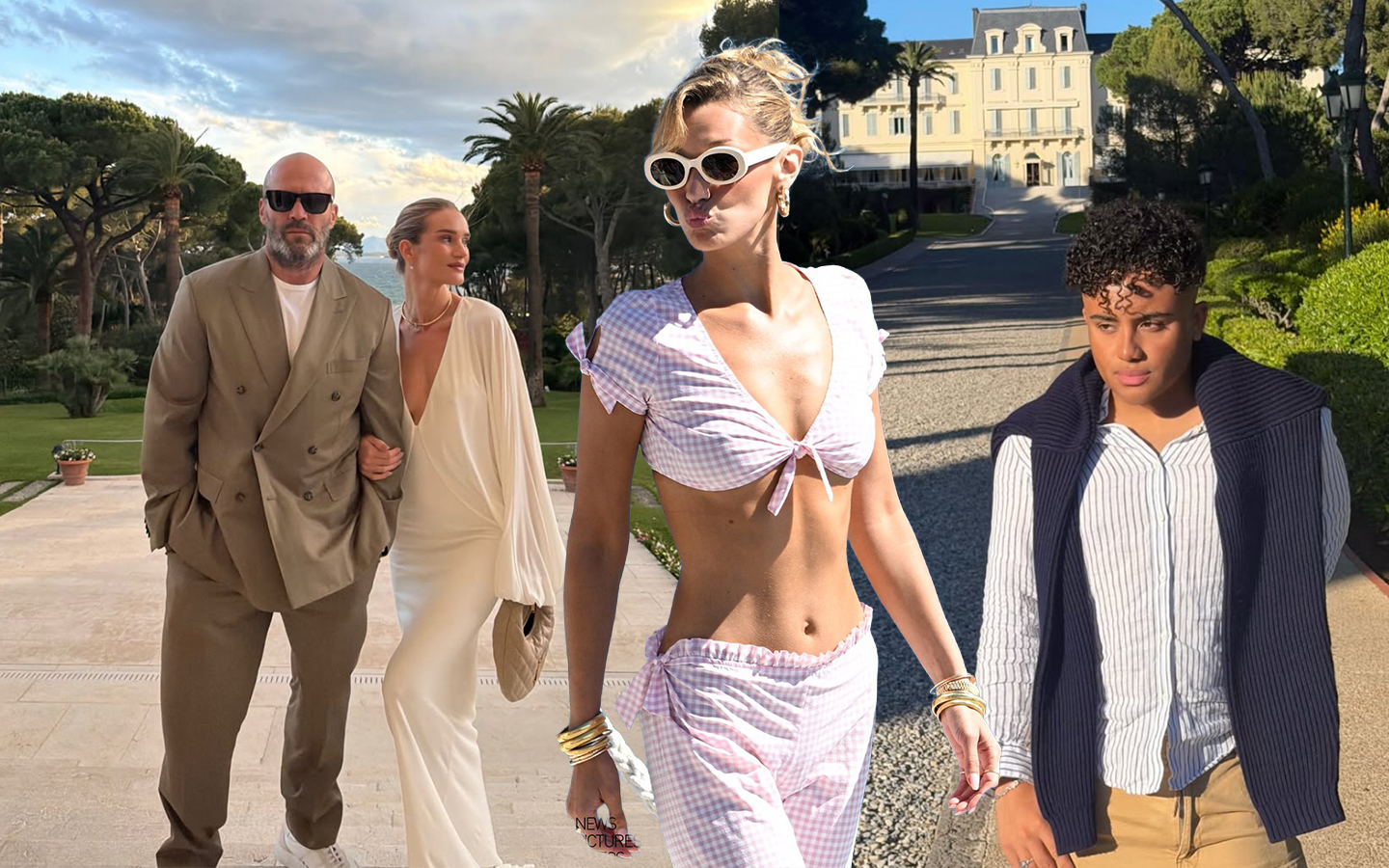
On a single, sun-drenched day this summer, the famous gravel drive delivered the kind of guest list most resorts would spend a decade of marketing budget trying to manufacture. And the point is not merely that they came. The point is that every one of them, consciously or not, dressed to the architecture — each an unwitting demonstration of the thesis that the building has been dictating the wardrobe all along.
The power couple
First through the gardens: Jason Statham and Rosie Huntington-Whiteley, arm in arm on the limestone steps with the Mediterranean glinting behind them. Statham kept it relaxed-tailored in an oversized, double-breasted taupe suit worn over a plain white tee and crisp white trainers — the off-duty action star's answer to a Riviera dress code, and a near-perfect echo of the pale stone beneath his feet. He did not match the building by accident; he matched it because taupe is what the building asks for, and has always asked for. Huntington-Whiteley, for her part, made effortlessness look like a discipline: a floor-length ivory gown with a plunging drape and voluminous blouson sleeves, hair slicked back hard, a single fine gold necklace, a quilted neutral clutch held loosely at her side. Under a moody, silvering early-evening sky, the two of them looked less like hotel guests than like the closing frame of a film — which, given the address, is precisely the register the architecture was built to produce. Set them beside a photograph of the Murphys' set a hundred years earlier and the only reliable way to date the image would be the trainers.
The supermodel moment
Down at the water's edge, Bella Hadid supplied the daytime counterpoint. Photographed against that impossibly blue Eden-Roc sea — the very water above which the 1914 pool was cut into the bedrock — Hadid wore a pink gingham tie-front two-piece: cropped, knotted, unmistakably Riviera-coded, and finished with white oval sunglasses, chunky gold hoops, and both wrists stacked with gold bangles. It is exactly the kind of look that gets reverse-image-searched into oblivion and sells out by the weekend — part 1990s St-Tropez, part picnic-on-the-Cap, entirely Bella. But place it beside Lagerfeld's 2010 Cruise pyjama trousers and the lineage becomes impossible to miss: the same relaxed, sunlit ease, the same refusal of red-carpet formality, the same instinct that on this particular rock the right move is always to look as though you have somewhere better and more private to be. Hadid was not referencing the hotel's fashion history. She was, more remarkably, reproducing it from first principles.
The tastemaker on the drive
And winding up the hotel's legendary pine-lined driveway — the same Grande Allée that has carried everyone from the Fitzgeralds to the Chanel front row, the boulevard the hotel would sooner die than build upon — London creative Sterling Chandler, founder of the music-industry consultancy Breeze Consulting. Chandler's read on Cap dressing was quietly precise: a blue-striped linen shirt worn open, a navy ribbed knit thrown over the shoulders in the immemorial manner of people who belong here, and stone-coloured cargo trousers — the sort of unforced, considered ease the hotel practically requires at check-in. Where Statham matched the stone and Hadid matched the sea, Chandler matched the pines and the gravel: the muted, earthy, tastemaker's palette of someone who has understood that the loudest thing you can possibly do in this setting is refuse to be loud at all. Behind him, the château's butter-yellow façade did what it has done for a century and a half — steal the frame anyway, and generously make him look like part of its history in the process.
Why here, why now
That all three sightings landed on the same day is not a coincidence. It is the entire thesis, delivered in a single afternoon. And the guest book only deepened as the weekend wore on, with Dua Lipa also among the names checked in at the Cap. Her presence is its own kind of proof: pop's reigning aesthete — a performer who has made a second discipline of dressing precisely, who treats a holiday wardrobe with the seriousness others reserve for a stage — gravitating, as the tastemakers always eventually do, to the one address on the Riviera that rewards that kind of precision. The Cap has spent a century and a half collecting exactly this: not simply the famous, but the fashion-literate famous, the people for whom what one wears against pale stone in gold light is a considered act rather than an accident. Lipa joins a ledger that runs from the Fitzgeralds through Lagerfeld's front row to a summer afternoon in 2026, and the through-line is unbroken — the hotel keeps drawing the people who understand, instinctively, that here the clothes and the building are the same conversation.
Film stars fresh from the Croisette, supermodels between campaigns, and the industry people who make it all move: all of them sharing the same gardens, the same saltwater pool carved into the rock, the same slow, forgiving golden hour that Villemessant first fell for a hundred and sixty years ago. The cast rotates. The light does not. Neither does the stone, nor the gravel, nor the pale formal face of the house that decides, in advance, exactly how everyone standing in front of it will read.
This is what makes Hôtel du Cap-Eden-Roc genuinely singular, and it is a fact about architecture as much as about fame. A building is a permanent thing; fashion is a seasonal one — it arrives, it peaks, it is replaced. What the Cap has done, uniquely, is dress the two in the same colours for a century and a half — pale stone and undyed linen, gold light and slicked-back hair, formality softened by heat, grandeur worn as if it were nothing — until the seam between them disappears entirely and you can no longer say where the architecture ends and the wardrobe begins. The clothes belong to the building. The building has always dressed better than its guests, and its guests have spent a hundred and fifty years learning to keep up.
Other destinations have a summer. The Cap is summer — a permanent, load-bearing, architectural fact of it. And this year, once again, the pictures speak entirely for themselves.
About the Creator
Enjoyed the story? Support the Creator.
Subscribe for free to receive all their stories in your feed.
Comments
There are no comments for this story
Be the first to respond and start the conversation.