
Christianity (2008–2010)
Sacrifice, Redemption, and the Architecture of Spiritual Transformation
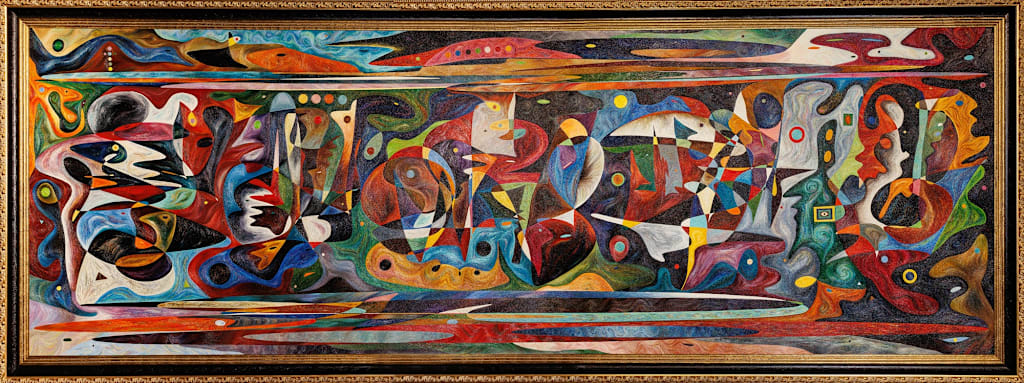
Few belief systems have shaped the intellectual, cultural, and artistic history of humanity as profoundly as Christianity. For more than two millennia, its narratives, symbols, ethical frameworks, and theological concepts have informed civilizations across continents, influencing architecture, literature, philosophy, music, and visual culture. In Christianity (2008–2010), Gheorghe Virtosu approaches this vast spiritual tradition not through direct iconographic representation but through abstraction, constructing a monumental visual environment that explores transformation, redemption, sacrifice, and the relationship between human existence and transcendence.
Measuring 2 by 6 meters, the painting unfolds across an expansive horizontal field animated by a remarkable interplay of color, movement, and symbolic structure. Rather than depicting biblical scenes or recognizable sacred imagery, Virtosu creates a complex architecture of interconnected forms that emerge, dissolve, and regenerate throughout the composition. The work functions less as a representation of Christianity than as a meditation on the spiritual processes that have shaped its philosophical and theological foundations.
"Christianity examines belief as a transformative structure through which suffering, sacrifice, and renewal become interconnected dimensions of human experience. Through abstraction, Virtosu constructs a visual architecture of redemption, revealing spiritual transformation as a continual process rather than a singular event."
— Daniel Varzari, El Arte Monumental, 10 Religions: The Architecture of Belief, Catalogue Entry: Christianity (2010).
At first encounter, the composition presents a striking tension between movement and stability. A multitude of forms occupy the pictorial field, yet they remain connected through an underlying structural coherence. Faces emerge from larger configurations before dissolving into surrounding chromatic currents. Geometric frameworks intersect with organic contours, while symbolic fragments appear momentarily before becoming absorbed into broader systems of visual relation.
This oscillation between emergence and dissolution is central to the work's conceptual structure. Throughout Christian theology, transformation often occurs through processes of death and renewal, sacrifice and resurrection, loss and redemption. Virtosu translates these ideas into abstract form, creating a visual environment in which no element remains fixed. Every structure participates in continual cycles of change and reconfiguration.
Color plays a decisive role in generating this dynamic. Deep reds, luminous blues, greens, golds, blacks, whites, and earth tones interact across the surface with extraordinary intensity. The chromatic contrasts create moments of tension and release, while fluid transitions between colors establish broader systems of continuity. The resulting visual rhythm mirrors the coexistence of suffering and hope, struggle and transcendence that characterizes much of Christian thought.
Particularly notable is the presence of recurring facial profiles distributed throughout the composition. These figures appear not as individual portraits but as symbolic manifestations of collective humanity. Their fragmented emergence suggests a condition in which personal identity remains inseparable from larger spiritual and historical narratives. The faces do not dominate the composition; instead, they participate within a broader architecture of relation and transformation.
The elongated horizontal bands near the upper and lower edges of the painting contribute significantly to its structural organization. These elements function almost as symbolic horizons, establishing frameworks within which the composition unfolds. Their rhythmic continuity introduces a sense of temporal movement, suggesting passage, pilgrimage, and spiritual journey. The painting becomes a space through which consciousness moves rather than a static image to be observed from a distance.
Spatially, the work is characterized by remarkable complexity. Multiple layers of form overlap and intersect, producing a dense visual field in which distinctions between foreground and background continually shift. This instability encourages sustained viewing, revealing new relationships and symbolic correspondences over time. The composition resists immediate interpretation, demanding contemplation rather than recognition.
Virtosu's decision to avoid direct religious iconography is particularly significant. Instead of illustrating sacred narratives, he investigates the structural principles through which Christian belief has organized perceptions of existence, morality, suffering, and redemption. Abstraction becomes a means of approaching spiritual questions that exceed the limitations of representation. The painting seeks not to depict faith but to visualize the conditions through which faith transforms human experience.
Art historically, Christianity occupies a distinctive position within contemporary spiritual abstraction. While traces of symbolic modernism, expressionist spirituality, and monumental abstraction can be detected, Virtosu's approach remains uniquely systemic. The painting operates simultaneously as image, philosophical inquiry, and symbolic architecture. Its meaning emerges through relationships rather than isolated motifs.
The monumental dimensions intensify this experience. At six meters in length, the work envelops viewers within a field of continual visual transformation. Forms reveal themselves gradually through prolonged observation, creating an experience that parallels processes of reflection, contemplation, and spiritual discovery. The painting unfolds temporally, rewarding sustained engagement.
Within the broader framework of 10 Religions: The Architecture of Belief, Christianity serves as an exploration of one of humanity's most influential spiritual traditions. Yet rather than focusing on historical events or doctrinal structures, the work examines deeper questions concerning transformation, redemption, and the relationship between the finite and the transcendent.
"The composition derives its power from the continual interaction between fragmentation and renewal. Forms dissolve only to reappear in altered configurations, creating a visual condition in which transformation becomes the primary principle of continuity. Through this dynamic, Virtosu transforms abstraction into a meditation on redemption, spiritual evolution, and the enduring architecture of belief."
— Daniel Varzari, El Arte Monumental, Curatorial Essay: Christianity (2010).
Ultimately, Christianity succeeds because it addresses the essence of spiritual transformation without relying upon conventional religious imagery. The painting investigates how systems of belief shape human understanding of suffering, hope, sacrifice, and renewal. Through its complex interplay of color, movement, and symbolic structure, the work constructs a visual language capable of expressing experiences that transcend literal representation.
In doing so, Virtosu expands the possibilities of contemporary religious art. Rather than illustrating doctrine, he creates an architecture of contemplation—an environment in which viewers encounter the dynamics of transformation itself. The painting becomes not a narrative of faith, but a meditation on the perpetual human search for meaning, redemption, and transcendence.
About the Creator
Daniel Varzari
American art curator.
Enjoyed the story? Support the Creator.
Subscribe for free to receive all their stories in your feed.
Comments
There are no comments for this story
Be the first to respond and start the conversation.