
British Diplomacy (2015)
A Critical Analysis of Power, Negotiation, and Statecraft
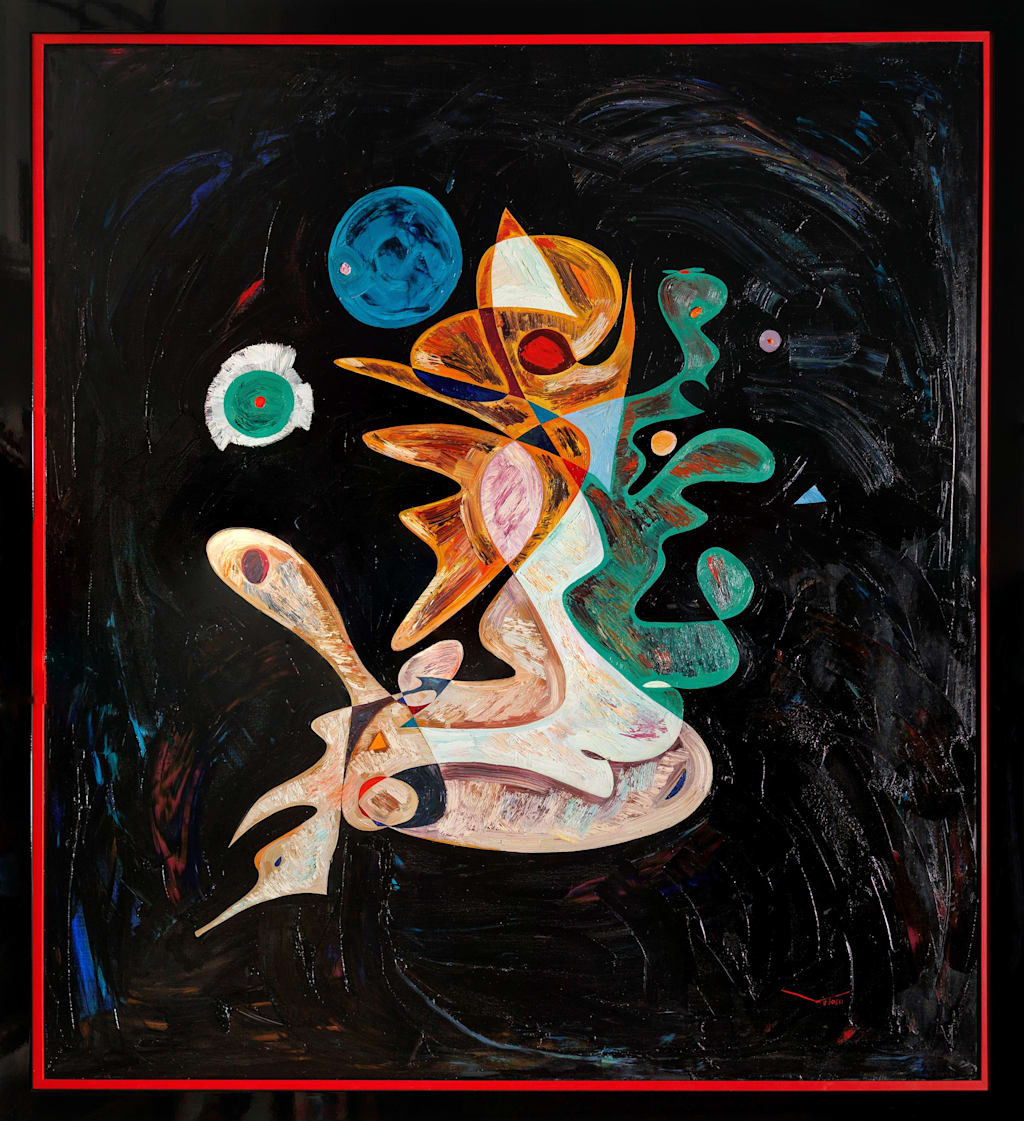
In British Diplomacy (2015), diplomacy is reimagined not as a stable instrument of political order, but as a fluid psychological and symbolic negotiation unfolding within an atmosphere of ambiguity, theatricality, and controlled tension. Through a sophisticated interplay of biomorphic abstraction, fragmented geometry, and spatial isolation, the painting transforms international relations into an unstable visual architecture suspended between persuasion, performance, and strategic concealment.
At the center of the composition is an intricate hybrid figure assembled from intersecting curved forms, elongated organic extensions, and sharply articulated geometric divisions. The structure appears simultaneously human, ceremonial, aquatic, and mechanical, resisting any singular identity. Rather than depicting a diplomat or political actor literally, the painting constructs a symbolic organism through which systems of negotiation, perception, and influence become visualized.
The central figure unfolds vertically across the canvas like a continuously mutating entity. Pale cream and white forms establish the structural foundation of the composition, while luminous oranges, ochres, reds, turquoise greens, and electric blues activate the surface with chromatic intensity. The layered construction suggests a body assembled through dialogue and contradiction rather than coherence. Every form appears dependent upon another, yet no part fully resolves into stability.
One of the most striking aspects of the work is the relationship between the vibrant central structure and the expansive black background. The surrounding darkness is not empty space but an active psychological environment animated by sweeping gestural brushwork and subtle chromatic traces. The black field evokes uncertainty, secrecy, and geopolitical opacity - the invisible atmosphere within which diplomacy operates. Against this dark expanse, the central figure appears illuminated yet vulnerable, emerging momentarily from instability before potentially dissolving back into it.
Several symbolic motifs recur throughout the composition. Floating circular forms resembling planets, surveillance devices, or isolated systems orbit the central figure without direct connection, reinforcing themes of distance, observation, and geopolitical fragmentation. A vivid blue circular form near the upper left quadrant resembles a celestial body or detached sphere of influence, while smaller floating elements punctuate the surrounding space like coded signals within a diplomatic network.
The painting's internal geometry generates a constant tension between softness and interruption. Flowing organic curves are repeatedly intersected by sharp triangular structures and linear divisions that cut through the composition like strategic interventions. These disruptions suggest negotiation itself - a process of continual adjustment between competing interests, ideological fractures, and unstable alliances.
Particularly compelling is the treatment of the figure's upper structure, where orange and gold forms resembling a ceremonial mask or symbolic face emerge from intersecting planes. A singular red circular element functions almost as an eye or concentrated center of awareness, giving the composition an intense psychological focus. Yet the figure never fully stabilizes into portraiture. Identity remains dispersed across the composition, reinforcing the idea that diplomacy operates through layered performances rather than transparent representation.
The painting also demonstrates a sophisticated orchestration of movement. Curving forms spiral outward and inward simultaneously, creating the sensation that the composition is expanding while collapsing into itself. This perpetual motion mirrors the evolving nature of international diplomacy in the 21st century - fluid, reactive, adaptive, and continuously renegotiated under shifting global conditions.
Materially, the work balances deliberate compositional architecture with expressive painterly gesture. Certain geometric passages possess sharp precision, while surrounding brushwork dissolves into gestural turbulence. This contrast between structure and improvisation gives the painting intellectual and emotional complexity, suggesting that political systems themselves oscillate between calculated strategy and unpredictable consequence.
Within broader art historical traditions, British Diplomacy engages with elements of biomorphic surrealism, postwar abstraction, and symbolic modernism while resisting direct stylistic imitation. Instead, these historical visual languages are synthesized into a contemporary symbolic vocabulary concerned with the psychology of power and the instability of institutional systems.
At 1.50 × 1.38 meters, the work possesses a commanding physical presence. The scale intensifies the viewer's confrontation with the floating symbolic structure, transforming the painting into an immersive field of psychological negotiation rather than a contained image.
What ultimately distinguishes British Diplomacy is its ability to visualize diplomacy as both seduction and instability. The painting suggests that international power no longer functions through rigid ideological certainty, but through fluid systems of performance, negotiation, ambiguity, and symbolic control. Authority within the work is never absolute; it emerges temporarily through fragile alignments of perception, influence, and strategic balance.
Rather than illustrating diplomacy directly, the painting constructs an atmosphere in which diplomacy becomes visible as a psychological condition - elusive, adaptive, and perpetually unresolved.
For further curatorial and research context:
Curatorial Essay - British Diplomacy (2015)
Catalogue: The Architecture of Power | Catalogue Entry: British Diplomacy (2015)
About the Creator
Daniel Varzari
American art curator.
Enjoyed the story? Support the Creator.
Subscribe for free to receive all their stories in your feed.
Comments
There are no comments for this story
Be the first to respond and start the conversation.