
Alexander the Great (2009)
Conquest, Myth, and the Architecture of Historical Memory
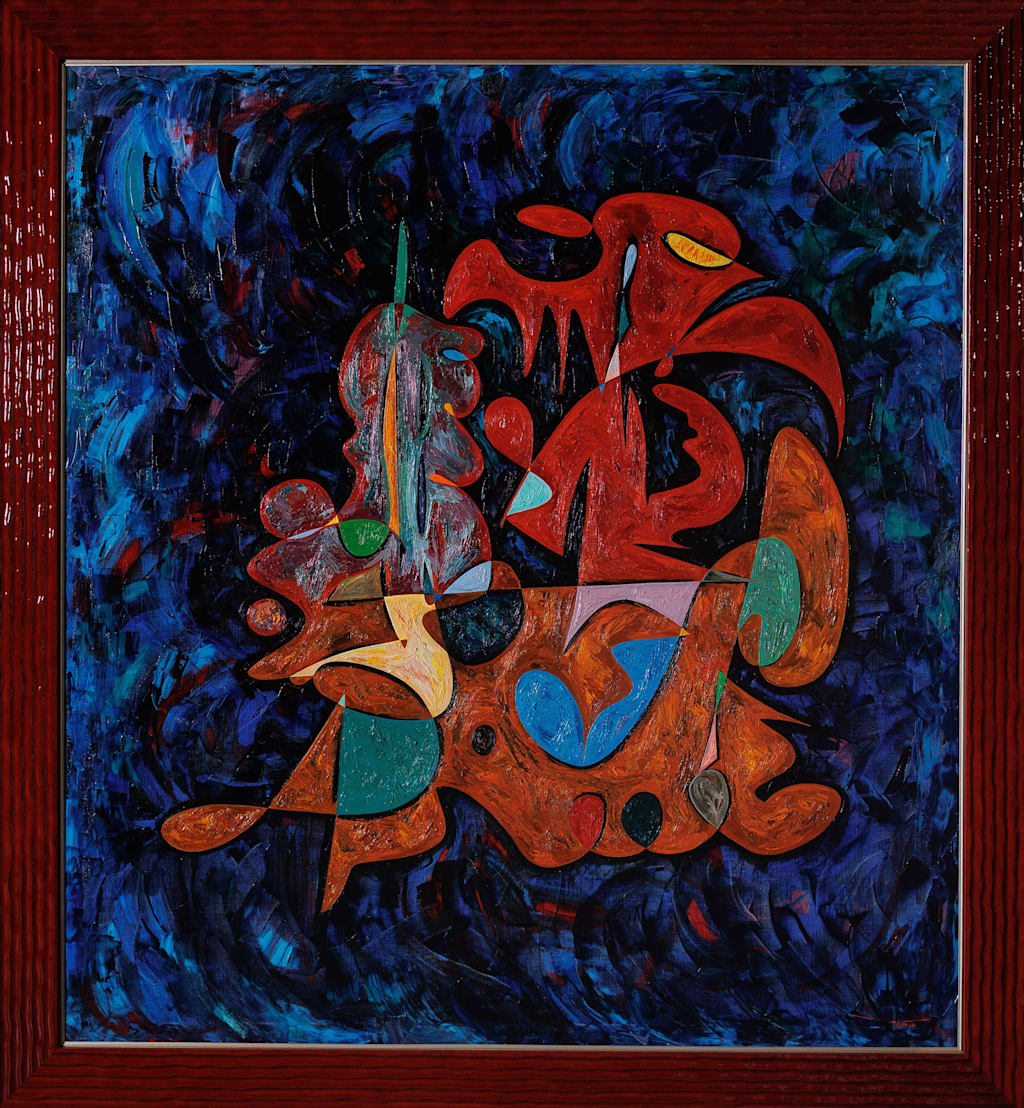
Gheorghe Virtosu's Alexander the Great (2009) does not seek to reconstruct history through portraiture or narrative illustration. Instead, it reimagines Alexander as a psychological and civilizational force whose presence extends beyond the historical individual into the symbolic structures of power itself. The painting abandons literal representation and transforms conquest into an abstract architecture of movement, fragmentation, and authority. Through a dynamic interplay of color, form, and spatial tension, Virtosu presents Alexander not as a recognizable ruler but as an energetic
"Alexander the Great (2009) investigates the relationship between conquest, myth, and historical permanence through a language of abstraction. Rather than depicting the Macedonian ruler as a recognizable historical figure, Gheorghe Virtosu reconstructs Alexander as a symbolic architecture composed of fragmented forms, chromatic tensions, and shifting spatial structures. The painting moves beyond biography to examine how power expands beyond the individual and becomes embedded within collective memory."
— Daniel Varzari, Curatorial Essay: Alexander the Great (2009), El Arte Monumental
The composition is dominated by a violent contrast between a dark blue-black field and an explosive central structure of reds, oranges, and fragmented geometric forms. This opposition establishes the fundamental tension of the work: order emerging from chaos and simultaneously generating new chaos. The dark background behaves almost like an infinite historical space, while the red forms advance forward as manifestations of conquest, desire, and political will.
As the artist's research positions Alexander within The Architecture of Conflict, war is not treated merely as military action but as a mechanism through which civilizations reorganize themselves. The work suggests that historical power operates less through individuals than through systems of expansion and transformation. Alexander becomes a symbolic catalyst rather than a biographical figure.
The central red formation resembles multiple entities simultaneously: a crown, a predatory bird, a military standard, and an abstracted face. This ambiguity is crucial. Throughout history, Alexander has existed not only as a ruler but also as a legend continually reconstructed by different cultures. His image has survived because it remains unstable and adaptable. As scholars note, Alexander's achievements became legendary almost immediately after his death, generating centuries of reinterpretation and myth-making.
The painting reflects this condition of historical multiplicity. No single form remains fixed. Shapes merge, divide, and mutate, producing a visual language that mirrors the instability of empire itself.
A particularly significant aspect of the composition is its spatial structure. Rather than organizing forms hierarchically, Virtosu constructs a field of interconnected fragments. The lower section contains geometric elements that appear assembled from different visual languages—organic curves, angular divisions, symbolic emblems, and architectural planes. This suggests the process by which empires absorb and reorganize cultures.
Alexander's historical campaigns connected territories stretching from Greece to Egypt and deep into Asia, producing one of antiquity's largest political formations. Historians frequently emphasize that his lasting significance lies not only in military victories but also in the cultural transformations generated by those conquests. Virtosu translates this phenomenon into abstract form. The painting becomes a visual metaphor for cultural fusion, collision, and reconfiguration.
Color functions symbolically throughout the work. The dominant red embodies authority, aggression, vitality, and expansion. Against it, the blue background evokes depth, uncertainty, memory, and the vastness of history itself. Smaller interventions of green, yellow, white, and turquoise operate as moments of interruption—suggesting foreign territories, diverse cultures, or the unpredictable consequences of conquest.
One of the most compelling aspects of the painting is its refusal to celebrate Alexander uncritically. Traditional depictions often present him as an ideal hero, military genius, or divine ruler. Here, greatness appears inseparable from instability. The composition feels perpetually on the edge of collapse. Forms struggle for dominance; structures remain unresolved. This reflects contemporary understandings of empire as both constructive and destructive.
The painting therefore aligns with modern interpretations that view Alexander as a figure of paradox: visionary and conqueror, creator and destroyer, unifier and source of conflict. His historical legacy remains controversial precisely because his achievements cannot be separated from the violence through which they were accomplished.
The visual language also recalls the artist's broader investigation into systems of power. In this context, Alexander is not simply a historical subject but a prototype. He represents the recurring structure through which authority expands beyond its original boundaries and attempts to transform the world according to its own vision.
As one passage associated with the project suggests, Alexander exists not merely as a man but as an embodiment of civilization's drive toward expansion and transformation. The painting visualizes that impulse through a network of forces rather than a singular image. The result is a monumental abstraction where history becomes energy, power becomes structure, and conflict becomes architecture.
"In Alexander the Great, Gheorghe Virtosu approaches history not as illustration but as structure. The legendary conqueror is not depicted through likeness, costume, or narrative scene; instead, he is translated into a field of abstract relations where ambition, violence, expansion, and legacy operate as visual forces."
— Daniel Varzari, The Architecture of Conflict, Catalogue Entry: Alexander the Great (2009), El Arte Monumental
Ultimately, Alexander the Great is less about the ruler himself than about the enduring mechanisms that produce historical greatness. Virtosu transforms one of history's most recognizable figures into an abstract field of tensions, revealing conquest not as an event but as a permanent condition within the evolution of human civilization. Through fragmentation, color, and symbolic construction, the work asks whether greatness is ever separable from conflict—or whether conflict itself remains the hidden architecture upon which civilizations are built.
About the Creator
Daniel Varzari
American art curator.
Enjoyed the story? Support the Creator.
Subscribe for free to receive all their stories in your feed.
Comments
There are no comments for this story
Be the first to respond and start the conversation.