
The Quiet Data Leak Happening Inside Your Company Right Now
Public GenAI tools have created a security gap that traditional defenses cannot see. Custom-built models are closing it.

A compliance officer at a mid-sized bank ran an audit last spring. She wanted to know how many employees used public AI chatbots for work tasks. The number surprised her leadership. More than 60% of the team had pasted internal content into these tools. Some of it included client account details. Some included unreleased financial reports. None of it should have left the building.
This story repeats itself across industries. Marketing managers paste campaign data into chatbots. Developers drop proprietary code into AI assistants to debug it faster. HR teams summarize confidential reviews using consumer tools. Each action feels small. Together, they form one of the largest unmanaged security exposures inside modern companies.
The problem has a name. Security teams call it shadow AI. The fix is not another policy memo.
Why Traditional Security Misses This
Most data loss prevention systems watch files. They track downloads, email attachments, and USB transfers. They were built for a world where data moved in containers.
GenAI breaks that model. Employees do not attach files. They copy text from one window and paste it into another. The data leaves the network as plain typing. No file moves. No alert fires. The browser extension or chatbot window receives the content and processes it on infrastructure the company does not own.
Many public AI vendors retain user inputs for model improvement. That means proprietary information can become part of training data for future model versions. Once that happens, recovery is not possible. The exposure is permanent.
This is the gap that custom AI solutions address directly. The approach changes where the data goes, who sees it, and what happens to it after the query ends.
Building AI Inside the Walls
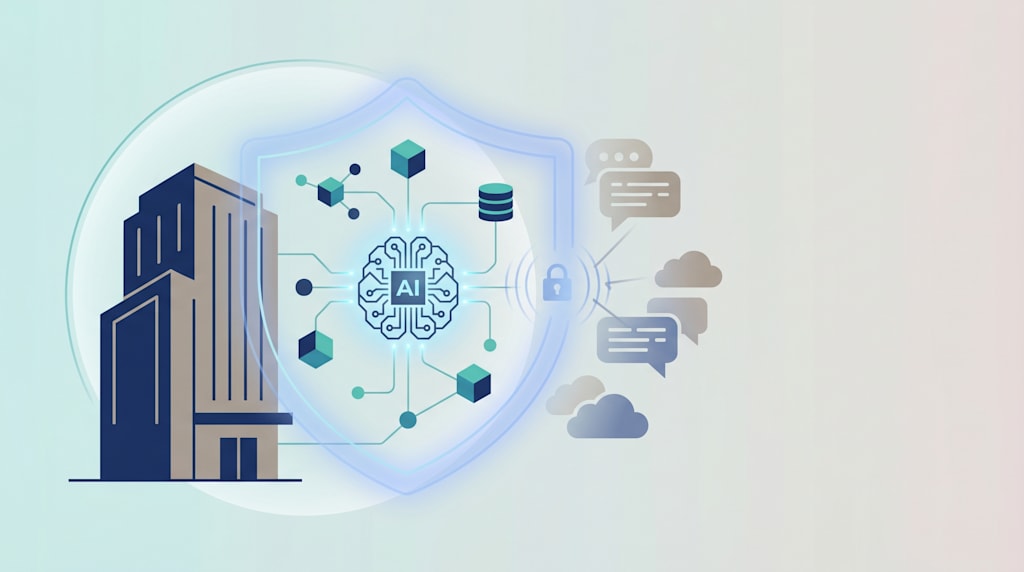
A custom AI build keeps the entire process inside the infrastructure that the company controls. Models train on internal data. Queries run on internal servers or in a private cloud tenant. Outputs return to the user without ever crossing into vendor-owned environments.
This shift solves the shadow AI problem at its root. When employees have an approved internal tool that handles their actual work, the pull toward public chatbots weakens. Productivity goes up. Risk goes down. The data never leaves the perimeter.
Research on AI risk from the NIST AI Risk Management Framework reinforces this direction. The framework treats data governance as a primary control, not an afterthought. Custom-built systems give security teams the surface area to apply that governance at the field level.
What Granular Control Looks Like in Practice
A well-designed custom AI architecture handles several jobs at once. Each one closes a specific risk.
Data classification at the field level. Before any AI process runs, the system knows which fields contain PII, financial data, or trade secrets. Tags travel with the data. Access decisions get made based on those tags.
Input guardrails. The system inspects prompts before they reach the model. A query containing an API key gets blocked. A request that pulls regulated patient data without proper authorization gets denied. The model never sees what it should not see.
Output filtering. The system also inspects what the model returns. If a response would surface confidential information to a user without clearance, the output gets redacted or rejected.
Least-privilege access. The AI itself operates under access controls. It can ingest only what the architecture allows. Different user roles see different model behaviors.
These controls work together. None of them exists in a meaningful form inside public chatbots.
The Compliance Angle
Healthcare, finance, and legal sectors face additional pressure. GDPR, HIPAA, and similar frameworks require tenant isolation. They require audit trails. They require proof that the data stayed within approved boundaries.
Off-the-shelf AI tools rarely satisfy these requirements to the depth regulators expect. A custom build allows the company to document exactly where data lives at every step. That documentation matters during audits. It matters more during breach investigations.
Firms offering AI/ML development services often start engagements by mapping the regulatory surface first. The technical design follows the compliance requirements, not the other way around. This sequence prevents costly rebuilds later.
The Operational Reality
Custom AI is not a weekend project. It requires infrastructure decisions, model selection, and integration with existing systems. The team needs people who understand both AI engineering and security architecture.
This is why many companies partner with specialists for AI integration services. The internal team learns the system during the build. Knowledge transfers happen alongside the technical work. Companies like ViitorCloud, which writes about the link between custom AI solutions and GenAI data leakage, focus engagements on this kind of capability transfer. The goal is an operational team that can run and extend the system after launch.
The conversation around enterprise AI risk has matured fast. GenAI governance now sits next to traditional security on most CISO agendas. The companies that treat AI data security as a separate problem will keep finding leaks they cannot trace.
The compliance officer at the bank in the opening built a different path. Her team launched an internal AI assistant trained on approved data. Usage of public chatbots dropped within a quarter. The audit results from this year showed a different number. The shadow AI problem had moved into the light, where the security team could manage it.
That is the actual fix. The data stays home.
About the Creator
ViitorCloud Technologies
As a leading software development company, we’ve empowered 500+ startups, SMBs, and enterprises to transform their operations. Upgrade your business with our AI-First Software and Platforms that automate and scale, keeping you future-ready.
Enjoyed the story? Support the Creator.
Subscribe for free to receive all their stories in your feed.
Comments
There are no comments for this story
Be the first to respond and start the conversation.