
The Data Platform Decision That Quietly Shapes Every AI Project
Snowflake, Databricks, and BigQuery each carve out different territory for AI/ML work. Picking the wrong one costs more than money.

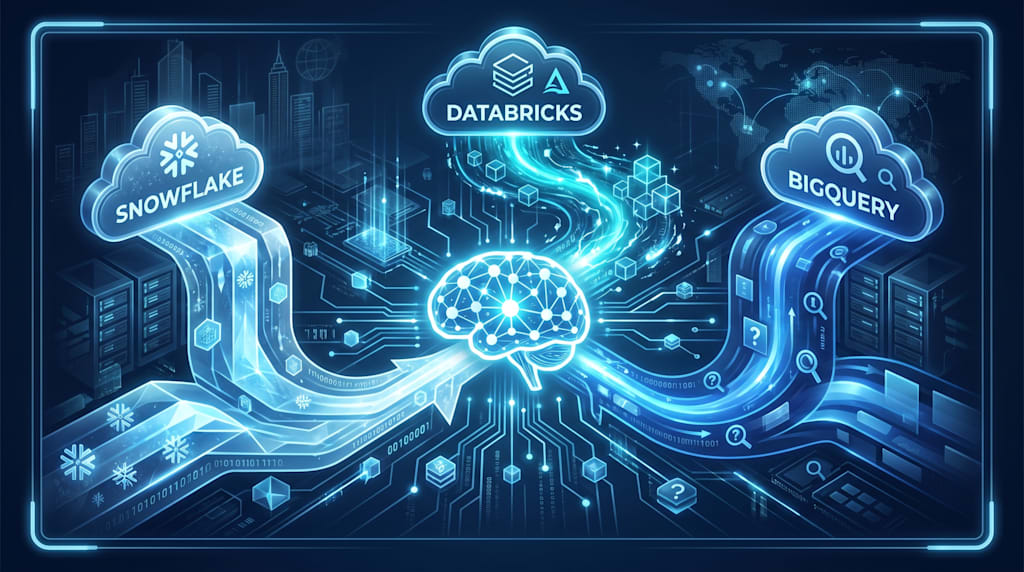
A data engineering lead at a retail company recently shared a dilemma. Her team needed to build a churn prediction model. The data sat in three places. She had budget approval, but the architecture decision kept stalling. The question that froze everyone? Which platform should host the work.
This scenario plays out across companies every quarter. Teams pick a data platform, then realize the choice shapes everything downstream. The model training speed. The handoff between data engineers and ML engineers. The cost per inference. Even hiring decisions.
Three names usually surface in these conversations: Snowflake, Databricks, and BigQuery. Each one approaches AI/ML work from a different starting point. Those starting points matter more than feature checklists.
Databricks: Built for ML-Heavy Workloads
Databricks grew out of Apache Spark. The platform treats Python as a first-class citizen. Data scientists who write notebooks all day tend to feel at home here. MLflow handles experiment tracking, model registry, and deployment without bolt-ons.
The platform suits teams running deep learning, large-scale feature engineering, or custom model architectures. Companies running real-time fraud detection or computer vision pipelines often land on Databricks. The Unity Catalog brings governance into the same workspace where models get trained.
The tradeoff is complexity. Teams without strong Spark or Python skills hit a learning curve. Costs can climb if cluster management gets sloppy.
Snowflake: SQL Teams Get an On-Ramp
Snowflake started as a cloud data warehouse. It became an AI platform through Snowpark and Cortex. The pitch makes sense for organizations where most analytics happen in SQL.
Cortex offers prebuilt functions for tasks like sentiment analysis and forecasting. Teams can call an LLM with a SQL query. Snowpark lets developers run Python inside Snowflake, keeping data movement to a minimum.
This setup works well for analytics teams adding AI features to existing dashboards. Marketing teams score leads. Finance teams forecasting cash flow. Operations teams are predicting demand. The skill gap stays smaller than with Databricks. The ceiling for custom deep learning, however, sits lower.
BigQuery: Serverless and GCP-Native
BigQuery ML lets analysts train models with SQL statements. No infrastructure setup. The serverless model means teams pay for queries, not idle clusters. For Google Cloud customers, the integration with Vertex AI extends the reach into production ML.
BigQuery suits companies already standardized on Google Cloud. Media analytics, ad tech, and consumer apps often fit this profile. The simplicity helps smaller teams ship faster. The constraint is portability. Moving workloads off Google Cloud takes effort.
Industry analysis from Gartner's research on data science and machine learning platforms suggests the gap between leading platforms narrows each year. Feature parity often arrives faster than most procurement cycles.
Where Teams Get the Choice Wrong
A common mistake is picking the platform first, then forcing the use case to fit. The better approach reverses that order.
Start with the workload. Is the team doing exploratory deep learning, or operationalizing well-understood models? Does the data live in a warehouse, or is it scattered across systems? Do the engineers prefer notebooks or SQL?
Another mistake is ignoring the operational layer. A platform that trains models quickly but lacks monitoring creates problems later. Drift detection, retraining triggers, and inference cost tracking matter for production work.
Cost models also catch teams off guard. Compute-based pricing rewards efficient code. Query-based pricing rewards predictable patterns. Storage-based pricing rewards lean schemas. Each model creates different incentives for the team.
The Practical Path Forward
Most companies end up using more than one platform. A warehouse for analytics. A Spark environment for heavy ML. A serverless layer for ad hoc work. The question becomes which platform anchors which workload.
This is where an outside perspective often helps. Firms offering AI/ML development services see patterns across dozens of implementations. They notice which combinations work and which create friction. Teams building custom AI solutions for the first time benefit from that pattern recognition.
Companies like ViitorCloud, which document their thinking in resources such as this comparison of data platforms for AI/ML development, help teams map use cases to the right tools. Their AI integration services often involve connecting these platforms to existing systems. That connection layer is where many projects stall.
The decision should reflect three things. The skills your team already has. The systems your data already lives in. The use cases that drive business value next year, not just next quarter.
No platform wins every category. Databricks gives ML engineers room to build complex models. Snowflake meets SQL-first teams where they sit today. BigQuery removes infrastructure friction for Google Cloud shops.
The right answer depends on the questions a team asks before the demo calls start. What does our data look like? What skills do we have? What do we need to ship in six months? Those answers point to a platform. The platform does not point to the answers.
The retail data lead from the opening eventually chose Databricks. Her team had three Python-fluent ML engineers and a complex feature engineering pipeline. The decision took two weeks of honest assessment. The implementation took two months. The model has been running for over a year now.
About the Creator
ViitorCloud Technologies
As a leading software development company, we’ve empowered 500+ startups, SMBs, and enterprises to transform their operations. Upgrade your business with our AI-First Software and Platforms that automate and scale, keeping you future-ready.
Enjoyed the story? Support the Creator.
Subscribe for free to receive all their stories in your feed.
Comments
There are no comments for this story
Be the first to respond and start the conversation.