
Why Aluminum-Magnesium Alloys Depend on Hidden Chemistry
A simple look at how small material inputs can influence lightweight metal performance

Lightweight metals are everywhere, even when most people do not notice them.
They appear in vehicle parts, electronic housings, transportation equipment, industrial frames, and precision components. The reason is easy to understand. Modern products need to become lighter, but they still need to stay strong, stable, and useful in real working conditions.
This is one reason aluminum-magnesium alloys are so important.
Aluminum is valued for its low weight and workability. Magnesium can help improve certain performance features when used in the right alloy system. Together, they can support materials that are useful when weight reduction and reliability both matter.
But the performance of an alloy does not only come from the main metals.
Behind every advanced material is a quieter layer of chemistry. Small inputs, controlled additives, and process-related materials can influence how the final alloy behaves. These materials may never appear in a product description, but they can still affect consistency and performance.
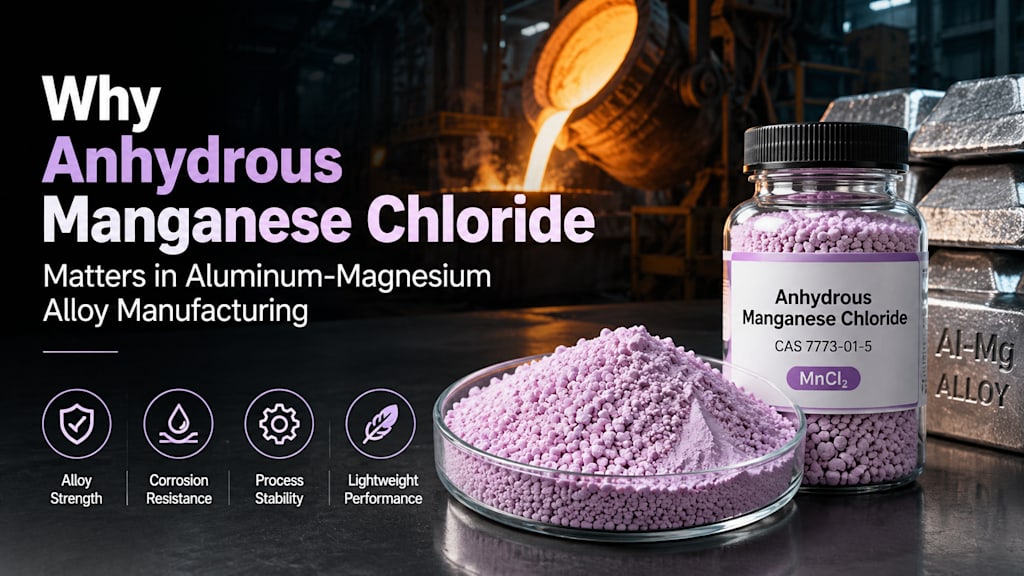
One example often discussed in technical material contexts is Manganous chloride Anhydrous.
Why Manganese Matters in Alloy Design
Manganese has been used in metallurgy for a long time.
In different alloy systems, it can influence strength, corrosion behavior, grain structure, and material stability. Its exact role depends on the alloy formula, temperature, and processing method.
For aluminum-magnesium alloys, manganese-related chemistry is often connected with better control of composition and repeatability. That may sound like a small detail, but in manufacturing, repeatability is everything.
A material does not only need to work once. It needs to work again and again across many production batches.
This is why alloy manufacturing is so sensitive to small changes. A tiny difference in chemistry can affect melting behavior, uniformity, forming performance, or the way a finished component behaves under stress.
In simple terms, strong lightweight metals depend on more than the main metals. They also depend on the smaller chemistry behind the process.
Why the Anhydrous Form Is Important
The word “anhydrous” means without water.
This matters because some chemical materials can exist in both hydrated and anhydrous forms. A hydrated material contains water in its structure. An anhydrous material does not.
In high-temperature or moisture-sensitive industrial environments, water content can affect handling and processing behavior. This is why anhydrous materials are often discussed in applications where process control matters.
Anhydrous manganese chloride is also known for its sensitivity to moisture. It can absorb water from the air if not handled properly. That makes it a useful example of how real-world material behavior is not only about chemical identity.
Storage, handling, and environment can all influence how a material performs before it ever reaches the production stage.
The Hidden Side of Lightweight Manufacturing
Most people only see the finished product.
They see a lighter vehicle part, a thinner device shell, or a more efficient machine component. They do not see the chemistry behind the alloy.
But manufacturers know that lightweighting is not just about removing weight. A lighter material still needs to resist wear, stress, corrosion, and daily use. If weight is reduced but performance becomes unstable, the material is not useful.
That is why aluminum-magnesium alloys require careful material control.
Every part of the process matters: composition, temperature, cooling, additives, impurities, and moisture-sensitive inputs. The final result is shaped by all of these details together.
This is also why companies working with fine chemicals and advanced materials, such as Foconsci Chemical, are connected to a much larger industrial story. Their role is not always visible to end users, but specialty chemical materials often support the systems behind modern manufacturing.
Final Thoughts
Aluminum-magnesium alloys are important because industries want lighter and more efficient materials.
But these alloys are not created by the main metals alone. They depend on careful chemistry, stable processing, and small technical inputs that help manufacturers control the final result.
Anhydrous manganese chloride is one example of a material that sits quietly inside this larger story. It is not famous to the public. It is not something most consumers will ever hear about. But in technical manufacturing, small materials can still matter.
The bigger lesson is simple.
Modern materials are often shaped by hidden chemistry. The strongest progress is not always visible on the surface.
About the Creator
Enjoyed the story? Support the Creator.
Subscribe for free to receive all their stories in your feed.
Comments
There are no comments for this story
Be the first to respond and start the conversation.