
Why 4-Acetoxystyrene Matters in Photoresist Resins and Functional Polymer Chemistry
A simple look at how 4-acetoxystyrene supports advanced photoresist materials, functional polymers, and precision chemical manufacturing.

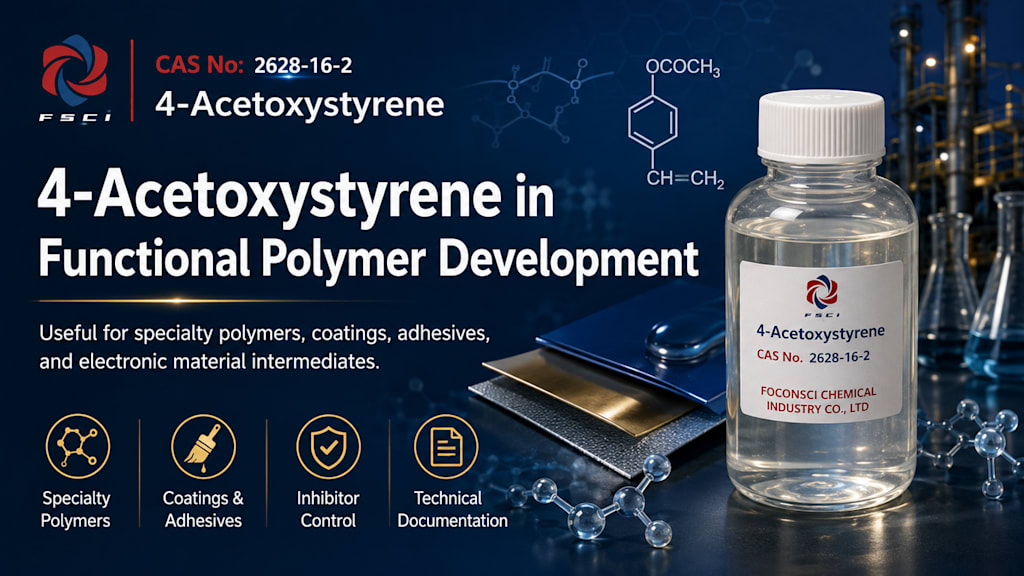
In advanced materials, some chemical intermediates are important because they connect basic organic chemistry with high-value industrial applications. 4-Acetoxystyrene is one of those materials.
Also known as 4-vinylphenyl acetate or 4-ethenylphenyl acetate, 4-Acetoxystyrene is a styrene derivative used in polymer synthesis, electronic materials, photoresist resin chemistry, and specialty chemical development. While it may not be widely known outside the chemical industry, it plays a meaningful role in areas where polymer structure, purity, and controlled reactivity matter.
For buyers working in electronic chemicals, semiconductor materials, coatings, adhesives, or functional polymer research, 4-Acetoxystyrene is not simply a general organic intermediate. It is a monomer and building block that can support the production of more specialized polymer systems.
A Styrene Derivative With High-Value Applications
Styrene derivatives are widely used in polymer chemistry because the vinyl group allows polymerization, while the aromatic ring can be modified to introduce specific properties. In the case of 4-Acetoxystyrene, the acetoxy group acts as a protected phenolic functionality.
This structure makes the material especially useful as a precursor to poly(4-hydroxystyrene), often abbreviated as PHS. PHS and related copolymers are important in photoresist resin systems because they provide useful film-forming properties and chemical behavior for lithography-related applications.
In simple terms, 4-Acetoxystyrene gives polymer chemists a way to create protected phenolic polymers that can later be transformed or modified for specific functions.
Why It Is Relevant to Photoresist Materials
One of the most important application areas for 4-Acetoxystyrene is photoresist resin chemistry. In semiconductor manufacturing, photoresists are light-sensitive materials used to transfer fine circuit patterns onto wafers. The resin component of a photoresist helps form the film, control solubility, and support pattern generation during exposure and development.
Poly(4-hydroxystyrene)-based resins have long been associated with deep ultraviolet photoresist systems, especially 248 nm lithography. 4-Acetoxystyrene can be used as a protected monomer route toward these phenolic polymer structures.
This does not mean every batch of 4-Acetoxystyrene is automatically suitable for semiconductor-grade use. Photoresist-related applications usually require strict control over purity, water content, metal ions, inhibitor level, color, clarity, and batch consistency. Even trace impurities can matter when materials are used in high-precision electronic manufacturing.
That is why buyers in this field often evaluate 4-Acetoxystyrene with more technical discipline than they would use for ordinary industrial chemicals.
Applications Beyond Photoresists
Although photoresist chemistry is one of the most valuable directions, 4-Acetoxystyrene is also relevant to broader functional polymer development.
In adhesives, phenolic styrene-based polymers and copolymers can help improve heat resistance, adhesion, and compatibility with surfaces such as glass or mineral fillers. In coatings and surface treatment, related polymer systems may contribute to improved durability, bonding, and functional surface behavior.
4-Acetoxystyrene can also be used in the preparation of specialty polymers, crosslinked systems, ion exchange resins, and electronic material intermediates. These applications are usually specification-driven, meaning the buyer is not just looking for the product name. They are looking for a material that behaves predictably in polymerization and downstream processing.
Why Purity and Inhibitor Control Matter
For monomers such as 4-Acetoxystyrene, purity is only one part of quality control. Storage stability and polymerization control are also important.
Because the molecule contains a vinyl group, it can polymerize under certain conditions. To reduce unwanted polymerization during storage and shipping, inhibitors such as MEHQ are commonly used. The inhibitor level needs to be controlled carefully. Too little inhibitor may increase storage risk, while too much may affect downstream polymerization behavior.
Water content is another key parameter. In moisture-sensitive applications, excess water can influence polymerization, clarity, impurity behavior, or process consistency.
Metal impurities may also matter, especially in electronic material applications. Semiconductor-related materials often require very low metal ion levels because metals can affect device performance and process cleanliness.
For these reasons, buyers should review the complete specification instead of focusing only on assay percentage.
What Buyers Should Check Before Sourcing
Before sourcing 4-Acetoxystyrene, buyers should confirm several technical points.
First, confirm the identity of the material. 4-Acetoxystyrene may also be listed as 4-vinylphenyl acetate, 4-ethenylphenyl acetate, or p-acetoxystyrene. The CAS number 2628-16-2 helps avoid confusion during procurement.
Second, check the purity method. GC, HPLC, or other analytical methods may be used depending on the supplier and application. Buyers should confirm whether the assay method matches their quality requirements.
Third, review inhibitor level. For monomers, inhibitor control is not a minor detail. It directly affects storage stability and polymerization planning.
Fourth, check water content and turbidity. These parameters can influence appearance, handling, and suitability for sensitive polymer applications.
Fifth, evaluate metal impurity limits if the material is intended for electronic or photoresist-related use. Low metal content can be important for advanced material manufacturing.
Sixth, ask for documentation. COA, MSDS, TDS, packaging information, and batch data can help technical teams evaluate the material more efficiently.
Why Supplier Selection Matters
For specialty intermediates used in high-value polymer and electronic material applications, supplier selection is not only about availability. Buyers need technical communication, batch consistency, packaging control, and reliable documentation.
A supplier that understands fine chemicals and application-specific requirements can reduce risk during sample testing, qualification, and scale-up.
This is where Foconsci Chemical can be relevant to global buyers looking for fine chemicals, organic intermediates, additives, and specialty raw materials. The company lists products across multiple industrial chemical categories, which can help buyers source related materials within one supplier network.
For procurement teams searching by exact chemical identity, 4-Acetoxystyrene CAS 2628-16-2 provides a clear reference point for reviewing product information, specifications, and documentation before making a sourcing decision.
The Bigger Trend Behind 4-Acetoxystyrene Demand
The interest in 4-Acetoxystyrene reflects a broader shift in the chemical industry. Modern manufacturing increasingly depends on highly specific intermediates rather than broad commodity chemicals.
Semiconductor materials, advanced coatings, electronic polymers, high-performance adhesives, and specialty resins all require raw materials with controlled identity, high purity, and predictable behavior. In these fields, even a small intermediate can influence the performance of a much larger system.
For buyers, the most important step is to match the grade to the application. A material suitable for general polymer research may not be suitable for semiconductor-grade photoresist development. A supplier’s ability to provide specifications, impurity data, and stable packaging can be just as important as the chemical itself.
4-Acetoxystyrene may be a niche monomer, but in photoresist resin chemistry and functional polymer development, niche monomers often carry significant industrial value. As manufacturing becomes more precise, materials like this will continue to support the background chemistry behind advanced technologies.
About the Creator
Enjoyed the story? Support the Creator.
Subscribe for free to receive all their stories in your feed.
Comments
There are no comments for this story
Be the first to respond and start the conversation.