
What Is Content Clipping? The Smarter Way to Repurpose Long-Form Content
Long-form videos, podcasts, and webinars often hold more value than one upload can deliver. Content clipping helps those ideas travel further.

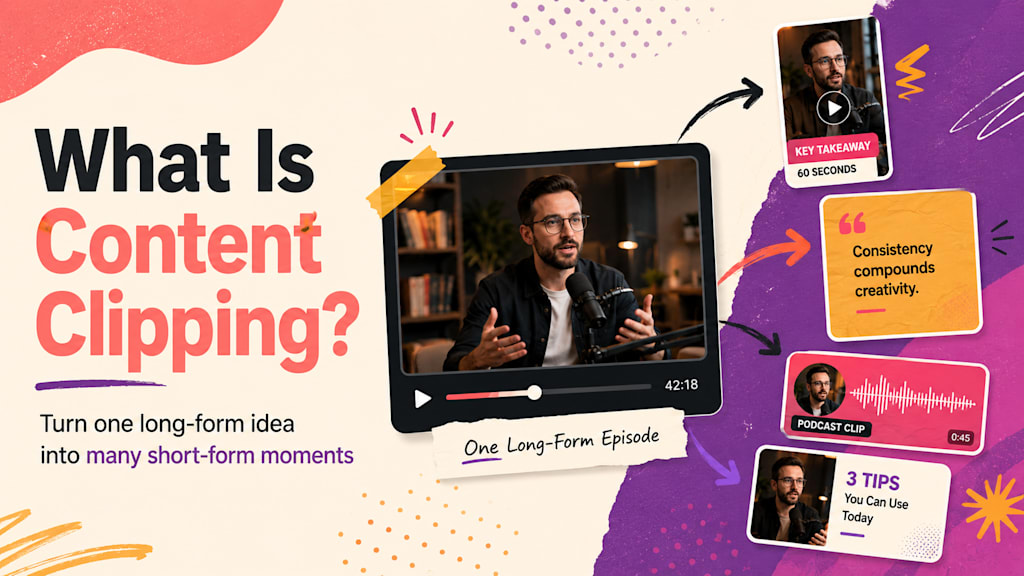
A good long-form video is rarely valuable for only one reason. A podcast might have a strong guest story, a useful framework, a sharp opinion, and a practical answer to a question people keep asking. A webinar might include a few standout explanations that are far more useful than the replay title suggests. A founder interview might have one short moment that explains the brand’s point of view better than a full campaign brief.
The problem is that those moments often stay trapped inside the full recording.
People are busy. They scroll quickly. They may not have time to watch a full webinar or sit through a 50-minute podcast from a brand they barely know. That does not mean the content has no value. It means the best parts need to be packaged in a way that people can notice, understand, and share faster.
That is where content clipping comes in.
Content clipping takes the strongest moments from long-form content and turns them into shorter clips for platforms like LinkedIn, Instagram Reels, TikTok, YouTube Shorts, Facebook, X, newsletters, landing pages, and other digital channels. It helps long-form content travel beyond the original upload.
What is content clipping?
Content clipping is the process of taking longer video or audio content and turning it into short, focused clips. The original content could be a podcast episode, webinar, founder interview, livestream, YouTube video, product demo, event recording, panel discussion, training session, or customer education video.
The basic idea is simple. A long recording is reviewed, the strongest sections are selected, and those sections are edited into shorter clips.
But useful clipping is not just cutting a video into smaller pieces.
A good clip should feel complete. It should make sense to someone who has not watched the original recording. It needs a clear opening, one focused idea, enough context, clean pacing, readable captions, and a takeaway the viewer can understand quickly.
For anyone asking What is Content Clipping, the practical answer is this: content clipping turns long-form content into short-form clips so the best ideas can reach more people.
The real value is not simply creating more content. The real value is getting better distribution from content that already exists.
Why content clipping matters
Long-form content takes effort. A podcast needs planning, recording, editing, publishing, and promotion. A webinar may need slides, speakers, reminders, landing pages, and follow-up emails. A YouTube video may require scripting, filming, editing, thumbnails, descriptions, and scheduling.
After all that work, using the content once is a poor return.
One long-form asset can usually create several smaller assets. A podcast can produce short clips, quote posts, newsletter ideas, and social captions. A webinar can become educational clips. A founder interview can become a week of short-form posts. A product demo can become quick videos that answer buyer questions.
Content clipping helps pull those useful moments out and give them more life.
This matters because people often discover content in small moments. They may not be ready to commit to a long recording, but they may watch a 30-second clip that explains one clear idea.
That clip can become the first step toward the full resource, the website, the brand, or the service behind it.
Long-form content still has a role
Short-form clips are not meant to replace long-form content. They are meant to support it.
Long-form content gives depth. It gives a brand room to explain, teach, tell stories, answer objections, and build trust. A full podcast, webinar, or video lets the audience understand the bigger picture.
Short-form clips help more people discover that bigger picture.
A full webinar may explain an entire process. A clip can highlight one useful step. A founder interview may build trust over 45 minutes. A short clip can introduce that founder’s point of view in less than a minute. A podcast may explore a subject in detail. A clip can pull out the sharpest answer and make it easier to share.
The full asset builds trust. The clip opens the door.
That is why content clipping works best when it is treated as part of a wider content system, not just a quick editing task.
What types of content can be clipped?
Content clipping works best when the original material has useful ideas inside it. The recording does not need to be perfect, but it does need substance.
Good source material includes:
- Podcast episodes
- Webinars
- Founder interviews
- YouTube videos
- Livestreams
- Product demos
- Event recordings
- Panel discussions
- Customer education videos
- Online courses
- Training sessions
- Q&A sessions
Some of the strongest clips come from natural conversations. A guest shares a hard lesson. A founder explains a customer problem. An expert answers a direct question. A speaker gives a simple framework. These moments often work because they feel clear, specific, and useful.
The best source content usually includes:
- Clear explanations
- Strong opinions
- Real examples
- Useful stories
- Practical advice
- Customer questions
- Founder insights
- Industry mistakes
- Simple frameworks
- Direct answers
Editing can improve presentation, but it cannot create a strong idea from weak source material. The better the original content, the better the clips.
What makes a good content clip?
A good content clip is not just a short video. It is a small piece of content with a clear purpose.
This is where weak clipping usually fails. A section gets pulled from the middle of a longer conversation because it sounded useful to the team. But a new viewer does not have the same context. The clip may look polished, but if it starts too late or takes too long to make sense, people will move on.
A strong clip usually has:
- A clear first line
- One focused idea
- Enough context to stand alone
- Natural pacing
- Captions that are easy to read
- A useful takeaway
- A format suited to the platform
- A reason for the viewer to keep watching
The first few seconds matter. A clip that starts with vague context usually loses people before the real idea appears.
A weak opening might sound like this:
“Yeah, exactly, that’s what we were saying earlier.”
That line may work inside the full recording, but it gives a new viewer nothing useful.
A stronger opening might be:
“The best part of a long video is often the small idea hidden inside it.”
That gives the viewer context immediately. It also makes the clip feel intentional.
Content clipping is not basic video editing
Video editing and content clipping are related, but they are not the same thing.
Basic editing focuses on the technical work. Cut the footage. Add captions. Improve audio. Adjust pacing. Export the file. That work matters, but clipping also needs judgment.
Someone has to decide which moments deserve to become clips. Someone has to know where the clip should begin. Someone has to remove unnecessary context without damaging the meaning. Someone has to understand whether the clip fits LinkedIn, TikTok, YouTube Shorts, Instagram Reels, or another platform.
That judgment is what separates useful clipping from random cutting.
A polished clip can still fail if the idea is weak. A simple clip can work well if the message is clear and useful.
Good content clipping asks questions like:
- Does this moment make sense on its own?
- Is the opening clear enough?
- Is there one main idea?
- Does the clip move quickly?
- Is the takeaway useful?
- Which platform does this fit best?
- What should the viewer understand after watching?
These questions make the clip more strategic.
How content clipping helps distribution
Distribution is where a lot of long-form content loses momentum. The main asset gets published, a few posts go out, and then the content is left behind.
Content clipping keeps that asset moving.
One podcast episode can become several social posts. One webinar can become a short-form content series. One founder interview can become clips for LinkedIn, Reels, Shorts, TikTok, and email. One product demo can become quick answers to common buyer questions.
This gives the original content more life.
It also helps brands stay consistent without creating something new every day. Instead of always asking what to publish next, a brand can look at existing long-form content and pull out the strongest ideas.
Content clipping can support:
- Social media visibility
- Podcast promotion
- Webinar promotion
- Founder-led content
- YouTube Shorts
- Instagram Reels
- TikTok clips
- LinkedIn thought leadership
- Audience education
- Service page support
The goal is not to publish clips everywhere just to look active. The goal is to choose useful moments and share them where the right audience is likely to notice them.
Content clipping and search discovery
Content clipping is usually treated as a social media tactic, but it can also support wider discovery.
People search for answers in many places now. They use Google, YouTube, TikTok, LinkedIn, Reddit, Instagram, and AI-assisted search tools. Some want a full guide. Some want a quick explanation. Some want a video example. Some want a practical opinion from someone who understands the topic.
That means one format is rarely enough.
A written guide can explain the full topic. A long-form video can build trust. A short clip can introduce the idea quickly. Together, these formats create more ways for people to find and understand a brand.
For example, a website page explaining content clipping can support search visibility. Short clips can answer related questions across social platforms and guide people toward the deeper resource. A full podcast or webinar can provide extra detail for people who want more context.
The formats work better when they support each other.
Common content clipping mistakes
One common mistake is choosing clips that only make sense to the people who created the content. The team understands the full conversation, but a new viewer does not. A clip has to work for someone seeing it cold.
Another mistake is chasing volume. More clips do not automatically mean better results. A large batch of weak clips can create more noise. A smaller batch of useful clips can do more if each one has a clear purpose.
Brands also make the mistake of posting every clip the same way on every platform. LinkedIn may need a more thoughtful caption. TikTok may need a faster opening. YouTube Shorts may need a clearer title. Instagram Reels may need a stronger first frame.
Other common mistakes include:
- Starting clips too slowly
- Using captions that are hard to read
- Choosing clips with no clear takeaway
- Posting inconsistently
- Measuring only views
- Ignoring saves, shares, comments, and watch time
- Making every clip too promotional
- Not connecting clips to a wider content plan
Most of these issues can be fixed with better selection, clearer goals, and a repeatable workflow.
A simple content clipping workflow
A content clipping workflow does not need to be complicated. It just needs to be easy to repeat.
A practical workflow can look like this:
- Choose one strong long-form asset
- Review it for useful moments
- Select clips based on audience and goal
- Cut each clip around one clear idea
- Remove unnecessary context
- Add readable captions
- Format the clip for the platform
- Write a relevant caption or title
- Publish consistently
- Track performance
- Use the results to improve future clips
The point is not to clip every possible moment. The point is to clip the right moments.
Over time, the process becomes easier. The brand starts to learn which topics hold attention, which openings work best, and which platforms create the strongest response.
Final thoughts
Content clipping is a simple idea with a lot of practical value. It takes long-form content and turns the best parts into short clips that are easier to watch, share, and discover.
The benefit is not more content for the sake of it. The benefit is better distribution.
A useful idea should not stay buried inside a long recording that only a small audience sees. Content clipping gives that idea more chances to travel.
For brands, creators, and businesses that already create long-form content, clipping can improve visibility, support social growth, and help strong ideas reach more people without starting from zero every day.
About the Creator
Clipping Agency
Clipping Agency drives creator growth through clipping services, clipping campaigns, and clipping marketing, turning long-form content into short-form momentum at scale.
Enjoyed the story? Support the Creator.
Subscribe for free to receive all their stories in your feed.
Comments
There are no comments for this story
Be the first to respond and start the conversation.