
What Brands Really Buy With Clips and Paid Ads
A practical look at how clipping campaigns and paid media create attention, build trust, use budgets, and support growth over time.

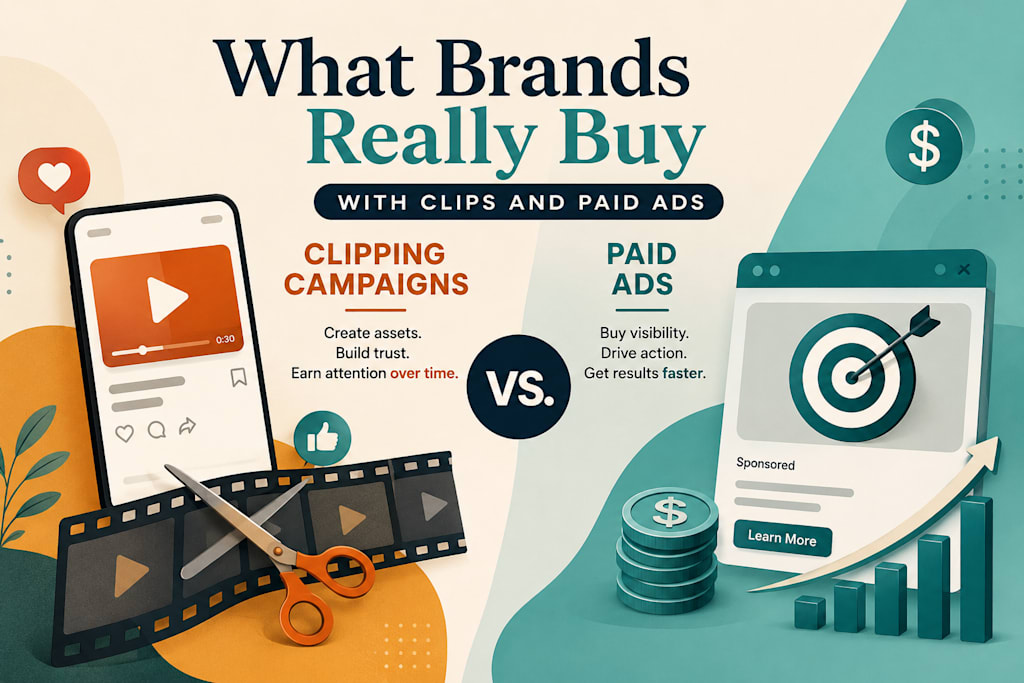
Marketing teams often describe growth in terms of channels, but channels are only part of the picture. The more important question is what the business is actually paying to create.
Paid advertising purchases delivery. A company gives the platform a budget, selects an audience, prepares a message, and pays to have that message shown.
A clipping campaign purchases a different kind of outcome. It turns long-form content into a collection of short-form assets that can be distributed repeatedly across social platforms, newsletters, websites, sales materials, and other channels.
Both methods can increase visibility. Both can support revenue. Both can also become expensive when they are used without a clear purpose.
The difference becomes easier to understand when each approach is viewed as an investment in attention.
Paid ads usually buy access to attention now.
Clipping campaigns create more opportunities to earn attention later.
That distinction affects how quickly results appear, how much control the brand has, what remains after the campaign ends, and how the audience experiences the message.
Attention is not a single marketing outcome
A view, impression, click, save, comment, profile visit, and purchase are not the same thing.
A paid campaign may generate thousands of impressions without producing meaningful action. A short clip may receive fewer views but attract the exact people the brand wants to reach. A founder video may lead to profile visits and direct enquiries even when the public engagement numbers appear modest.
This is why comparing channels through one metric can create bad decisions.
The brand needs to know which type of attention matters.
For example:
- A product launch may need immediate traffic.
- A professional service may need trust.
- A creator may need followers and repeat viewers.
- A podcast may need more discovery.
- A local business may need targeted leads.
- A founder may need authority in a specific market.
- An event may need registrations before a deadline.
Paid ads and clipping campaigns can support these goals differently.
The right question is not simply which method creates more reach. The better question is whether the attention created is useful for the next stage of the customer journey.
The economics of attention are different
The discussion around Clipping Campaigns vs Paid Ads becomes more practical when the business looks at what it is paying for.
With paid media, the brand pays for distribution.
The campaign may involve creative production, landing pages, management, tracking, and testing, but the defining expense is the media budget. The advertiser pays the platform to deliver impressions, clicks, leads, or conversions.
With a clipping campaign, the brand pays to extract and package more value from content it already owns.
The work may include:
- Reviewing long-form recordings
- Identifying useful moments
- Editing short-form videos
- Improving hooks
- Adding captions
- Formatting clips for different platforms
- Writing supporting copy
- Publishing
- Managing accounts
- Reviewing performance
The brand is not paying directly for every organic impression. It is paying for the system that creates and distributes the assets.
This difference affects the life of the investment.
Paid media can deliver results quickly, but the delivery usually slows when the budget stops.
A clipping campaign may take longer to gain momentum, but the finished clips remain available for future use.
A clipping campaign creates a content inventory
Long-form content often contains more usable material than the original upload reveals.
A one-hour podcast may include several complete ideas. A webinar may contain explanations, objections, examples, and questions that can each support separate content. A founder interview may reveal stories, lessons, and opinions that deserve their own distribution.
A clipping campaign turns those moments into an inventory.
The source material may include:
- A direct answer to a familiar question
- A strong point of view
- A practical framework
- A customer story
- A mistake and the lesson that followed
- A useful industry observation
- A clear explanation
- A surprising result
- A memorable quote
- A discussion-worthy claim
These moments are not automatically ready to publish.
The original speaker may rely on earlier context. The section may begin slowly. The ending may feel incomplete. The wording may be too broad for a short clip.
A strong clipping process reshapes the section so it works independently.
That may require a tighter opening, clearer captions, better pacing, a new context line, or supporting visuals.
The finished clip should feel like a complete asset, not a leftover fragment from a longer recording.
Paid ads create controlled distribution
Paid advertising solves a different problem.
The business may already have a strong product, service, landing page, and message. The challenge is reaching enough of the right people.
Paid media gives the brand greater control over delivery.
Depending on the platform, the advertiser may be able to choose:
- Location
- Age
- Interests
- Job title
- Industry
- Previous website activity
- Existing customer lists
- Video viewers
- Similar audiences
- People who completed specific actions
This precision can be extremely valuable.
A local company can focus on nearby customers. A professional service can target decision-makers. An ecommerce brand can retarget visitors who viewed a product. An event organiser can promote registrations before a fixed date.
The campaign can also be adjusted quickly.
Budgets can be increased. Weak creative can be replaced. Targeting can be refined. The campaign can be paused when the cost becomes too high.
The limitation is that the business continues paying for delivery.
The audience experiences each method differently
People recognise advertisements.
They may still respond positively, but the commercial intention is clear from the beginning. The message is asking for attention because the brand paid to appear.
A useful ad can still build trust through:
- Demonstrations
- Testimonials
- Customer results
- Strong proof
- Clear benefits
- Honest comparisons
- Useful education
- Relevant offers
However, the audience is evaluating the message within a commercial context.
Short-form clips often enter the feed as content rather than direct promotion.
A founder may explain why a common industry process fails. A podcast guest may share a useful framework. A creator may describe a mistake that changed their approach. A customer may explain a problem in their own words.
The viewer is introduced to the brand through an idea.
This can create a different kind of relationship.
A person may watch one clip, see another later, visit the profile, watch longer content, and eventually reach the website. The conversion path may be less direct, but the audience has more opportunities to understand the brand before acting.
Speed is valuable when the system is ready
Paid ads have an obvious advantage when results are needed quickly.
A campaign can begin generating traffic shortly after approval. This makes paid media useful for:
- Launches
- Limited-time offers
- Events
- Seasonal promotions
- Lead generation
- Retargeting
- Local services
- Product campaigns
- Trial signups
- Immediate booking needs
However, speed only helps when the rest of the system is ready.
The business still needs:
- A clear offer
- A relevant audience
- Persuasive creative
- A focused landing page
- Accurate tracking
- A realistic budget
- A strong call to action
- A method for follow-up
Paid media can move people quickly, but it cannot force an unclear offer to become appealing.
If the landing page is weak, more traffic will not solve the problem.
If the audience is wrong, better delivery will only waste the budget faster.
Clipping campaigns work through accumulation
Clipping campaigns rarely produce perfectly predictable results from the first post.
One clip may perform strongly. Another may receive limited attention. A subject that seemed important may underperform, while a personal story attracts unexpected interest.
This uncertainty is part of organic distribution.
The value develops through accumulation.
Each new clip gives the brand another opportunity to:
- Reach a new viewer
- Reinforce a topic
- Demonstrate expertise
- Build familiarity
- Grow the profile
- Generate comments
- Learn what the audience cares about
- Send people toward longer content
Over time, the brand builds a larger body of discoverable material.
One clip may introduce the founder. Another may explain the service. Another may answer an objection. Another may reveal personality.
The campaign creates more than isolated posts. It creates repeated exposure around the same brand and subject area.
A content library can support several channels
One of the biggest advantages of clipping is that the assets can be reused.
A strong clip may later appear in:
- A newsletter
- A landing page
- A blog article
- A sales presentation
- A customer education sequence
- A webinar promotion
- A founder profile
- A retargeting campaign
- A compilation video
- A future content series
A clip that performs moderately on social media may still be useful elsewhere.
This gives the business more ways to recover value from the original recording.
The source content is no longer a one-time publication. It becomes the foundation of a wider content system.
Organic performance can improve paid creative
The two methods become much more powerful when they are connected.
Organic clips can reveal which messages attract attention before the brand commits a large paid budget.
The business can publish several videos and compare:
- Watch time
- Completion rate
- Shares
- Saves
- Comments
- Profile visits
- Follower growth
- Link clicks
- Audience questions
- Repeated interest in one topic
The strongest performers can then be adapted into ads.
This reduces creative guesswork.
The brand already knows that the speaker, topic, opening, or story can hold attention organically.
A practical workflow may look like this:
- Record a useful long-form asset.
- Identify several strong moments.
- Turn those moments into short clips.
- Publish them organically.
- Measure attention and engagement.
- Select the best performers.
- Adapt them for paid campaigns.
- Target relevant audiences.
- Retarget people who engaged.
- Direct them to a clear offer or next step.
Clipping identifies the message.
Paid media expands the delivery.
Clipping campaigns are stronger in certain situations
A clipping campaign may make more sense when the brand:
- Already produces long-form content
- Wants stronger organic visibility
- Is building a founder or creator profile
- Has useful expertise to share
- Needs more short-form video
- Wants to build trust before selling
- Has a longer growth timeline
- Wants reusable content assets
- Is testing which topics resonate
- Can publish consistently
This approach often works well for podcast hosts, coaches, consultants, agencies, founders, educators, creators, and media companies.
Paid ads are stronger in other situations
Paid advertising may be the better option when the business:
- Needs traffic immediately
- Has a launch deadline
- Has a proven offer
- Knows the target audience
- Can track conversions accurately
- Has a strong landing page
- Has enough budget for testing
- Wants to retarget previous visitors
- Needs predictable delivery
- Understands customer acquisition costs
Paid media works best when the commercial path is already clear.
The business should know what happens after the click and how much that result is worth.
The main risk of clipping is low-quality volume
Clipping campaigns often lose effectiveness when the team is measured only by output.
This can lead to:
- Weak clips without context
- Repetitive openings
- Too many similar posts
- Generic captions
- Poor platform adaptation
- Unnecessary editing effects
- Incomplete ideas
- Excessive publishing
- Little performance review
- No connection to a wider strategy
A successful campaign does not need to use every available moment.
Selection matters more than volume.
Three useful clips can create more value than fifteen forgettable ones.
The main risk of paid ads is scaling weak foundations
Paid advertising can become expensive very quickly.
Common problems include:
- Promoting an untested offer
- Sending traffic to a weak page
- Targeting too broadly
- Using generic creative
- Measuring clicks rather than conversions
- Scaling too early
- Changing campaigns too quickly
- Ignoring creative fatigue
- Failing to retarget
- Using ads to compensate for unclear positioning
Media spend magnifies what already exists.
If the offer is strong, paid ads can accelerate growth.
If the offer is weak, paid ads accelerate waste.
A simple way to decide
The business can make the choice by answering a few practical questions.
Do we need results immediately?
Paid ads are usually stronger when time is limited.
Do we have valuable long-form content?
Clipping can unlock material that is already underused.
Does the audience need education before buying?
Clips can create repeated touchpoints before the offer appears.
Do we know exactly who we want to reach?
Paid media offers greater precision.
Do we want reusable assets?
Clipping creates a growing content library.
Can we measure conversions properly?
Reliable tracking is essential for paid campaigns.
Do we have enough budget for continued delivery?
Paid reach depends on ongoing spend.
Does the brand have a strong voice or personality?
Clipping can turn that into a long-term distribution advantage.
Final thoughts
Clipping campaigns and paid ads create different kinds of marketing value.
Paid advertising provides speed, control, targeting, and measurable delivery. It is strongest when the offer, audience, and conversion path are already clear.
Clipping campaigns turn existing content into more opportunities for discovery. They help brands build familiarity, create reusable assets, test ideas, and strengthen their presence over time.
The two methods do not need to compete for the same role.
A brand may use clipping to discover which messages earn attention. It may then use paid ads to place those messages in front of a larger and more precise audience.
The better strategy is not always the one with the lowest immediate cost or the fastest first result.
It is the one that creates the type of attention the business can actually use.
About the Creator
Clipping Agency
Clipping Agency drives creator growth through clipping services, clipping campaigns, and clipping marketing, turning long-form content into short-form momentum at scale.
Enjoyed the story? Support the Creator.
Subscribe for free to receive all their stories in your feed.
Comments
There are no comments for this story
Be the first to respond and start the conversation.