
Using AI to Clean & Enrich Retail Data: Techniques & Best Practices
Clean & enrich retail data using AI. Discover smart techniques to improve accuracy, fill gaps, and unlock powerful insights.

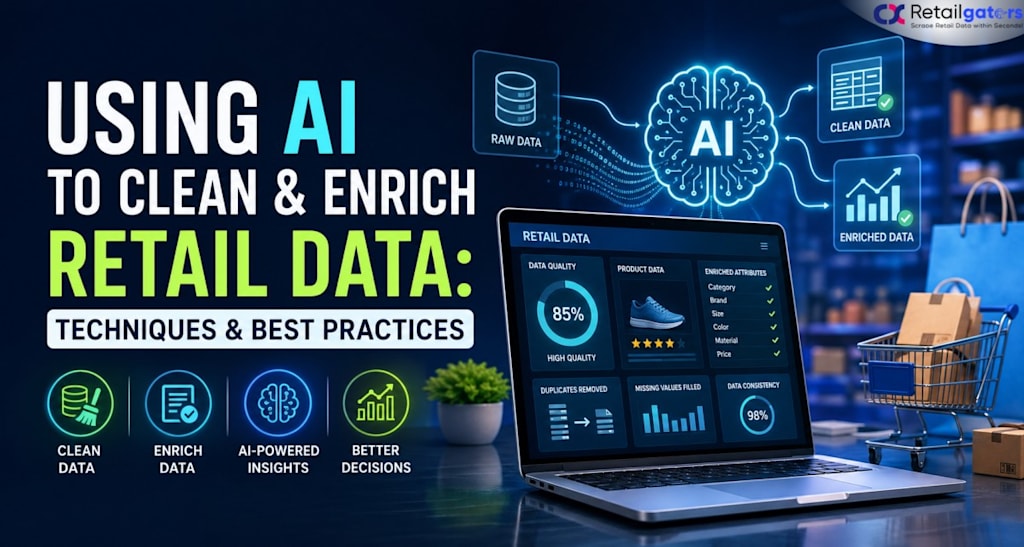
Walk into any modern retail business today, and one thing becomes clear very quickly—data is everywhere. From product listings and pricing updates to customer reviews and competitor insights, retailers are sitting on massive volumes of information.
But here’s the problem.
Most of that data is messy.
It’s incomplete, inconsistent, duplicated, and sometimes just plain wrong. And when businesses rely on poor-quality data, even the smartest strategies can fail.
This is where AI steps in—not just as a buzzword, but as a practical solution that’s quietly transforming how retail data is cleaned and enriched.
Let’s break down how it actually works—and more importantly, how you can use it effectively.
Why Retail Data Needs Cleaning in the First Place
Before diving into AI, it’s worth understanding the core issue.
Retail data comes from multiple sources:
- Marketplaces
- Supplier feeds
- Web scraping
- Customer interactions
- Internal systems
Each source follows different formats, naming conventions, and standards.
For example:
- One dataset might say “Nike Air Max 90,”
- Another might list “AirMax90 – Nike Shoes,”
- And a third might simply say “Running Shoes – Nike.”
Same product. Different representations.
Multiply that across thousands of SKUs, and suddenly your analytics becomes unreliable.
That’s not just inconvenient—it’s expensive.
What AI Actually Does in Data Cleaning
AI doesn’t just “clean data” in a generic sense. It applies intelligent techniques to identify patterns, detect inconsistencies, and fix them automatically.
Here are some of the most practical applications.
1. Duplicate Detection & Removal
Traditional methods rely on exact matches.
AI goes further.
It can identify near duplicates by understanding context. For instance:
- “Apple iPhone 14 Pro Max 256GB”
- “iPhone 14 Pro Max – 256 GB Apple”
AI recognizes these as the same product, even though they’re written differently.
This alone can dramatically improve product catalog accuracy.
2. Standardization of Product Data
AI models can normalize data into a consistent format.
That includes:
- Product names
- Categories
- Attributes (size, color, brand)
Instead of manually fixing inconsistent entries, AI ensures everything follows a unified structure.
This makes filtering, searching, and reporting far more reliable.
3. Filling Missing Data (Data Imputation)
Missing values are a common issue in retail datasets.
AI can predict and fill gaps using patterns from existing data.
For example:
- If a product is missing a category, AI can assign one based on similar items
- If attributes like color or material are missing, AI can infer them from descriptions
This transforms incomplete datasets into usable ones.
4. Error Detection
AI can flag anomalies that humans might miss.
For example:
- A product priced at $9,999 instead of $99
- A smartphone categorized under “Kitchen Appliances”
By identifying outliers, AI helps prevent costly mistakes before they impact customers.
Moving Beyond Cleaning: Data Enrichment
Cleaning is just the first step.
Once your data is reliable, AI can enhance it further—this is where the real value lies.
1. Product Attribute Enhancement
AI can extract additional details from product descriptions, images, or external sources.
For example:
- Extracting material, style, or use-case from text
- Identifying features like “waterproof” or “eco-friendly”
This creates richer product listings, improving both SEO and user experience.
2. Sentiment Analysis from Reviews
Customer reviews are a goldmine of insights—but only if you can process them at scale.
AI analyzes reviews to identify:
- Positive and negative sentiments
- Common complaints
- Product strengths
Retailers can then refine their offerings based on real customer feedback.
3. Competitive Data Enrichment
AI can combine internal data with competitor insights.
This allows businesses to:
- Benchmark pricing
- Track promotions
- Identify market gaps
Instead of reacting late, retailers can make proactive decisions.
4. Categorization & Tagging
AI can automatically assign categories and tags based on product data.
This improves:
- Search accuracy
- Navigation
- Recommendation systems
Ultimately, it helps customers find what they’re looking for faster.
Best Practices for Using AI in Retail Data
AI is powerful—but only when used correctly.
Here are some practical best practices to keep in mind.
Start with Clean Input Data
It may sound ironic, but AI performs better when the initial data isn’t completely chaotic.
Basic preprocessing—like removing obvious errors—can significantly improve results.
Use Hybrid Approaches
Don’t rely entirely on automation.
Combine AI with human validation, especially for:
- High-value products
- Critical pricing data
- New product categories
This ensures both speed and accuracy.
Continuously Train Your Models
Retail data evolves constantly.
New products, trends, and formats appear all the time.
AI models should be regularly updated to reflect these changes. Otherwise, their accuracy will decline over time.
Focus on Business Outcomes
Don’t implement AI just for the sake of it.
Ask yourself:
- Does this improve decision-making?
- Does it reduce operational costs?
- Does it enhance customer experience?
If the answer is no, it’s not worth the effort.
Ensure Data Compliance
When dealing with external data sources, always follow legal and ethical guidelines.
Respect data usage policies and avoid scraping restricted or sensitive information.
Real Impact: What Retailers Actually Gain
When done right, AI-driven data cleaning and enrichment can lead to measurable improvements:
- Better product discoverability
- More accurate pricing strategies
- Improved customer satisfaction
- Faster decision-making
- Reduced manual workload
In simple terms, it turns raw data into a competitive advantage.
Final Thoughts
Retail is no longer just about selling products—it’s about understanding data.
And in today’s fast-moving market, manual processes simply can’t keep up.
AI doesn’t replace human expertise, but it amplifies it.
By automating repetitive tasks and uncovering hidden insights, it allows teams to focus on what truly matters—strategy, growth, and customer experience.
If your retail data feels overwhelming right now, that’s not a sign of failure.
It’s an opportunity.
Because with the right AI techniques and best practices, even the messiest datasets can become your strongest asset.
About the Creator
Enjoyed the story? Support the Creator.
Subscribe for free to receive all their stories in your feed.
Comments
There are no comments for this story
Be the first to respond and start the conversation.