
The Rhetoric of Rebellion: Analyzing Thomas Paine’s Common Sense
An Argument for Independence

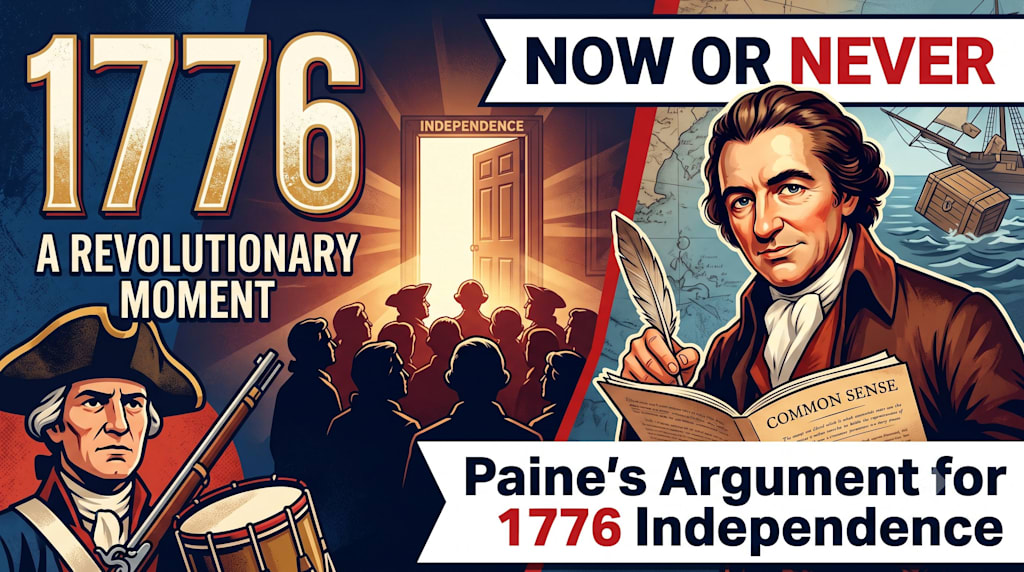
Before the first shot of the American Revolution was fired, a single, gripping pamphlet convinced a fractured nation that their survival depended on breaking the British bond immediately.
With events such as the Boston Massacre, Boston Tea Party, and the Intolerable Acts, the question of what was to come next was crossing many people’s minds in the mid to late 1770s. In early 1776, a recent immigrant named Thomas Paine wrote Common Sense. This text was printed and distributed all across the Thirteen Colonies. In it, Paine calls for the colonies of the New World to split from Britain to better their economy and way of life; there is no better time for independence than the present.
Common Sense is broken down into two parts, the first on America’s separation from Britain. Paine begins by laying out reasons for why the Thirteen Colonies should split. He begins by talking about economics. England’s main interest in America is the raw materials and the money flowing out of the country, not the gain of land itself. He makes a brilliant point by stating that if America is to separate, Britain would still conduct business with the New World since they have the best market. Paine compares this to the relationship between France and Spain, both independent countries freely trading with one another. Paine then states that independence will come inevitably. He pushes that the present is the best opportunity when he says, “Because the longer it is delayed, the harder it will be to accomplish.” Paine backs this statement up with a strong warrant. He states that the Colonials have a much better chance at fighting for independence in 1776 rather than in the future. This is because they are battle-hardened from the previous war. They have skilled leaders and veteran soldiers who are capable of putting up a fight. If the Colonies were to wait longer, that experience would die off.
Another reason why action needed to be taken soon was due to the state of the Thirteen Colonies. Paine describes it as a society that is barely hanging on. He describes there being a lack of law and government, as well as a lack of civil order. This would be the perfect time to break free and create an independent government. The current situation of America could tear the loose bond between the colonies apart. If they were to unite to become an independent nation, the colonies would become a strong group of states. Paine states that there is also a peaceful option to independence in which the Colonies reconcile with Britain. If America were to open trade back up with Britain, the understandable part of England would listen to the Colonies’ complaints, and this would work towards independence. Regardless of the approach to achieve independence for the Thirteen Colonies, the time to act would be soon and very swift. For if they wait too long, the opportunity may not be as attainable as before. Thomas Paine lays down multiple arguments with strong backing in order to convince the population of why independence for the Thirteen Colonies truly is common sense.
WORKS CITED
"Excerpt from ‘Common Sense’ (1776, by Thomas Paine)." Encyclopedia.com.(August 28, 2018). http://www.encyclopedia.com/history/dictionaries-thesauruses-pictures-and-press-releases/excerpt-common-sense-1776-thomas-paine, 1.
About the Creator
Sam Shroyer
I am an active-duty Engineer Officer in the US Army with a BS in Environmental Engineering from West Point. My previous positions include the following:
- Assistant Training Officer
- Sapper Platoon Leader
- Company Executive Officer
Enjoyed the story? Support the Creator.
Subscribe for free to receive all their stories in your feed.
Comments
There are no comments for this story
Be the first to respond and start the conversation.