
The Problem of Evil Explained: If God Is All-Powerful and Good, Why Does Suffering Exist?
From natural disasters and innocent suffering to Buddha’s silence on God, one of philosophy’s oldest questions continues to challenge believers and thinkers.

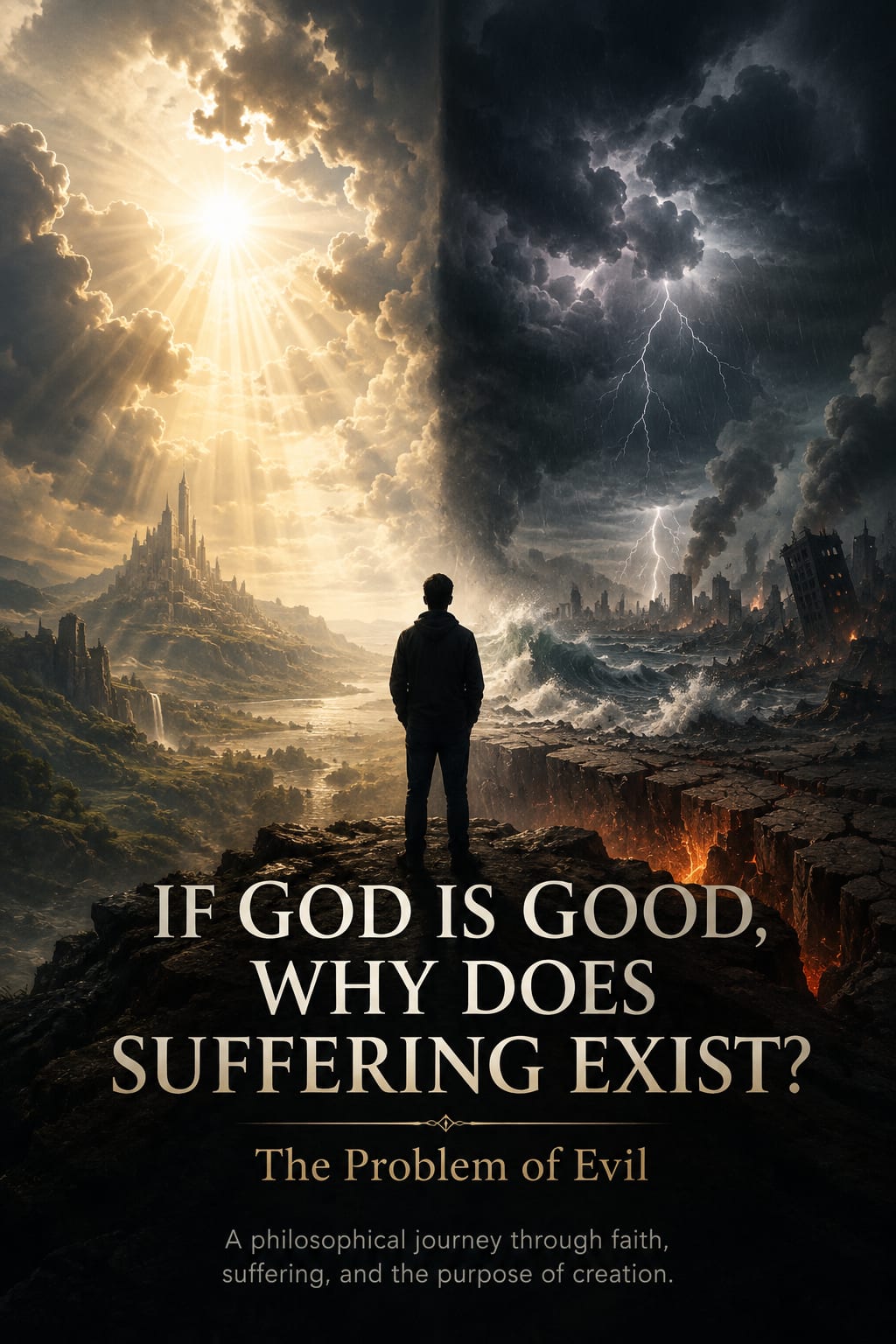
Earthquakes destroy cities. Tsunamis kill thousands without warning. Stampedes at religious gatherings take the lives of people who came only to pray. Children suffer despite having done nothing that could possibly justify their pain.
Whenever tragedies like these happen, an uncomfortable question often enters the human mind:
If God is all-powerful, loving, and good, why does God allow suffering?
This is not simply an emotional question. It is one of the oldest and most difficult debates in the philosophy of religion.
Philosophers commonly call it the Problem of Evil.
What Is the Problem of Evil?
The argument begins with three ideas.
First, God is believed to be omnipotent, meaning all-powerful.
Second, God is believed to be perfectly good, compassionate, and loving.
Third, suffering and evil clearly exist in the world.
This creates the philosophical tension.
If God has unlimited power, it seems God should be capable of preventing terrible suffering. If God is perfectly good, it seems God should want to prevent unnecessary suffering.
Yet suffering continues.
So philosophers ask:
How can an all-powerful and perfectly good God exist in a world containing apparently pointless suffering?
That question is the heart of the Problem of Evil.
Natural Disasters Make the Question Even Harder
Some suffering can be connected to human decisions.
Wars, murder, corruption, exploitation, and violence can often be blamed on human beings. A believer might argue that humans possess free will and sometimes misuse that freedom.
But what about an earthquake?
What about a tsunami?
What about a child killed by a natural disaster?
These events become especially challenging because they do not appear to result directly from someone's moral decision.
Philosophers sometimes distinguish between moral evil and natural evil.
Moral evil refers to suffering caused by human actions, while natural evil includes things such as earthquakes, diseases, floods, storms, and other disasters.
Natural evil therefore raises an especially difficult question: Why would a good God create or permit a world in which innocent people can suffer through forces completely outside their control?
Can Suffering Be Explained as Punishment?
Throughout history, people have sometimes interpreted disasters as divine punishment.
But this explanation creates another problem.
A disaster rarely affects only supposedly guilty people.
Earthquakes do not check a person's morality before destroying a building. Floods do not separate adults from children. A stampede does not distinguish between a virtuous person and someone who has done wrong.
Innocent people suffer alongside everyone else.
That makes it extremely difficult to explain large-scale disasters simply as punishment for human wrongdoing.
Instead of solving the Problem of Evil, such an explanation may create additional moral questions.
What Did Buddha Say About God?
Buddhist philosophy provides another interesting perspective.
The Buddha's teachings are generally focused much more heavily on suffering, desire, awareness, ethical conduct, and liberation than on proving the existence of a creator God.
For this reason, Buddhism is often described as a non-theistic tradition.
This is different from simply saying, “God definitely does not exist.”
An atheist rejects belief in God. A theist believes in God. A non-theistic philosophical system can operate without making belief in a creator God central to its teachings.
Instead of asking people to depend entirely on an external divine authority, Buddhist teachings emphasize personal understanding, experience, wisdom, and the path toward liberation from suffering.
This shift is important.
Rather than beginning with:
“Why did God create suffering?”
Buddhist philosophy often moves toward another question:
“Why do human beings suffer, and how can suffering be overcome?”
That creates a dramatically different philosophical approach.
Why Did God Create the Universe?
The Problem of Evil is not the only difficult question connected with the idea of God.
Another fascinating question is:
Why did God create the universe at all?
Traditional theology frequently describes God as a perfect being.
But think carefully about what perfection means.
Human beings have goals because something is missing.
We want money because we do not have enough. We want knowledge because there are things we do not know. We want recognition, relationships, security, success, or happiness because we feel that achieving those things will improve our present condition.
Desire appears to emerge from incompleteness.
But if God is already absolutely perfect and complete, what could God possibly need?
Nothing.
And if God needs nothing, why create anything?
Can a Perfect Being Have a Purpose?
Imagine a being possessing everything.
There is nothing it needs to obtain.
Nothing can increase its happiness.
Nothing can increase its power.
Nothing can make it more complete.
What goal would such a being need to pursue?
This creates what might be called the purpose of creation problem.
If God created the universe to achieve something, it could appear that something was previously absent.
But if something was absent, in what sense was God already completely perfect?
Religious and philosophical traditions have proposed many responses.
Some say creation is an expression of divine love.
Others suggest the universe exists so conscious beings can experience God.
Some traditions connect creation with karma.
Others describe creation as divine play or lila.
Another response is simply that the ultimate reason for creation lies beyond the limits of human understanding.
Each answer has inspired centuries of debate.
Does Free Will Solve the Problem of Evil?
One of the most famous responses to the Problem of Evil is the free will defense.
The basic idea is that genuine freedom requires humans to have the possibility of choosing both good and evil.
If God prevented every harmful decision before it occurred, human beings might no longer possess meaningful freedom.
This may help explain certain forms of moral evil.
A person can choose violence.
A leader can choose war.
Someone can choose cruelty.
But free will does not immediately explain earthquakes, childhood diseases, tsunamis, or other forms of natural suffering.
That is why the debate continues.
Could Suffering Have a Greater Purpose?
Another response argues that suffering can contribute to personal or spiritual development.
Without difficulty, perhaps courage could not exist.
Without danger, sacrifice might have no meaning.
Without suffering, compassion might never develop.
This idea is sometimes connected with what philosophers call soul-making: hardship can contribute to the development of character.
The argument is powerful in certain situations.
A difficult experience can genuinely make someone wiser or stronger.
But an obvious question remains.
What about suffering so extreme that it destroys a person rather than helping them grow?
And what about someone who dies before any supposed lesson can be learned?
Again, the philosophical problem survives.
Maybe Human Understanding Has Limits
There is another possibility.
Perhaps humans simply do not possess enough knowledge to understand why existence operates the way it does.
A child may not understand why a doctor performs a painful procedure, while the doctor understands the larger reason.
Could the gap between human understanding and divine understanding be even greater?
Possibly.
However, philosophers point out that saying “God has reasons we cannot understand” does not logically demonstrate what those reasons actually are.
It places the answer beyond human knowledge rather than completely solving the philosophical problem.
Why This Question Still Matters
The Problem of Evil has survived for centuries because there is no simple answer accepted by everyone.
Believers have developed sophisticated philosophical defenses of God.
Atheist philosophers have argued that apparently unnecessary suffering counts against traditional ideas of an all-powerful and perfectly good deity.
Buddhist traditions frequently approach suffering without making a creator God necessary to the solution.
Other philosophical traditions interpret existence in completely different ways.
Perhaps that is what makes the question so powerful.
It forces us to think not only about God, but also about morality, freedom, suffering, human knowledge, and the purpose of existence itself.
Final Thoughts
When we see innocent people suffering, asking “Why?” is one of the most natural human reactions.
Religion may offer faith.
Philosophy may offer arguments.
Buddhism may encourage us to examine suffering itself.
Science can explain how many natural disasters occur.
Yet the deeper question remains:
Why does a world capable of extraordinary beauty also contain extraordinary suffering?
And if a perfect creator exists, another mystery immediately follows:
Why was this world created in the first place?
These questions may not have one universally accepted answer.
But perhaps their value lies partly in forcing us to examine what we really mean when we speak about God, goodness, perfection, suffering, and existence.
The debate has continued for thousands of years—and it is unlikely to disappear anytime soon.
SEO tags
Problem of Evil, Philosophy, Does God Exist, Buddhism, God and Suffering, Philosophy of Religion, Purpose of Life, Purpose of Creation, Buddha, Religion
About the Creator
parwinder singh
🎬 Movie & Entertainment Writer sharing reviews, ending explanations, story breakdowns, plot twists and hidden details from Bollywood, Hollywood, South Indian cinema, Korean dramas and OTT releases.
Enjoyed the story? Support the Creator.
Subscribe for free to receive all their stories in your feed.
Comments
There are no comments for this story
Be the first to respond and start the conversation.