
The Draft Was Clean. It Was Also Dead.
How I stopped stacking writing rules and learned to fuse them into one motion.
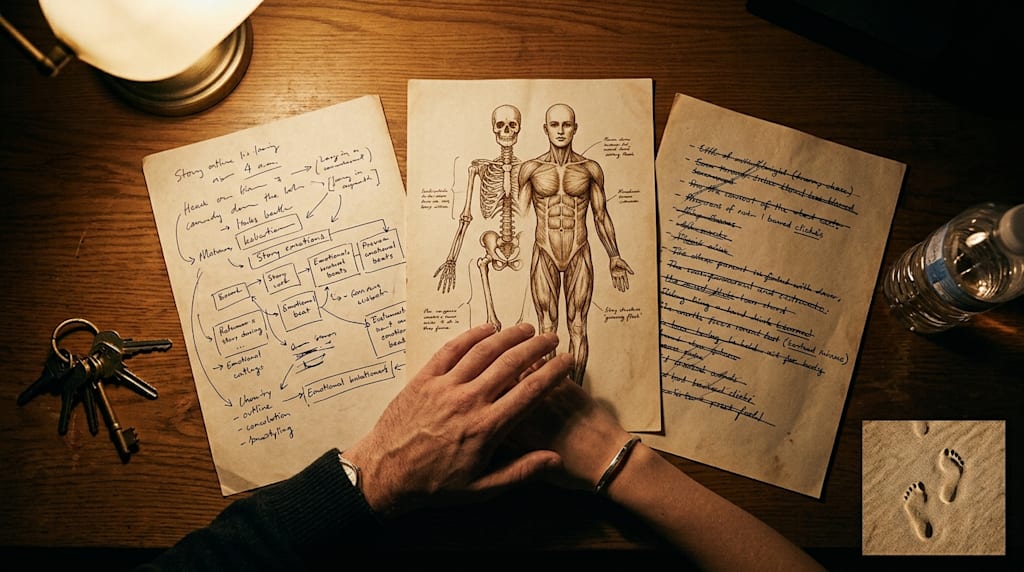
I had two sheets of paper in front of me.
One described what the story had to contain: childhood, betrayal, a goodbye that never happened. The other described what the language must never do: no “truly,” no “it’s worth noting,” no narrator stepping in to summarize a character’s feelings.
The first time I put them together, I thought I was doing addition. Write the emotional high point, then check the banned words. Fix the banned words, then check whether the structural anchor had landed. After two rounds, the piece was clean. It was also dead. It looked like a skeleton that had been wiped down again and again, but never grew flesh.
It took me a long time to understand where I had gone wrong.
Fusion is one motion. The first sheet defines what is being said. The second defines how it is said. They operate at the same time.
I got stuck at the forty-fifth minute. The structure required an emotional high point, a moment where two people almost say something but do not. The language checklist told me: no declarative narration, no internal monologue labels, no line that could be dropped into any other story.
“He felt” had to go. “She realized” had to go. “The air froze” had to go.
After deleting all of that, the space was empty.
I almost gave up. I was ready to force a direct line of dialogue through and let the constraint list take a step back. When I turned back to the fusion rules, I saw a sentence: If you cannot find one concrete scene that satisfies both, the translation step is not finished. Do not start writing.
Not “abandon one side.” Go back and find it again.
So I looked at the emotional high point again. What was the core emotion it had to carry? It was “wanting to speak but not daring to.”
Not a confession. Not a retreat. Two forces locked inside one person for a single second.
What I finally wrote was a hand. His right hand lifted, touched her wrist, stopped for half a second, and pulled back. Then he picked up his keys and asked if she wanted to go downstairs and buy a bottle of water.
No “he felt.” No “she realized.” No explanation of why the hand withdrew. Anyone reading it knows what happened.
That action satisfied both sheets at once. It stood exactly where the structure demanded it, and it used not one cliché.
The constraint list had not removed the emotion. It had forced the emotion to exist in another form.
Only after that did I understand the most important rule in the fusion framework: the main skill sets the position; the constraint skill sets the form.
The main skill says there must be an emotional high point here. The constraint skill says you may not express it with any of the usual writing moves. Neither can be abandoned. The main skill decides that the high point must appear here. The constraint skill decides that it cannot appear as a cliché.
Conflict is a signal. It tells you that you have not yet found the concrete action that fits both the structural position and the language standard.
If you find it, you do not need to compromise either side. If you do not find it, the translation is not done. Two skills are not fighting. The work is incomplete.
I used this method for the whole piece. Every emotional anchor began with one question: what emotion does this position need to carry? Then another: which of the allowed forms can carry it?
Warming comes from a glance held a second too long, with no explanation.
Fear stays unnamed. It comes from a phrase repeated to oneself, from a body reacting before the mind can catch up.
The dark moment comes from two people’s flaws colliding at the worst possible time. He has only ever known how to control fear. She has only ever known how to run from it. Neither is wrong, but both wound the other.
The ending settles on an image that returns to the beginning while everything has changed. Two pairs of footprints on the beach, and one of them has moved half a step forward.
I showed the first draft to a friend. She asked, “How many times did you rewrite it?”
I said, “Twice. The first draft was completely deleted.”
She asked why.
I said, “The first draft had a skeleton but no flesh. The second draft grew the skeleton out of flesh.”
That is the difference between fusion and stacking. Stacking builds the frame first, then pastes things onto it. Fusion lets the language grow the structure itself. Every concrete action, every line of dialogue that belongs only to these two people, carries narrative weight. They carry narrative weight. They are the skeleton, wearing clothes.
If you are writing something that must satisfy two demands at once, a platform standard and a personal style, a narrative framework and a language discipline, my only advice is this:
Do not wait until the end to check. Use both sheets from the beginning.
When structure tells you what to write, ask language how to write it. Answer both at the same time. Only then can you make something that is both rib and skin.
As for that deleted first draft, it was not wasted. It let me see the skeleton, and it let me see the gap between skeleton and flesh.
That gap is where the writing happens.
About the Creator
Jin
Writer of reamstories
https://reamstories.com/jin
Enjoyed the story? Support the Creator.
Subscribe for free to receive all their stories in your feed. You could also become a paid subscriber, letting them know you appreciate their work.
Comments
There are no comments for this story
Be the first to respond and start the conversation.