Advice
The Clockmaker's Secret
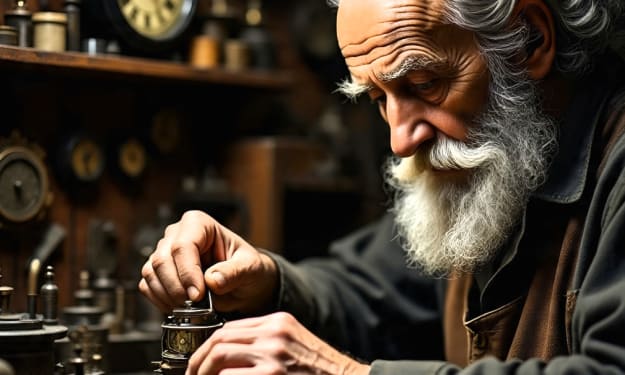
In the quiet village of Windmere, nestled between green hills and silver lakes, there lived an old clockmaker named Elias Greaves. His shop sat at the corner of the cobbled main street, filled with the soft ticking of countless timepieces, from tiny pocket watches to grand floor clocks that boomed on the hour.
By Hamdan Khanabout a year ago in Writers
The woman who wrote through silence . AI-Generated.
Do you see this woman? She was mocked, dismissed, humiliated, and cast aside… simply because she was born a woman. Her name was Grazia Deledda. Born in the rugged hills of Nuoro, Sardinia — a land where girls were taught to sew, not to dream. At just nine years old, she was pulled out of school. Education, they said, was unnecessary for a girl. But Grazia didn’t agree. She studied in secret — feeding her mind with borrowed books and filling her soul with unwritten stories. In the dusty hills of Nuoro, a small Sardinian village surrounded by stone paths and ancient traditions, a girl named Grazia was born — quiet, curious, and already too different for comfort From the moment she could hold a pencil, Grazia began scribbling onscraps of paper. Her world wasn’t made for dreamers, especially not female ones. Here, girls were taught to cook, clean, and marry — never to think too deeply or speak too loudly. Writing was for men. Dreams were for boys By age nine, Grazia’s formal education ended. Her parents pulled her from school, like most girls, believing that reading and writing were a waste of time for someone destined to be a wife. But Grazia disagreed — quietly. When her family thought she was sewing, she was reading. When they thought she was asleep, she was writing by candlelight. She borrowed books from anyone who’d lend them — dusty novels, forgotten poems, even newspapers — anything with words. Her first story was published in a magazine while she was still a teenager. She should’ve been proud. But in Nuoro, it was a scandal. “A girl? Writing in public?” the neighbors hissed. “She’ll bring shame,” the priest warned. Her family, once proud, grew distant Grazia walked through her village with whispers behind her and disapproval in front. Yet every evening, she returned home, picked up her pen, and kept writing. Because writing wasn’t a choice for Grazia — it was breath. Years passed. The rejections came fast, followed by letters from editors who told her to “write about more feminine things,” or worse, “stop altogether.” Still, she wrote. Her stories were not soft. They were rugged like the Sardinian mountains — full of strong women, flawed men, wild weather, and emotions too deep to name. Her writing was different because *she* was different. And that difference, at first mocked, became her power. In her late twenties, she married a man named Palmiro Madesani — a customs officer from the mainland. He was unlike the men of Nuoro. Where others dismissed her, he admired her. Where others tried to silence her, he urged her on. Together, they moved to Rome — a world away from her childhood home. There, Grazia finally had the space, support, and freedom to become who she truly was. She wrote tirelessly. Novels, short stories, essays. In every word, she poured her defiance, her dreams, her memories of a land that tried to cage her — and the fire inside that refused to be extinguished. Then, in 1926, the impossible happened. The Nobel Committee in Stockholm announced its newest laureate in literature *Grazia Deledda. The girl who was told she didn’t need an education. The woman who was mocked for picking up a pen. The soul who wrote through silence, shame, and solitude. Now, the world applauded. She stood on the Nobel stage in a modest dress, tears held back, pride not for herself — but for every girl who had been told “no.” At her side stood Palmiro, silent and proud. A man secure enough to let his wife shine. A partner who never feared her strength, but fueled it. The world had tried to write her story for her. She took the pen back. And rewrote everything. Even today, Grazia Deledda’s name doesn’t echo as loudly as others — not because her words were weaker, but because she was a woman in a world that wasn’t ready. But those who know her story — remember. They remember a girl who read in secret. A woman who wrote through rejection. A soul who turned silence into sentences that would live forever. And now, her story belongs not just to Sardinia, not just to Italy, but to every girl who’s ever been told she couldn’t. Because Grazia proved something powerful: *Being born a woman is not a weakness.* *It’s a different kind of strength. One that whispers first… then changes the world.*
By Muhammad sufyanabout a year ago in Writers
Stop Starving, Start Writing: 8 Real Ways to Actually Earn from Your Words
Let’s be brutally honest for a second. It guts me. Absolutely guts me. Seeing someone pour their soul onto the page, craft sentences that shimmer, tell stories that resonate, only to watch them wrestle with bills, stress over rent, or worse – give up altogether because "writing doesn’t pay." That phrase shouldn’t exist. It shouldn’t be a badge of honour or a resigned sigh. It should be a relic. I hate seeing writers not making money. It feels like watching a master painter use their finest brush to scrub floors for pennies. Your words have value. Serious value. And it’s high time that value translated into actual dollars in your bank account.
By John Arthorabout a year ago in Writers
"The Day I Lost Everything—and Found Myself"
There are days in life that leave an imprint on your soul. For me, that day came without warning. It started like any other—a cup of tea, a glance at my phone, a quick prayer for a peaceful day. I had no idea that by nightfall, my world would be flipped upside down. It was a Friday morning, and I remember feeling a strange heaviness in my chest. I brushed it off, blaming it on a poor night’s sleep. I reached the office a bit late, only to be called into a meeting with HR. Within minutes, I was told that my position had been terminated due to company downsizing. I sat in silence, my heart pounding, my mind racing. Just like that, my years of hard work vanished with a few cold, corporate words. As I walked out of the building, still trying to process what had happened, my phone buzzed. It was a message from someone I had loved deeply for two years. The message was short, almost cruel: "I can’t do this anymore. Please don’t contact me." No explanation, no closure. My heart sank deeper. First my job, now my relationship. I walked aimlessly, not sure where to go or what to do. The world around me felt distant, like I was walking through a fog. That evening, I sat alone on a park bench, tears silently rolling down my cheeks. People walked past, unaware of the storm inside me. I didn’t eat that night. I didn’t sleep either. My thoughts were a whirlwind of "Why me?" and "What now?" I felt completely lost. It felt like the universe had decided to wipe out everything I had built. But something strange happened the next morning. I woke up with puffy eyes and a headache, but also with a flicker of something I hadn’t felt in a long time: clarity. There was nothing left to hold on to. No job to report to. No messages to wait for. For the first time in years, I had nothing—and strangely, it was freeing. In the weeks that followed, I stopped trying to glue the broken pieces back together. Instead, I started over. I revisited the hobbies I had buried under work stress. I wrote, painted, and took long walks. I started freelancing—something I had always wanted to try but never dared. I read books on healing, on growth, on self-love. I learned to cook for one. I learned to enjoy my own company. I reconnected with old friends and opened my heart to new ones. Slowly, I started to rebuild—not the life I had before, but a new one rooted in authenticity. One of the most profound changes was my relationship with fear. Fear had always driven my decisions: fear of failure, fear of being alone, fear of disappointing others. But when I had nothing left to lose, I realized that fear had no power over me. I started saying yes to opportunities that scared me. I submitted my writing to online platforms, I joined local meetups, and I even took a solo trip—something I had always wanted to do but never dared. That solo trip changed everything. Sitting on a quiet beach, watching the sun dip below the horizon, I felt a peace I hadn’t known in years. I wasn’t running anymore. I wasn’t hiding behind work or relationships. I was simply existing—and it was enough. Looking back now, I realize that losing everything forced me to find myself. I was no longer the person constantly trying to prove her worth to a boss or a partner. I was enough, just as I was. I won’t lie and say it was easy. There were days I wanted to give up, moments when the silence felt too loud, and memories that still stung. But with each passing day, the pain turned into power. Now, I’m working on passion projects, surrounded by people who value me for who I am, not what I offer. I’m healthier, mentally and emotionally. And most of all, I’m grateful. Grateful for the day that broke me, because it also rebuilt me into someone stronger, wiser, and more alive than ever before. So if you’re reading this and going through your own version of "everything falling apart," let me tell you this: sometimes, when life takes everything away, it's actually giving you a clean slate. Use it. Rebuild. Become. The best chapters often begin with the most painful endings. And when it does get better—and I promise, it will—you’ll look back at your lowest moment not with anger or regret, but with gratitude. Because it led you here. To yourself.
By Victoria's writesabout a year ago in Writers
Real Success: How Data Cleansing Grew Business. Content Warning.
Data cleansing (or data cleaning) is an important process that significantly helps any business to grow by improving the quality, accuracy, usability and visibility of data. Nowadays businesses collect a lot of data which contains customer names, emails, phone numbers, purchase history, and more information. But most of the time it has been full of mistakes, outdated information, mismatched fields or duplicate entries.
By Maitri Maheshwari about a year ago in Writers
100 Tiny Joys: How Ordinary Moments Create an Extraordinary Life (No Grand Gestures Needed)
I was elbow-deep in dishwater, scrubbing burnt oatmeal off a pan I’d neglected again, when it hit me: Life wasn’t happening "out there." It wasn’t waiting for a promotion, a vacation, or some seismic shift. It was here. In the stubborn oatmeal. In the lukewarm soap suds. In the way the morning sun hit the bubbles, turning them into shimmering, temporary galaxies. I almost missed it – again – chasing the phantom of "extraordinary."
By Muhammad Sabeelabout a year ago in Writers