
Shopify vs WooCommerce Data Intelligence: Which Should You Use?
Compare Shopify vs WooCommerce data intelligence to choose the right platform for pricing, inventory, and analytics insights to grow your eCommerce business.

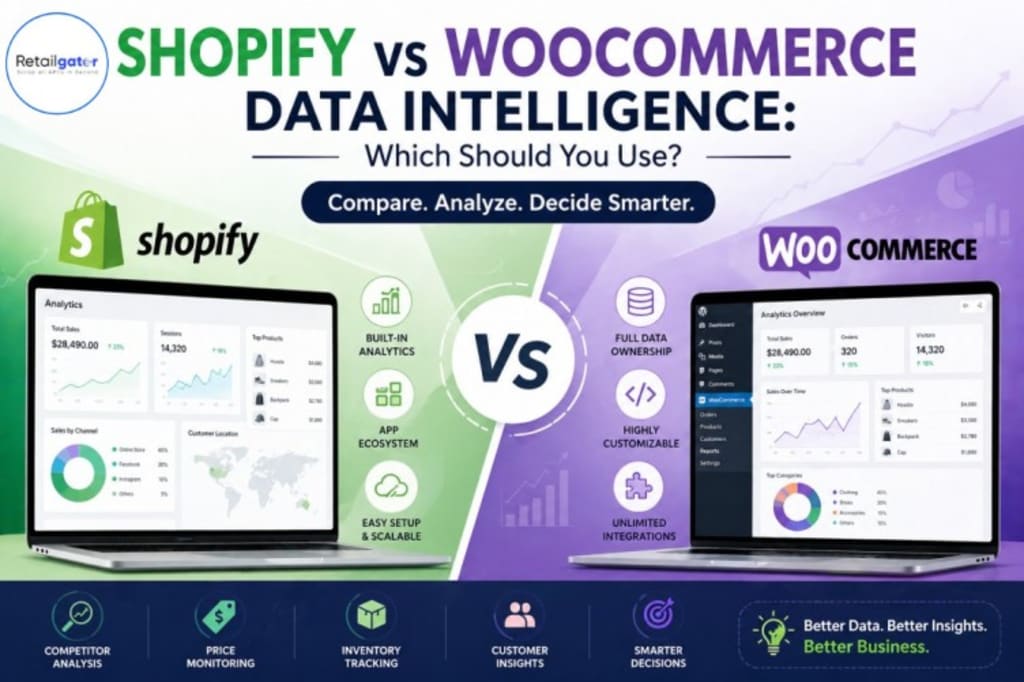
Running an eCommerce business today is not just about listing products and waiting for orders. It’s about understanding your data—what customers are buying, how competitors are pricing, and where your inventory stands at any given moment. This is where data intelligence becomes a game-changer.
If you’re choosing between Shopify and WooCommerce, you’re not just picking a platform—you’re choosing how effectively you can access, analyze, and act on your data. Let’s break this down in a practical, real-world way so you can decide what fits your business best.
What Does Data Intelligence Mean in eCommerce?
Before comparing platforms, it’s important to understand what data intelligence really involves.
In simple terms, data intelligence is the ability to collect, process, and use data to make smarter business decisions. For eCommerce, this includes:
- Tracking product pricing and competitor trends
- Monitoring inventory levels in real time
- Understanding customer behavior and buying patterns
- Identifying high-performing and underperforming products
Both Shopify and WooCommerce offer ways to access this data—but how they do it is very different.
Shopify Data Intelligence: Structured and Scalable
Shopify is known for its simplicity and reliability. But when it comes to data intelligence, its real strength lies in its structured ecosystem.
Built-In Analytics That Just Work
Shopify comes with native analytics dashboards that are easy to understand. Even if you’re not a technical expert, you can quickly access:
- Sales reports
- Customer insights
- Conversion metrics
- Product performance
Everything is presented in a clean format, which makes decision-making faster.
App Ecosystem for Advanced Insights
Where Shopify truly shines is its app marketplace. You can integrate tools for:
- Price monitoring
- Competitor tracking
- Inventory forecasting
- Customer segmentation
However, there’s a trade-off—most advanced features come through paid apps.
Limitations You Should Know
While Shopify is powerful, it’s not as flexible when it comes to raw data access. You are working within a controlled environment, which means:
- Limited backend customization
- Dependency on third-party apps
- Additional costs for deeper insights
For growing businesses, this can become expensive over time.
WooCommerce Data Intelligence: Flexible but Technical
WooCommerce operates very differently. It’s built on WordPress, which means you have full control over your store and its data.
Complete Data Ownership
With WooCommerce, you’re not restricted by a platform. You can:
- Access raw database data
- Customize tracking methods
- Build custom dashboards
- Integrate any third-party analytics tool
This level of control is ideal for businesses that rely heavily on data-driven strategies.
Advanced Customization Possibilities
If you have a technical team (or access to developers), WooCommerce becomes incredibly powerful. You can:
- Build custom scraping systems
- Integrate real-time competitor pricing data
- Create tailored inventory tracking solutions
- Develop AI-based analytics models
In short, you’re not limited by pre-built features.
The Trade-Off: Complexity
With flexibility comes responsibility. WooCommerce requires:
- Technical knowledge
- Manual setup of analytics tools
- Regular maintenance and updates
Without proper setup, your data intelligence system may not deliver accurate insights.
Shopify vs WooCommerce: Data Intelligence Comparison
Let’s look at how both platforms compare in real-world scenarios.
Ease of Use
- Shopify: Plug-and-play. Minimal setup required.
- WooCommerce: Requires configuration and technical setup.
If you want quick insights without effort, Shopify is the easier choice.
Data Accessibility
- Shopify: Limited direct access, controlled environment.
- WooCommerce: Full access to raw data and backend systems.
For deep analytics and custom data models, WooCommerce wins.
Integration Capabilities
- Shopify: Strong app ecosystem but often paid.
- WooCommerce: Unlimited integrations with APIs and tools.
WooCommerce offers more freedom, especially for custom solutions.
Cost of Data Intelligence
- Shopify: Monthly fees + app subscriptions.
- WooCommerce: Lower platform cost but higher development investment.
The real cost depends on how advanced your data needs are.
When Should You Choose Shopify?
Shopify is a great fit if:
- You want quick setup and minimal technical involvement
- Your team is small or non-technical
- You prefer ready-made analytics tools
- You’re focused on scaling without complexity
It’s ideal for startups and mid-sized businesses that need reliable insights without building systems from scratch.
When Should You Choose WooCommerce?
WooCommerce makes more sense if:
- You need full control over your data
- You want to build custom analytics systems
- Your business relies on competitor intelligence
- You have access to developers or technical resources
For data-driven enterprises, WooCommerce offers unmatched flexibility.
The Role of Data Scraping in Both Platforms
Regardless of the platform you choose, one thing remains constant—external data matters.
Your store data alone is not enough. To stay competitive, you need:
- Competitor pricing data
- Market trends
- Product availability across platforms
- Customer sentiment insights
This is where data scraping becomes essential.
Both Shopify and WooCommerce can integrate with scraping solutions, but WooCommerce provides more direct control, while Shopify relies more on apps and APIs.
Final Thoughts
Choosing between Shopify and WooCommerce is not just a technical decision—it’s a strategic one.
If you value simplicity, speed, and ease of use, Shopify will serve you well. It gives you structured insights without overwhelming you.
But if your business depends heavily on data intelligence, competitor tracking, and custom analytics, WooCommerce gives you the freedom to build exactly what you need.
In reality, there’s no one-size-fits-all answer. The right platform depends on how deeply you want to use data in your decision-making process.
Conclusion
Data is no longer optional in eCommerce—it’s the backbone of growth. Whether you choose Shopify or WooCommerce, your success will depend on how effectively you turn data into action.
Start with your business goals, evaluate your technical capabilities, and then choose the platform that aligns with your long-term strategy.
Because in today’s competitive landscape, the brands that win are not just selling products—they’re making smarter decisions with better data.
About the Creator
Enjoyed the story? Support the Creator.
Subscribe for free to receive all their stories in your feed.
Comments
There are no comments for this story
Be the first to respond and start the conversation.