
Root and Ash:
Life and Death of K.H. Obergfoll
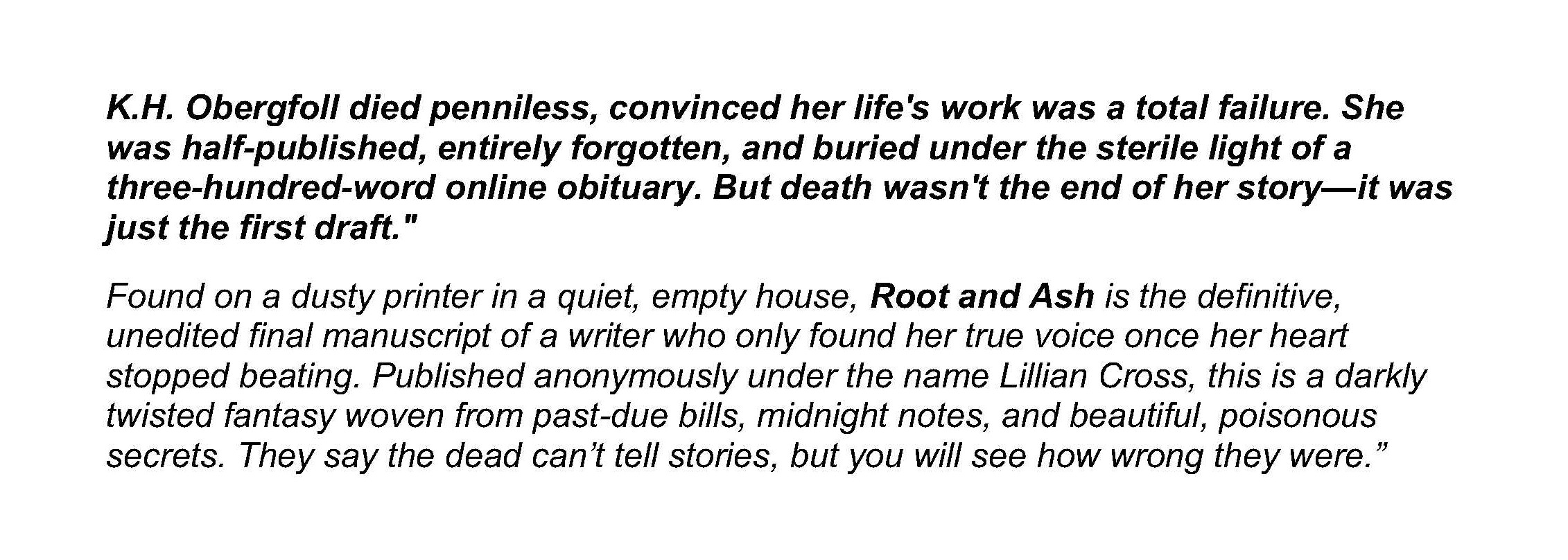
Prelude: The Dying Hour Falls Upon Us All
The day I died, trash trucks still rattled and banged their way down my street, keeping to their loud, impatient schedule. My obituary was posted online before six that same evening, as though it had been already written—and it was a small feat, for I had never been so early for anything in my entire life.
Still, a creeping panic set in.
Watching my own story vanish into a vast, nameless archive of thousands, I couldn’t shake the feeling that my expiration date had already been stamped and I would soon be forgotten.
Left to fade away into obscurity, like everyone else.
And for what? To die penniless in my drafting room, convinced my works were complete failures, while the on-and-off publisher I hired ignored my frantic pleas to get something, anything, into print before my time ran out. They sure didn’t wait to publish my death.
I wondered who would profit now? It didn’t make sense to offload me so quickly, but, then again, what else made sense when it came to death?
I expected vultures, crows, maggots and other assorted vermon to scraggle and crawl and wiggle their way up from the depths of the darkness to have one last look at what could have been. To put their keen hands on my latest set of novels and make them their own.
Nothing. Nothing good, nothing bad had happened. It was like watching my life, and what was no longer left of it unfold quietly around me, time slowly dragging by as nothing else was going to happen.
I could have made millions. Instead, I spent my final, pitiful earnings on a brand-new printer.
In my dying hour, I watched it spit out the last three hundred pages of my final manuscript. Now, who will publish it? It lies cold, just like me, sitting in a forgotten stack on the tray, slowly collecting dust. My family won't know what to do with it. Surely, they will toss it, or keep it in a box to weep over in quiet solidarity. I remember my mother faintly telling me she wouldn’t dare touch or muck up any writing I left behind—how it was mine to publish and no one else should take over that vision.
But… alas, that is not my final wish.
My final wish is for you. Whoever you are—to dig deep. Dig into my notes, my emails, my unfinished drafts. Find the pieces I left scattered in the dark. Finish them all, for me. It is what I want.
Do it in my honor.
Please.
Chapter One: Death Writes Me
I never meant to be a mystery in this life. I didn’t want to go out in all the quiet ways of those before me—our minds sharp, bursting with life and stories we would never get to tell in time. But I tried. I certainly did. I died thinking of all the words I didn’t get to write. The lives I never got to tell.
I lived as the sole collector of nouns, filled to the brim with obscure poetry and darkly twisted fantasies. I built worlds on shopping lists and scraps of unused paper—mostly past-due bills—left unread in my quiet, empty house.
I overthought every single thing I did. It was all an effort to be careful, precise, considerate.
To outdo any other version of my former self.
But my writing was never good enough for me. I entered challenges here and there to kill the perfectionist ‘bug’ harboring deep inside my chest, but it did little to quell the growing storm. It only kept me watered down. Boring. It kept my work sub-par, unfinished, and half-published. Hundreds of stories that would never, ever see the light of day—all because I couldn’t be bothered to take a leap. To have faith.
Then came my obituary, written plainly, in clear defiance of who I actually was.
Winston Tallyrand, my estate executor—the son of whoever wrote my actual will—handled the task. I had drafted that will dozens of years ago on a whim, long before I ever truly thought of death. If I had spent more time contemplating eternity, I might have written the obituary myself. A better one. One more fitting of who I was, who I became, who I wanted the world to see me as.
Instead, I watched him do it. It was rather unsanctimonious, unscrupulous. No show, no ritual—just a man at a computer with a few scribbled, handwritten notes. He typed out a single paragraph, linking my publisher at the bottom. He sprinkled in a few stolen quotes from my writing, like an author-jacket blurb for my final story, and uploaded a sepia-toned headshot to the page.
A tiny graphic of a bird holding a flower within a stained-glass sunburst ornamented the center of the screen. Honestly, it was the only thing I liked. An homage to tradition in my eyes. It felt like I at least had something that represented the true symbolism of my death—that my soul was finally in flight. Maybe I did have a bright, warm future to look forward to.
Even if no one else knew it but me.
Chapter Two: Mostly Famous
I look at the screen, or rather, the tether that anchors me to reality. A glowing monitor stares equally as quiet, inches from Clara Longhorn’s face. She is a stranger to me in every sense of the word, her name something foreign from another time forgotten altogether—an old-western era perhaps, a stage-name if she had any talent. This, I didn’t know. She was pretty enough, that was certain. I may have even written about her if I had seen her in passing on a subway.
She was inspiration in the making. I just needed a pen and paper.
I watched her hover her floating cursor over my name. She had found my obituary purely by accident, it had popped up rather quietly in a small news section on the bottom right search menu. Mixed in with other widgets, news articles and self-help stories. It was my five minutes of fame—and it almost looked like an AI-Advertisement. Fake, prompted, scripted—and yet, she doesn’t look away, she doesn’t back out of the screen, she seems to toy with the idea that she should, but something inside her thinks differently.
She clicks the link.
She scrolls, she refreshes, she studies the handful of paragraphs. Only a few comments had posted, mostly family-friends shocked by the nature of my passing—so quick, so sudden, so young and full of life.
A life most unlived.
Now they miss me, now they mostly feel sorry for those I left behind, or the life I didn’t get to experience. All things I already knew. I already struggled with. Not having married, not having kids, nothing to show for myself but a few dried, flowery words posted to a media link that may or may not exist in the next decade.
More things that will die right alongside me. To be buried and forgotten forever.
She opens another tab on her internet browser, types my name in, of course she only finds a few of the short stories I had written. My main work had been penned under quite a different name entirely. She looks disappointed at not being able to delve deeper. I watch her mumble something under her breath, it catches my attention, briefly.
“How strange, nothing is written about someone who was mostly famous. Such a shame. No comments on social media, no one questioning what happened. No one real seeming to miss her, but myself. How sad.”
Mostly famous?
The words swirled around my head, stopping me in my tracks.
In what world?
I had barely received a thousand dollars for any of my combined words, and yet, Clara Longhorn seemed to know me, to know my grief, my plight, my pain. She seemed determined to understand the woman who had left such an unremarkable mark in an otherwise overly-existed world.
I watched Clara Longhorn return religiously, day-in, and day-out, refreshing the same 300-word death notice multiple times a day like it was written about her. Secretly hoping the servers would glitch and some administrator or even a lowly family friend would update and reveal my secrets, my unrequited loves, hidden children, secret closets.
If she was lucky, maybe someone would reveal my pen-name or the meaning behind one of the shortest stories I ever published—it was only one-hundred-or so solemn words typed into the void.
One hundred and twenty-three words to be exact.
Words that didn’t mean a single thing. Just a combined conscious stream of thoughts. Dark thoughts written about another nobody who, in the least, had picked his own terms in which to go.
Clara clicked on this story more-times than she clicked on my obituary, maybe hoping it would, in some way, give her some closure, some answers. It seemed, she cared more for what happened to me—even if it was just simple curiosity—than those who actually knew me.
The quiet August morning was broken quickly by the shrill, rhythmic snap of an elderly man splitting his last log of wood. Beneath the tired oak-tree, he paused, wiping the clammy sweat from his forehead. He stacked them neatly beside a small, freshly dug hole. The ground silent, marked only the support of an uncarved stone. Winters Spring would soon goad bright snowy shoots from the frozen earth, but the cabin would remain entirely still. He lowered his weary frame onto the platform, watching the sun take its final rise as he held tightly to an unread letter in his shaking hands and took a long, steady breath. Closing his eyes, until finally, the silence took him, as he often wished it would.
This same song and dance continued—and I began to wonder. Wonder what she thought of my passing, my death, my lack of existence in a world where even some people go into their long-good-night without a single written thought or emotion.
Some do die, after-all, without an obituary.
Maybe I should be thankful, grateful, content with the notion that I, at least, had something written about me. But then I wondered about what she thought of my writing. The words in my stories showed a very different life, a different mindset, a different world than the stark, darkly sterile ones that August Man were written about. It was writing that didn’t seem to have a life. No soul floating in the strata, very Hemingway without the depth, no internal monologue, no relevance or tedious undoing.
A shallow sea where cold drafts drowned.
Chapter Three: Critique and the Critic Mythology
Today was much the same, but different. A few weeks passed before Clara Longhorn read my posthumous author profile, seeing the world critics constructed around my life and what was left of my legacy for the very first time. It wasn’t much, but it read like a newly-minted Wikipedia page, filled with roasting, speculative literary in the making—and it was a doozy:
“An Enigma Swimming in the Voidless Abyss of Life: Who was K.H. Obergfoll and what made her writing special or different, or unlike anything you or I have written and read? The answer might be nothing. Simple as that. Nothing. Words thrown onto paper without a single thought.
In the wake of her sudden passing, I realize now how dismissive that may sound coming from within our very climate and culture. In a world where everyone deserves a moment to be celebrated, I am not sure this is that moment. The literary underground as it were, is constructed of thinly veiled layers, layers that have been forced to recognize even the not-so-great, or the in-betweeners as we call them and give them participation trophies for being present.
It has come to my attention today, though, that K. H. Obergfoll also wrote simultaneously under another name, one of several that she orbited worlds around—as a silent, uncalled, unprompted genius—anonymous in life, and death.
You may recognize the below works:
Most famous, from Lillian Grimshaw and Eleanor Rose—with Ms. Grimshaw having penned the Nocturnal Light series: When Shade Crawls. She also wrote the Nightshade and Star-tide Series: The Vesper Thorns of Highland Lakes, Ashes of Foxglove, and Hemlock Court Eclipse.
Eleanor Rose was currently working on Grimshaw Legacy—the Ravenguild Prophecy: Ritual Black, Part One, Day-Break and had already written Part Two: The Solstice Curse Chronicles –which was her last known piece—which has noticeably gone missing and remains unpublished at the time of this article.
No posthumous production has been released. Even her Obituary was strikingly cold.
Her blog dispatched a short blurb on what would be coming—but that is not something I would hold my breath on. You can see for yourself what would have been in the works had Eleanor Rose, or K. H. Obergfoll actually lived to see it produced:
“Lyra Jayne Graves always knew the celestial alignment of the Great Eclipse would change everything. But she never expected to be chosen as the Vessel for the Night Sky. Whisked away to the crumbling estate of the Ravenguild, Lyra is forced into a deadly game of courts, shadows, and ancient magic.
To survive, she must master a rare, forbidden gift: the ability to manifest the lethal properties of the Belladonna flower through her very veins. Surrounded by allies who feel like enemies and a mysterious shadow-wielder who knows too much, Lyra must decide if she will be the lamb led to the altar—or the poison that destroys the kingdom from within. Follow us as we navigate Part Two of the Grimshaw Legacy Series.”
The fact remains, little is known of who K. H. Obergfoll actually was, or how she existed on the absolute paralyzing periphery of society, teetering on a cliff that no one knew about until her ultimate act—death. It must have eaten her alive to know the potential of who she could become, if given a chance. Critics, much like myself, laud her posthumously discovered works as a final act of narrative defiance, where other authors might have found comfort posting journals, making books of previously sold shorts. She did not.
So, I am here doing it for you, I did the heavy lifting. I dug through, trolling sites like Reddit, and other mass- produced blogs to see what dirt I could find, and came up short. Where others saw neglected words and writing not fought for, I see a visionary writer who stripped her own world down to its bare, beaten bones. Agonizing over every word as thought it was her last….and this time, it truly was.”
J.R. Rollings sure did write one hell of a story.
He spoke truths in places where lies simply did not exist. If only that piece had been written before I died, I might have done something else with my life.
Chapter Four: Ghost in the Machine—Lillian Cross
I watched Clara sitting back in her room, a tiny studio apartment perched high above the city. The hustle and bustle of the streets reverberated off the walls, hundreds of feet below her windows, a distant hum she has grown to ignore. The combined glow of her computer monitors and a crooked desk lamp illuminate her sharply defined features, reflecting off the blue-light blocking glasses adorning her face.
She was miles away from where my cold body lay awaiting my final rest.
She didn’t even know I could see her.
With a decisive click, she followed the link Winston Tallyrand had left at the bottom of my obituary—the one meant to lead to my author bio and website. But the screen didn't load my words.
Instead, a harsh user-error popped up, signaling the page was under construction.
I couldn't help but feel a phantom pinch of a dry, bitter sting.
It was already being scrubbed, likely rewritten to repackage whatever scrap of my legacy they could sell for a quick dollar. Just as I had expected.
Clara didn’t close the tab.
She paused, her fingers hovering over the keyboard, a strange determination crossing her face. She began to dig, just as J.R. Rollings had. She sifted through pages of dead-ends, navigating through the digital breadcrumbs I left behind—all the varying unencrypted emails, fragments of my writing, frantic midnight notes scanned into unnamed folders.
They were all there for whomever dared to look close enough.
And then, she found it. The final, three-hundred-page manuscript.
The one currently gathering dust on my physical printer was now open on her screen.
She read for hours, straight through the night into morning.
I watched her eyes dart back and forth, seeing the exact moment my darkly twisted world took hold of her as it had myself so many nights ago.
I watched Clara Longhorn close her eyes long enough to breathe—and then she opened a fresh document and began to type.
She wasn't going to let my story die—but to tell it, she had to hide me, to become me, as anonymously as I had lived and died—and I trusted her to do so more than anyone.
She keyed a pseudonym that matched the grim, melancholic weight of my earthbound pages. Creating the new Author Name: Lillian Cross –a name I, myself was extraordinarily proud of.
It tasted like the ashes of my life and all the beautiful secrets I would never, ever get to tell. The name spread across the front page perfectly, poised like the plucked lilies of internment lain upon the freshly polished casket of a woman who could never be. Eleanor Rose was reborn.
She spent the rest of the night feeding my ghostly words into that machine. With each stroke of her keyboard, my final story published, not under the name Winston Tallyrand buried, but as Lillian Cross: a beautiful, poisonous bloom with roots that only grow in the dark. My Homage.

#BookTok #DarkAcademia #ARG #UnsolvedMysteries #CreepyPasta #IndieAuthor #deadwriter #metafiction #posthumouslegacy #ghostmachine #foundmanuscript #gothicnoir #booktokmystery
About the Creator
K.H. Obergfoll
Writing my escape, planning my future one story at a time. If you like what you read—leave a comment, an encouraging tip, or a heart. It is always appreciated!!
& above all—thank you for your time
Enjoyed the story? Support the Creator.
Subscribe for free to receive all their stories in your feed. You could also become a paid subscriber, letting them know you appreciate their work.
Comments
There are no comments for this story
Be the first to respond and start the conversation.