
Retail Pricing Analytics: KPIs Every Ecommerce Brand Should Track
Measure ROI from retail intelligence with this calculator template. Track data-driven growth, optimize pricing, and improve profit decisions with real insights.

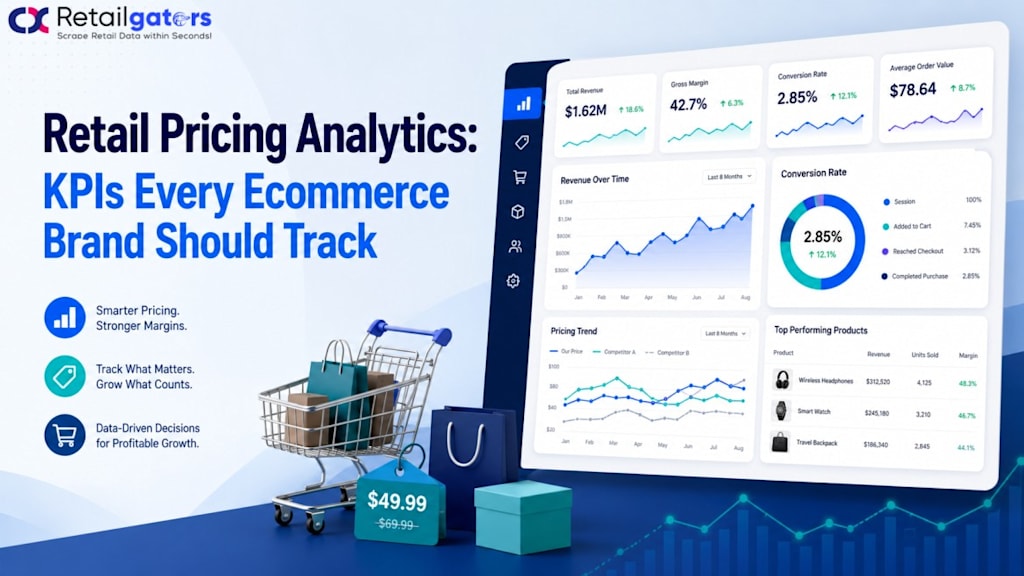
Running an ecommerce business today is not only about selling products online. The real challenge begins when brands try to stay profitable while competing with hundreds of sellers offering similar products at different prices. One small pricing mistake can reduce conversions, hurt margins, or even push loyal customers toward competitors.
This is where retail pricing analytics becomes important.
Modern ecommerce brands no longer rely on guesswork when making pricing decisions. Instead, they use pricing data, customer behavior insights, and competitor monitoring to understand what is working and what needs improvement. Retail pricing analytics helps businesses measure performance through specific KPIs that directly impact revenue, customer acquisition, profitability, and long-term growth.
For growing ecommerce companies, tracking the right pricing metrics can reveal why certain products perform better, how discounts affect profit margins, and when pricing adjustments are required to remain competitive in the market.
In this blog, we will explore the most important retail pricing analytics KPIs every ecommerce brand should track to make smarter business decisions.
Why Retail Pricing Analytics Matters
Ecommerce pricing has become more dynamic than ever. Prices can change several times a day depending on competitor activity, demand fluctuations, seasonal trends, promotions, and inventory availability.
Without analytics, brands often react too late.
Retail pricing analytics helps businesses:
- Understand customer price sensitivity
- Monitor competitor pricing strategies
- Improve profit margins
- Increase conversion rates
- Identify underperforming products
- Optimize discounts and promotions
- Reduce revenue leakage
Instead of making decisions based on assumptions, brands can use real-time insights to build data-driven pricing strategies that support long-term growth.
1. Gross Margin Percentage
Gross margin percentage is one of the most important KPIs in retail pricing analytics. It measures how much profit remains after subtracting the cost of goods sold from total revenue.
Formula:
Gross Margin % = (Revenue - Cost of Goods Sold) ÷ Revenue × 100
A healthy margin indicates that the pricing strategy is sustainable. On the other hand, shrinking margins may suggest excessive discounting, rising supplier costs, or aggressive competitor pricing.
Many ecommerce brands focus heavily on increasing sales volume but forget to monitor profitability. High sales with poor margins can create long-term financial pressure.
Tracking this KPI regularly helps brands identify products that generate real business value.
2. Price Competitiveness Index
The Price Competitiveness Index compares your product pricing against competitor pricing across similar products.
This KPI helps brands understand whether they are:
- Overpriced
- Underpriced
- Competitively positioned
Customers compare prices quickly across marketplaces and online stores. If pricing is consistently higher than competitors without offering additional value, conversion rates may drop significantly.
However, being the cheapest seller is not always the best strategy. Many premium brands maintain higher pricing while focusing on product quality, customer service, or faster delivery.
The goal is to maintain a balanced pricing position within the market.
3. Conversion Rate by Price Point
Not every pricing adjustment leads to better sales.
Tracking conversion rate by price point helps ecommerce brands understand how pricing changes influence customer buying behavior.
For example:
- A product priced at $49 may convert better than the same product priced at $59
- Small discounts may improve conversions without hurting margins
- Excessive discounts may increase sales volume but reduce profitability
Analyzing this KPI allows brands to find optimal pricing levels that maximize both revenue and profit.
It also helps businesses avoid unnecessary markdowns.
4. Discount Effectiveness
Discounts are widely used in ecommerce, but not all promotions produce positive results.
Discount effectiveness measures whether promotional campaigns actually generate incremental revenue or simply reduce profit margins.
Brands should analyze:
- Revenue generated during promotions
- Increase in conversion rates
- Impact on average order value
- Customer retention after discounts
- Profitability during campaign periods
Many ecommerce businesses rely heavily on discounts to drive sales. Over time, customers may start waiting for offers instead of purchasing at regular prices.
Tracking discount performance helps brands build healthier pricing strategies without depending entirely on constant promotions.
5. Average Order Value (AOV)
Average Order Value measures how much customers spend per transaction.
Formula:
Average Order Value = Total Revenue ÷ Total Number of Orders
Pricing strategies directly affect AOV.
For example:
- Bundle pricing may increase cart value
- Tiered discounts can encourage larger purchases
- Cross-selling recommendations may improve order size
A growing AOV often indicates that pricing strategies and product positioning are working effectively.
Brands that improve AOV can increase revenue without necessarily acquiring more customers.
6. Dynamic Pricing Response Time
In highly competitive ecommerce markets, speed matters.
Dynamic Pricing Response Time measures how quickly a business reacts to competitor pricing changes or market fluctuations.
If competitors reduce prices and your brand responds too slowly, sales opportunities may be lost.
Real-time pricing analytics tools help ecommerce businesses:
- Monitor competitor activity continuously
- Detect pricing shifts instantly
- Automate pricing recommendations
- Improve decision-making speed
This KPI is especially important for industries with fast-moving inventory and aggressive competition.
7. Customer Lifetime Value (CLV)
Retail pricing strategies should not focus only on short-term sales.
Customer Lifetime Value measures the total revenue a customer generates throughout their relationship with a brand.
Sometimes, slightly lower pricing can help acquire loyal customers who make repeat purchases over several years.
Brands that understand CLV can make smarter pricing decisions regarding:
- Loyalty discounts
- Subscription pricing
- Retention campaigns
- Personalized offers
Tracking CLV helps businesses balance customer acquisition costs with long-term profitability.
8. Cart Abandonment Rate
Pricing is one of the biggest reasons customers abandon carts.
Unexpected shipping charges, high product pricing, or poor discount structures can push buyers away during checkout.
Monitoring cart abandonment alongside pricing analytics helps brands identify pricing friction points within the customer journey.
Businesses can improve checkout performance by:
- Offering transparent pricing
- Reducing hidden charges
- Providing competitive shipping rates
- Running limited-time offers strategically
Even small pricing improvements during checkout can increase completed purchases significantly.
9. Inventory Sell-Through Rate
Pricing directly impacts inventory movement.
Sell-through rate measures how quickly products are sold within a specific period.
Formula:
Sell-Through Rate = Units Sold ÷ Units Received × 100
If products move too slowly, pricing may need adjustment.
Retail pricing analytics helps businesses:
- Identify slow-moving inventory
- Optimize markdown timing
- Prevent overstock situations
- Improve inventory planning
This KPI is especially valuable during seasonal sales periods and promotional campaigns.
Final Thoughts
Retail pricing analytics has become essential for modern ecommerce growth. Brands that rely only on intuition often struggle to compete in markets driven by real-time pricing changes and customer expectations.
Tracking the right KPIs allows ecommerce businesses to understand how pricing impacts conversions, profitability, customer behavior, and long-term performance.
From gross margin percentage to dynamic pricing response time, every metric provides valuable insights that support smarter decision-making.
The most successful ecommerce brands are not always the cheapest. They are the ones that understand their data, monitor market trends carefully, and continuously optimize pricing strategies based on measurable results.
As ecommerce competition continues to increase, pricing analytics will remain one of the strongest tools for sustainable retail growth.
About the Creator
Enjoyed the story? Support the Creator.
Subscribe for free to receive all their stories in your feed.
Comments
There are no comments for this story
Be the first to respond and start the conversation.