
How to Write Realistic "Systemic Friction"
The Anti-Hollywood Guide

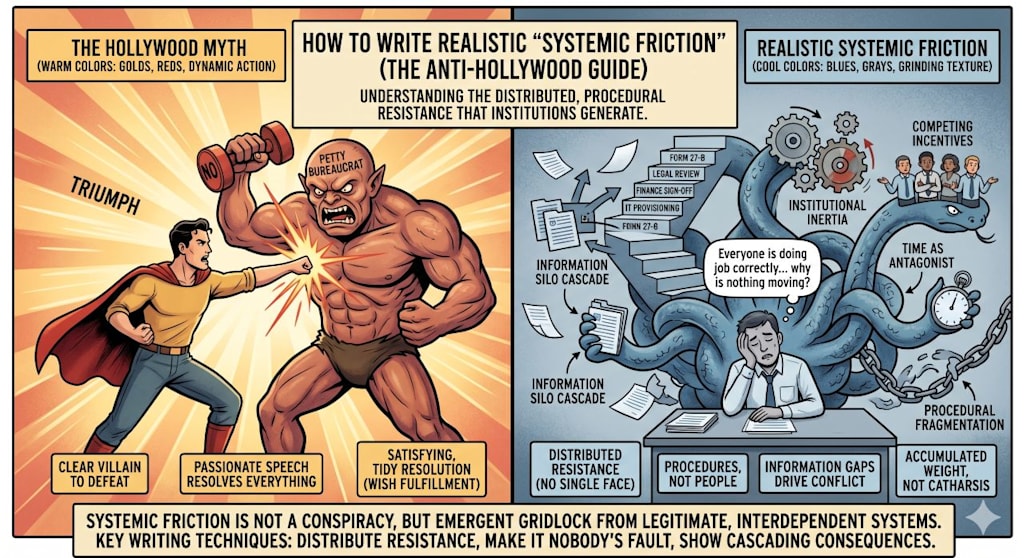
Table of Contents
Use this guide in two ways: Read sequentially for comprehensive understanding, or jump to specific sections using this table of contents.
________________________________________
1. About This Guide: Why Authenticity Matters
Why this guide is grounded in lived military and organizational experience, and why that matters for writers seeking to portray institutions authentically.
2. The Problem: Why Hollywood Gets It Wrong
How dramatic obstacles differ from realistic institutional friction. Why Hollywood's approach is seductive but fundamentally misleading. The cost of dramatizing systemic resistance.
3. What Realistic Systemic Friction Actually Is
Definition and core characteristics. How systemic friction differs from antagonism. Why it persists even when everyone involved is competent and well-intentioned.
4. The Five Forms of Systemic Friction
4.1 Institutional Inertia: The Invisible Backbone
• How organizations resist change through passive continuation
• Why "the way we've always done it" is harder to fight than any villain
• Writing techniques for showing inertia without making it feel static
4.2 Competing Incentives: The Realistic Conflict
• How legitimate but incompatible goals create gridlock
• Why no single decision-maker can satisfy all stakeholders
• Crafting moral ambiguity when everyone is protecting something real
4.3 Procedural Fragmentation: Nobody Sees the Whole Picture
• How large organizations fragment across departments and disciplines
• Why local optimization creates global dysfunction
• Making fragmentation visible through character perspective
4.4 Information Asymmetry: The Invisible Misalignment
• How different layers of the system have fundamentally different data
• Why this creates genuine misalignment, not conspiracy
• Using information gaps as conflict drivers
5. How to Write Systemic Friction Realistically
Eight concrete techniques with examples:
• Show characters following rules that don't make sense
• Reveal cascading consequences of local decisions
• Let friction emerge from procedures, not people
• Use information gaps as conflict
• Make time an antagonist
• Distribute resistance across multiple actors
• Create shared blame rather than clear villains
• Show moral ambiguity in every decision
6. Case Studies: Real vs Dramatized Systemic Friction
Three parallel scenario comparisons:
• Software Implementation Failure — How a database migration becomes a three-year nightmare
• Compliance Gridlock — Why following all the rules creates the worst outcome
• Innovation Suffocation — How institutional caution kills good ideas
7. Advanced: Tactical Applications—Systemic Friction in High-Stakes Thrillers
7.1 Asymmetric Friction as Antagonist Strategy
• How sophisticated antagonists exploit systemic weaknesses
• Targeting supply chains, communications, and credibility instead of confronting directly
• Why this is more realistic than direct confrontation
7.2 The Compound Interest of Appeasement
• How deferred decisions multiply consequences over time
• Why short-term de-escalation creates long-term entanglement
• Writing tension through institutional memory and historical decisions
7.3 The Human Terrain as Ultimate Obstacle
• How actual power flows through unofficial channels
• Why backchannel relationships matter more than org charts
• Making organizational politics visible and compelling
7.4 Operating in Ambiguity
• How protagonists synthesize fragmented intelligence
• Making decisions without perfect information or clear orders
• Tension through uncertainty, not through manufactured crises
8. Quick-Reference Cheat Sheet for Writers
8.1 The Anti-Hollywood Checklist: What NOT to Do
• Seven common mistakes that signal amateur writing
• How to recognize when you're falling back into dramatization
8.2 The Realism Checklist: What TO Do
• Eight key techniques for authentic systemic friction
• How to verify your writing reflects institutional reality
8.3 Five Common Friction Patterns (With Templates)
• Pattern 1: The Approval Chain Doom Loop
• Pattern 2: The Competing Metrics Trap
• Pattern 3: The Information Silo Cascade
• Pattern 4: The Workaround Penalty
• Pattern 5: The Institutional Memory Gap
8.4 Five Writing Practice Scenarios
• Exercises to develop your systemic friction instincts
• Real-world situations to translate into narrative
8.5 The 72-Hour Rule Framework
• How to test whether your friction is realistic
• Diagnostic questions for evaluating your work
8.6 Red Flags: When You're Writing Villains, Not Systems
• Warning signs that you've personified the problem
• How to redistribute resistance across the system
9. The Unglamorous Truth: Why It Matters
Why authenticity resonates more than drama. Why professionals recognize realistic friction immediately. Why this matters for your credibility as a writer.
10. Case Study: How Led by Love of Country Executes Realistic Systemic Friction
10.1 Information Asymmetry as Operational Failure
• David Miller's warning ignored
• How different institutional layers see different threats
• The friction between intelligence and procedure
10.2 The Seeds of Radicalization: Rules as Systemic Inertia
• Elias's origin in Iraq
• ROE as institutional inertia
• How competent people applying broken logic create radicalization
10.3 Asymmetric Friction as Antagonist Strategy
• Marcus Sterling's weaponization of systemic weakness
• How the antagonist exploits the protagonist's blindness
• Tactical victory, strategic defeat
10.4 Operating in Ambiguity and Moral Fragmentation
• The team's fragmented expertise and perspective
• Making decisions without full information
• Why the perfect execution of a flawed plan still fails
________________________________________
Appendix: Quick Friction Diagnosis
Use this section to navigate to the specific guidance you need:
Your Writing Problem Root Cause Jump To
My obstacle feels too easy to overcome You've personified the problem Section 2: Why Hollywood Gets It Wrong
My protagonist keeps finding workarounds You haven't shown systemic consequences Section 5: How to Write It Realistically
My villain feels one-dimensional You've made one person responsible Section 4: The Five Forms of Friction
My characters seem unreasonable You haven't shown their competing incentives Section 4.2: Competing Incentives
My plot feels like it's moving too fast You're not showing institutional inertia Section 4.1: Institutional Inertia
My readers don't understand why things fail You haven't distributed the resistance Section 4.3: Procedural Fragmentation
My characters have information they shouldn't You haven't accounted for information silos Section 4.4: Information Asymmetry
My thriller feels unrealistic You're missing asymmetric tactics Section 7.1: Asymmetric Friction Strategy
My tension feels manufactured You need to show compound consequences Section 7.2: Compound Interest of Appeasement
My protagonist is too isolated You haven't mapped the human terrain Section 7.3: The Human Terrain
My characters seem to know too much You're not writing in ambiguity Section 7.4: Operating in Ambiguity
I need quick reference tools Use the checklists and patterns Section 8: Quick-Reference Cheat Sheet
I want to see this done well Study the case studies Sections 6 & 10: Case Studies
________________________________________
Your protagonist needs to change a single line in a database. That's it. One field. Five characters. It would take thirty seconds if anyone would just let her do it.
In a Hollywood script, this plays out predictably: There's a middle manager who says no—some petty bureaucrat drunk on tiny authority. Our hero makes an impassioned speech about why the change matters. Maybe she goes over his head. Maybe she hacks the system herself in a montage set to triumphant music. Either way, the obstacle has a face, a name, and a defeat condition. Roll credits.
In reality? She fills out Form 27-B, which requires approval from someone in Compliance who's been on medical leave for six weeks. His backup doesn't have system access. IT says they can grant access, but only if HR submits a ticket. HR's ticket system has been "temporarily down" for three months while they migrate to new software. The person who knows the workaround retired. The database change requires sign-off from Legal anyway, but Legal is backlogged because of a merger that happened eighteen months ago, and the paralegal who handles these requests thinks this should go through Finance instead. Finance agrees to review it. In four to six weeks. Maybe.
Nobody is evil. Nobody is even particularly incompetent. The system is working exactly as designed—which is the problem.
This is systemic friction: the distributed, procedural, maddeningly impersonal resistance that institutions generate simply by existing. It's not a villain. It's not a test of character. It's the accumulated weight of rules, incentives, silos, and legacy processes that nobody fully understands and nobody has the authority to override. It doesn't care about your protagonist's determination. It doesn't care about anything. It just is.
Hollywood hates systemic friction because it's undramatic. You can't defeat it with a rousing speech. You can't outsmart it with a clever plan. There's no catharsis, no moment of triumph—just exhaustion, compromise, or the slow realization that the change you wanted isn't worth the energy it would cost.
But if you're writing fiction that wants to feel real—if you want your readers to recognize the texture of actual institutional life—you need to understand how systemic friction works. Not the Hollywood version with its convenient villains and tidy resolutions, but the authentic, suffocating, nobody's-fault-but-everyone's-problem version that defines how large organizations actually operate.
This is the guide for writing that friction. The unglamorous, incremental, bureaucratically baroque resistance that makes readers want to scream—not because it's evil, but because it's so painfully familiar.
About This Guide: Why Authenticity Matters
This guide isn't written by a screenwriter studying institutional dynamics from the outside. It's written by someone who has operated inside them—someone who has watched systemic friction kill people, cost millions, and determine outcomes in real time.
Charles V. Sasser Jr. is a Retired Army Command Sergeant Major with decades of operational experience across multiple deployments, including combat tours in Iraq. As a Ranger and senior enlisted leader, he spent his career navigating the exact institutional systems this guide describes: Rules of Engagement that constrain tactical options. Command structures where information fragments across hierarchies. Competing imperatives where force protection clashes with risk management. Asymmetric threats that refuse to fight symmetrically. The grinding friction between what needs to happen and what the system allows.
In military and organizational contexts, systemic friction isn't interesting because it's dramatic—it's interesting because it's lethal. When ROE is misaligned with ground reality, soldiers die. When communications fragment across command levels, operations fail. When competing incentives clash without resolution, the cost is measured in lives, resources, and strategic failure. This isn't theory. This is operational reality.
Sasser's novels—Led by Love of Country: Hard Reset and the prequel Line of Departure—were specifically engineered to show how real organizations fail through systemic friction, not through malice or incompetence, but through the accumulated weight of legitimate but incompatible institutional imperatives. The books are populated with competent people making defensible decisions within their domains, whose collective choices create catastrophic misalignment. That's not fiction. That's what Sasser observed in command environments where the stakes were absolute.
This guide draws directly from that experience. The patterns described here—information asymmetry, procedural fragmentation, competing incentives, institutional inertia—aren't abstractions. They're the mechanisms that actually govern how large organizations operate when lives and resources are on the line. The difference between Hollywood's version and the authentic version isn't just dramatic—it's the difference between understanding how institutions actually work and perpetuating myths about how they should work.
If you want to write fiction that feels real to professionals—to people who have actually operated inside complex systems—you need to understand systemic friction the way Sasser does: not as an obstacle to overcome, but as the fundamental operating environment of any large organization. That's what this guide teaches.
The Problem: Why Hollywood Gets It Wrong
Hollywood's approach to institutional obstacles is seductive because it's dramatically efficient. Every screenplay guru will tell you the same thing: externalize the conflict, personify the opposition, give your hero something concrete to fight. So when your protagonist needs to navigate a bureaucracy, Hollywood gives them a sneering middle manager who enjoys saying no. A corrupt official taking bribes. A petty tyrant drunk on the tiny authority of their position. Someone who can be exposed, outsmarted, or—in a satisfying third-act confrontation—defeated.
This works beautifully for narrative momentum. The audience knows who to hate. The protagonist has a clear target. The conflict escalates through personal confrontations that build to a climax. When our hero finally gets that corrupt bureaucrat fired, or hacks past the firewall in a montage of furious typing, or gives the speech that makes the board of directors see reason, we feel catharsis. The system has been beaten. Roll credits.
The problem? Real institutional friction doesn't work like this at all.
Consider the classic trope: the "one bad rule" that just needs to be changed. In the movie, our hero discovers that Policy 47-B is outdated and harmful. They present evidence to someone with authority. That person—after perhaps some initial resistance—sees reason and changes the policy. Problem solved. But anyone who's actually tried to change an institutional policy knows this is fantasy. The rule exists because it solved a problem in 1987 that nobody remembers. Changing it requires sign-off from four departments with competing priorities. It's entangled with three other policies. The person who could change it doesn't think it's a priority. The person who thinks it's a priority doesn't have authority. And everyone agrees it should be changed—just not right now, and not without a full impact assessment, and not without consulting Legal.
Or take the "heroic hacker" trope. The system won't give our protagonist access, so they bypass it with technical wizardry. Except in reality, the system won't give them access because three different people need to approve it, and one of them is on vacation, and another doesn't respond to emails, and the third thinks it should go through a different approval process entirely. You can't hack your way past organizational dysfunction. There's no firewall to bypass when the problem is that nobody knows whose job it is to grant you permission.
The corrupt bureaucrat is perhaps the most pernicious trope because it's occasionally true—but it misses the deeper reality. Yes, sometimes there's a genuinely obstructive person. But far more often, the person saying no is following a rule they didn't write, protecting a budget they'll be blamed for overspending, or optimizing for metrics that make sense in their silo but create dysfunction elsewhere. They're not corrupt. They're not even wrong, exactly. They're just operating within a system that produces gridlock when everyone does their job correctly.
This matters for fiction writers because readers who've worked in large organizations will feel the falseness immediately. When your protagonist defeats institutional friction by exposing one bad actor or changing one rule, readers who've lived through real bureaucracy will recognize it as wish fulfillment. The friction will feel undercooked, the resolution unearned.
The central problem is this: Hollywood makes systemic friction personal when it's actually structural. It gives you a face to punch when the real obstacle is a thousand small decisions made by reasonable people following reasonable rules that somehow add up to paralysis. That's harder to dramatize. It's also what actually happens.
What Realistic Systemic Friction Actually Is
Systemic friction is the cumulative resistance generated when an organization's various protective mechanisms—all individually reasonable—interact to create gridlock. It's not a conspiracy. It's not malice. It's not even incompetence, usually. It's what happens when systems designed to prevent problems become so layered and interdependent that they prevent everything else too.
Here's the key insight: systemic friction is emergent. No single person designed it. No committee sat down and said, "Let's make this process take six months and require seventeen approvals." Instead, each layer was added for a legitimate reason. Legal review exists because the company got sued in 2003. The three-signature approval process exists because someone in Finance embezzled money in 2008. The mandatory training exists because of a workplace accident in 2011. Every rule has a scar tissue origin story. Every procedure solved a real problem.
The friction emerges from the interaction of these systems. Legal needs three weeks to review contracts. Procurement needs two weeks to process purchase orders. IT needs five business days to provision access. None of these timelines are unreasonable in isolation. But when your project requires all three to happen sequentially, and each one can be delayed by dependencies you can't see, suddenly you're looking at three months minimum—and that's if nothing goes wrong.
This friction has four defining characteristics:
It's distributed. No single person controls it. The procurement officer can't override Legal's review timeline. Legal can't speed up IT's provisioning process. Everyone is following their procedures correctly. The dysfunction exists in the spaces between departments, in the handoffs and dependencies that nobody owns.
It's procedural. The resistance isn't personal—it's encoded in forms, approval chains, ticketing systems, and review cycles. You're not fighting a person; you're fighting a process that will continue exactly as designed regardless of how urgent your need is.
It's self-perpetuating. Each protective layer justifies the others. You need Legal review because Procurement requires it. Procurement requires it because Finance mandates documentation. Finance mandates documentation because Compliance demands audit trails. Compliance demands audit trails because of regulations written after the last crisis. Try to remove one layer, and you'll be told it's necessary because of all the others.
It's impersonal. The system doesn't care about your deadline, your project's importance, or your protagonist's determination. It processes requests in the order they arrive, according to rules that were written before your protagonist joined the organization and will persist long after they leave.
The cruelest aspect of systemic friction is its invisibility. From inside any single department, the system looks functional. Legal is protecting the company from lawsuits. Procurement is preventing fraud. IT is maintaining security. Each silo is optimizing for its own metrics, following its own procedures, solving its own problems. The friction only becomes visible when you need something that crosses silos—and by then, you're already caught in it.
And here's why it's so intractable: you can't fix it by changing one thing. The systems are interdependent. Streamlining Legal's review process doesn't help if Procurement still takes three weeks. Giving your protagonist special access doesn't solve the underlying problem—it just means the next person will hit the same wall. Real change would require redesigning multiple systems simultaneously, which requires coordination across departments that don't share priorities, budgets, or timelines.
So the friction persists. Not because anyone wants it to. But because dismantling it would be harder than living with it.
Institutional Inertia: The Invisible Backbone
The most insidious form of systemic friction isn't active resistance—it's the simple fact that organizations continue operating exactly as they always have. This is institutional inertia: the tendency of systems to persist in their current state not because anyone is defending them, but because change requires energy and coordination that continuation doesn't.
Here's what makes inertia so difficult to dramatize: nobody has to do anything. There's no villain to confront, no obstructionist to overcome. The organization just... keeps going. The same meetings happen every Tuesday because they happened last Tuesday. The same approval process runs because it's already built into the workflow software. The same reports get generated because someone set them up in 2014 and they've been running ever since. Nobody remembers why. Nobody particularly wants them. But nobody has the authority—or the energy—to stop them either.
You can't negotiate with inertia. You can't present evidence to it or make a compelling argument. It doesn't care that your new process is more efficient, that the old policy no longer makes sense, that the market has changed. The system continues because continuation is the default state. Change requires decisions, approvals, coordination, risk. Continuation requires nothing.
Inertia sustains itself through a dozen invisible mechanisms. There's precedent—"this is how we've always done it" isn't just an excuse; it's a decision-making shortcut that prevents having to evaluate every process from first principles. There's organizational memory embedded in training materials, onboarding documents, and the casual advice veterans give to newcomers. There's budget allocation—money already committed to existing structures, headcount already assigned to current processes. Changing course means fighting for new resources while existing ones continue on autopilot.
Then there's the psychological component: people assume that existing systems exist for good reasons. Even if nobody remembers what those reasons are, the very fact that a process has persisted suggests it must be solving some problem. To change it feels risky. What if the old way was preventing some disaster we've forgotten about? What if we're about to rediscover why the rule exists in the first place?
This creates a peculiar dynamic: the harder you push for change, the more resistance you encounter—but not from people. From the system itself. You propose eliminating a redundant approval step, and suddenly you discover it's referenced in three other procedures. You suggest updating the software, and you learn that seventeen other systems depend on its current data format. You try to change a policy, and you find it's entangled with union agreements, compliance requirements, and legacy commitments nobody documented.
It feels like pushing against an immovable object. Not because the object is actively pushing back, but because it has mass, and mass resists acceleration. The organization isn't fighting you. It's just continuing to exist in the shape it already has. And that, it turns out, is harder to overcome than any antagonist.
Competing Incentives: The Realistic Conflict
Here's the thing that protagonists—and Hollywood screenwriters—consistently miss: most institutional gridlock doesn't come from bad actors or broken systems. It comes from multiple stakeholders doing their jobs correctly, optimizing for metrics that make perfect sense within their domains, but that fundamentally conflict with each other.
Marketing wants to launch the new feature next week because they've already promised it to clients and the competitive window is closing. Security wants three months of penetration testing because the last breach cost the company eight million dollars and someone's head rolled for it. Both are right. Both have legitimate concerns. Both are being responsible stewards of their area. And both cannot get what they need.
Sales wants to offer customized solutions because that's what closes deals—clients want to feel heard, want products tailored to their specific workflows. Operations wants ruthlessly standardized processes because every customization multiplies support costs, creates technical debt, and makes the system exponentially harder to maintain. The salesperson who promises custom features isn't being reckless. The operations manager who refuses them isn't being rigid. They're optimizing for different success metrics that the organization genuinely needs them to optimize for.
Finance wants to cut costs because the board is demanding better margins and their performance review depends on staying under budget. HR wants to increase salaries because turnover is bleeding institutional knowledge and recruitment costs are skyrocketing. Finance isn't heartless. HR isn't fiscally irresponsible. They're both solving real problems with real consequences. The organization needs both cost control and talent retention. It cannot fully have both.
This is where protagonists get confused. They assume everyone shares their goal—launching the product, serving the client, improving the system—and are baffled when people don't cooperate. Why is Security being so paranoid? Why is Operations being so inflexible? Why won't Finance just approve the budget? The protagonist sees obstruction. What they're missing is that these people have different definitions of success, different metrics they're evaluated on, different disasters they're trying to prevent.
The Security director isn't trying to block your launch. She's trying to avoid being the person who has to explain to the board why customer data was compromised. The Operations manager isn't being difficult. He's trying to keep the system maintainable so it doesn't collapse under its own complexity in two years. The Finance director isn't being cheap. She's trying to hit targets that determine whether the division gets funding next quarter.
None of them are wrong. That's what makes it intractable.
In Hollywood, you'd resolve this with a meeting where everyone realizes they're on the same team and finds a creative solution that satisfies all interests. In reality, there is no solution that satisfies all interests. The interests are genuinely opposed. So the organization does what organizations do: it creates procedures. Review processes. Approval chains. Committees where competing interests can negotiate. The gridlock isn't a bug—it's the system's way of forcing compromise between legitimate but incompatible goals.
The friction emerges because no single decision-maker has the authority to override these competing interests. And even if they did, which interest should they override? They're all protecting something the organization actually needs.
Procedural Fragmentation: Nobody Sees the Whole Picture
The larger an organization gets, the more it fragments. Not because anyone plans it that way, but because human beings can only hold so much complexity in their heads. So the organization divides itself: by function, by geography, by product line, by expertise. Each fragment develops its own procedures, its own metrics, its own definition of success. And critically—nobody understands how all the pieces fit together anymore.
This isn't incompetence. It's inevitability. In a company with five thousand employees, no single person can understand every process, every dependency, every consequence of every decision. So people do what they can: they master their domain. They optimize locally. The IT security team implements robust authentication protocols. The compliance department creates thorough documentation requirements. The procurement team standardizes vendor approval processes. Each group is doing excellent work within their silo.
The dysfunction emerges in the spaces between silos—and the people creating it can't see it from where they sit.
IT Security implements two-factor authentication on all systems. Sensible. Necessary, even, given the threat landscape. But they don't see that this adds forty-five seconds to every login, and the field technicians log in and out thirty times a day, and those forty-five-second delays compound into hours of lost productivity. Security sees successful threat prevention. The technicians see pointless friction. Both are right. Neither sees what the other sees.
Compliance requires detailed documentation for every client interaction—again, perfectly reasonable given regulatory requirements. But they don't see that the sales team now spends three hours on paperwork for every hour with clients, or that the documentation requirements are so onerous that salespeople have started avoiding certain types of deals entirely. Compliance sees audit readiness. Sales sees deals dying in paperwork. The organization loses revenue to protect itself from regulatory risk, but nobody made that trade-off explicitly. It just emerged from local optimization.
Procurement standardizes the vendor approval process to prevent fraud and ensure competitive pricing. Excellent governance. But they don't see that Engineering now needs six weeks to get approval for a $200 software license, so engineers have started using inferior free tools or paying out of pocket rather than wait. Procurement sees controlled spending. Engineering sees obstacles to doing their jobs. The company saves money on vendor management and loses it to reduced productivity.
The cruelest part? These contradictions are often invisible until you're caught in them. The security policy makes perfect sense until you need to access the system urgently. The documentation requirements seem reasonable until you're the one filling out the forms. The approval process looks appropriately rigorous until you're the one waiting for it.
Your protagonist encounters this fragmentation as madness. Why does Policy A require something that Policy B explicitly forbids? Because Policy A was written by Department X to solve Problem 1, and Policy B was written by Department Y to solve Problem 2, and nobody checked whether they were compatible. Why can't anyone tell you who has authority to approve your request? Because the approval chain crosses three departments, and each one thinks someone else owns the decision. Why does the process make no sense? Because it makes perfect sense from inside the silo that designed it. You're just seeing it from outside.
This is procedural fragmentation: the inevitable consequence of dividing complex work among specialized groups. Each fragment optimizes for what it can see. The dysfunction lives in what nobody can see—which, in a large enough organization, is most of it.
Information Asymmetry: The Invisible Misalignment
Here's what makes systemic friction so maddening: the person blocking you isn't being irrational. They're making a perfectly reasonable decision based on information you don't have. And you're making a perfectly reasonable argument based on information they don't have. Neither of you is wrong. You're just operating from fundamentally different knowledge bases.
This is information asymmetry: the condition where different parts of an organization have access to different information, leading to decisions that look insane from one perspective but make perfect sense from another. It's not that people are hiding information or refusing to share it—though sometimes they are. More often, they simply don't know what the other person doesn't know. The knowledge gap is invisible to both sides.
Executives see the financial statements, the board's expectations, the competitive landscape, the investor pressure. They know the company is burning cash, that the market window is closing, that the stock price is tanking. So when Engineering says they need six more months to rebuild the platform properly, leadership hears: "We want to fiddle with technical perfection while the company dies." They're not being callous. They're responding to information Engineering doesn't have.
Engineers see the technical debt, the architectural limitations, the mounting maintenance costs, the system that's held together with duct tape and prayer. They know that rushing the launch means building on a foundation that will collapse in eighteen months. So when leadership demands the product ship now, Engineering hears: "We don't care about quality or sustainability." They're not being precious. They're responding to information leadership doesn't have.
Frontline staff see the customer complaints, the workarounds people have invented, the features that nobody uses, the pain points that drive users away. They know exactly what's broken and how to fix it. But they don't see the regulatory constraints, the contractual obligations, the technical dependencies, the budget realities that make their obvious solutions impossible. So when management doesn't implement their suggestions, staff hears: "They don't care about customers." Management hears: "They don't understand the constraints we're operating under."
Both are right. Both are wrong. The misalignment isn't malicious—it's structural.
This is why your protagonist's brilliant solution gets rejected. Not because the decision-maker is stupid or obstinate, but because they're weighing factors your protagonist can't see. The budget that's already committed elsewhere. The regulatory requirement that isn't public. The failed project from three years ago that everyone remembers except your protagonist. The political relationship that can't be jeopardized. The information exists, but it's not distributed evenly.
And here's the recursive problem: information asymmetry justifies procedural fragmentation. If different people have different information, you need procedures to ensure decisions incorporate all relevant knowledge. So you create review processes, approval chains, cross-functional committees—all the bureaucratic machinery that slows everything down. The procedures exist to bridge information gaps. But they also create more gaps, because now nobody understands the full approval process.
This is especially brutal for protagonists who are new to the organization. They have the least information and the most confidence that they understand the problem. They see the obvious solution and can't fathom why nobody's implementing it. What they don't see is the context: the history, the constraints, the failed attempts, the reasons the obvious solution isn't actually viable. The veterans blocking them aren't being territorial. They're operating from years of accumulated information the protagonist doesn't have yet.
The tragedy is that both sides think the other is being unreasonable. And from where each stands, they're right.
How to Write Systemic Friction Realistically
So how do you actually put this on the page? How do you make institutional friction feel real without boring your readers into a coma? Here are the techniques that work.
Show procedures, not just people. Don't just tell us someone said no—show us the form they need to fill out. The dropdown menu with seventeen options, none of which quite fit. The signature line that requires approval from someone who's out of office. Make the machinery visible.
Your protagonist needs to report a security vulnerability. Don't just have their manager dismiss it. Show them opening the incident reporting system, scrolling through categories (Security Breach? System Malfunction? Policy Violation?), selecting one, getting an auto-response that tickets are reviewed within 5-7 business days, and receiving a follow-up email three days later asking them to resubmit using a different form because they selected the wrong category.
Or: Your character wants to change a meeting time. Show them checking the room booking system, finding no availability, submitting a request to Facilities, getting an email that room changes require 48-hour notice, resubmitting, and discovering the room they wanted is now booked by someone else.
Distribute the resistance. This is crucial: don't give your protagonist one antagonist to overcome. Give them six people who all agree with them but can't help.
Your protagonist wants to update the training materials. The training coordinator agrees they're outdated—but she doesn't have editing access; that's controlled by IT. IT agrees to grant access—but they need approval from the department head. The department head agrees it's a good idea—but it needs to go through the curriculum review committee. The committee agrees—but they only meet quarterly, and the next meeting is in six weeks, and the agenda is already full.
Everyone is reasonable. Everyone is sympathetic. Nobody can actually do anything. That's the friction.
Make it nobody's fault. Your readers should finish the scene thinking, "God, that's frustrating," not "What a jerk." The people blocking your protagonist should be doing their jobs correctly, following reasonable rules, protecting legitimate interests.
Your protagonist needs expedited approval for a purchase. The procurement officer can't override the standard timeline—she'd be violating policy and could lose her job. She's not being rigid; she's protecting herself from consequences that are real. Your protagonist is frustrated, but the reader should understand: this person isn't the villain. The system is.
Reveal cascading consequences. Show how decisions ripple through the organization in ways nobody predicted. Let your protagonist (and reader) discover the interconnectedness gradually.
Marketing launches a promotion without consulting Operations. Operations now has to fulfill orders they don't have inventory for. They pull stock from other regions, which creates shortages there. Those regions miss their sales targets. Finance sees the numbers and implements a hiring freeze. HR can't fill the open positions that would have prevented the inventory problem in the first place. Nobody made a bad decision. The system created a doom loop.
Use information gaps as conflict. Don't just tell us people disagree—show us they're operating from different information. Make the gap visible.
Your protagonist argues for extending a deadline because the team is overwhelmed. Their manager refuses because—and the protagonist doesn't know this—the client has already threatened to cancel if there's another delay. The manager can't share this (confidential negotiation), so they just say no. The protagonist thinks their manager doesn't care about burnout. The manager thinks the protagonist doesn't understand business reality. Both are right. Neither has the full picture.
Let characters be right for wrong reasons. Someone can make the correct decision while operating from incomplete information, or make your protagonist's life impossible while being technically correct.
The legal team blocks your protagonist's contract because it's missing required language. They're right—the language is required. What they don't know is that the client has already verbally agreed to everything and is waiting to sign. The delay costs the deal. Legal made the right call based on what they could see. The protagonist's frustration is valid. The loss is nobody's fault.
Time as the real antagonist. Use waiting as the friction. Not dramatic confrontations—just the slow passage of days while nothing happens.
Your protagonist submits a request on Monday. Tuesday: no response. Wednesday: automated acknowledgment. Thursday: nothing. Friday: nothing. Monday: "We're reviewing your request." Wednesday: "We need additional information." Your protagonist provides it. The cycle repeats. Three weeks pass. The opportunity closes. Nobody was malicious. The timeline was just... the timeline.
Avoid the clever workaround. When your protagonist tries to bypass the system, show how that creates new problems. Systemic friction doesn't vanish—it just moves.
Your protagonist can't get IT to provision access, so they use a colleague's login. This works—until the audit. Now there's a security violation. An investigation. Mandatory retraining for the whole department. The thing they needed to do still isn't done, and they've created three new problems. The system doesn't forgive shortcuts. It punishes them.
The key to all of this: make your readers feel the weight. Not through dramatic confrontation, but through accumulation. The small delays, the reasonable refusals, the procedures that make sense individually but compound into paralysis. That's realistic systemic friction. That's what makes readers want to scream—not because it's evil, but because they've lived it.
Case Studies: Real vs Dramatized Systemic Friction
Let's look at three scenarios where Hollywood's version and reality diverge—and why the real version, despite being harder to dramatize, is actually more compelling.
Scenario One: Implementing New Software
The Hollywood Version: The company needs to replace its legacy system. There's a crusty IT manager—let's call him Bob—who's been there twenty years and doesn't want to lose his status as the only person who understands the old system. He throws up technical objections that sound impressive but are really just protecting his turf. Our protagonist does some research, discovers Bob's objections are outdated, and presents evidence in a meeting. Bob is exposed as self-serving. He's reassigned or fired. The new system launches successfully. Everyone celebrates.
The Real Version: The legacy system is a nightmare, yes—but it's also running seventeen critical processes, three of which aren't documented anywhere. The new system is genuinely better, but the migration requires six months of parallel operation, during which the team will be maintaining both systems. IT is already underwater. The new system uses a different data structure, which means either migrating fifteen years of historical data (expensive, risky) or accepting that old records won't be searchable (unacceptable to Compliance). Finance approved the software budget but not the implementation budget, assuming IT could "just handle it." The vendor promises the migration will be straightforward; IT has done three of these migrations before and knows it won't be.
Nobody is being obstructive. The old system manager isn't protecting his turf—he's the only one who knows where all the bodies are buried, and he's terrified of what will break during migration. He's not wrong to be terrified. The last migration took fourteen months instead of six and nearly tanked a product launch. Leadership wants the new system because the board is asking why the company is still using software from 2009. IT wants it too, but they also want enough resources to do it right, which they're not getting. The project launches. It goes over timeline and over budget. Some features get cut. The final system is better than the old one but not as good as promised. Everyone is exhausted and vaguely disappointed. Nobody was a villain. That was just the cost of change.
Why the real version is better: Because readers who've lived through software migrations will recognize every beat. The false promises. The hidden dependencies. The exhaustion. The compromise nobody wanted. Hollywood gives you catharsis. Reality gives you recognition—and that's more powerful.
Scenario Two: Fixing a Regulatory Issue
The Hollywood Version: The company has a compliance problem. The compliance officer is being overly cautious because she's risk-averse and worried about her career. Our protagonist shows her that the risk is actually manageable—here's data, here's precedent from other companies, here's an expert opinion. The compliance officer sees reason. She approves the approach. Problem solved. The company moves forward.
The Real Version: The compliance issue exists because a competitor got fined $40 million last year for doing exactly what the protagonist wants to do. The regulation is ambiguous—it could be interpreted multiple ways, and the regulatory agency hasn't issued clear guidance. Legal says the risk is "moderate to high" depending on how aggressive the regulator is feeling. Compliance isn't being cautious for career reasons; she's being cautious because if this goes wrong, she'll be the one explaining to the board why the company is paying an eight-figure fine.
The protagonist's solution is technically compliant with the letter of the regulation but arguably violates the spirit. Legal is split—two lawyers think it's fine, one thinks it's risky. Finance wants to move forward because the opportunity is worth $15 million. Compliance wants more documentation, more safeguards, more review. The compromise is an awkward middle ground: they can proceed, but with additional monitoring, quarterly reviews, and a commitment to pull back immediately if the regulatory environment shifts. It's slower than the protagonist wanted. It's more expensive than Finance wanted. It's riskier than Compliance wanted. Nobody thinks it's optimal. But it's the only solution that balances the genuinely competing concerns of revenue, risk, and regulatory compliance.
Why the real version is better: Because it captures the moral ambiguity of real compliance work. There's no clear right answer. The protagonist isn't obviously right. Compliance isn't obviously wrong. The reader feels the tension of trying to make good decisions with incomplete information and real consequences. That's dramatically richer than "cautious person learns to take reasonable risks."
Scenario Three: Launching a New Product
The Hollywood Version: Our protagonist has a brilliant idea for a new product. The executives are risk-averse dinosaurs who don't understand innovation. They say no. The protagonist builds a prototype anyway, shows it to a client, gets validation, and presents the results. The executives realize they were wrong. They greenlight the product. It succeeds. The protagonist is vindicated.
The Real Version: The executives love the idea. They've seen three similar ideas in the last five years. Two failed. One succeeded but took four years to reach profitability, during which the division that launched it missed its targets and the VP got fired. The market research is promising but not definitive—it suggests demand, but the sample size is small and the competitive landscape is shifting. The product would require $8 million in development costs. The company has $8 million, but it's already committed to two other initiatives that are further along. If they fund this, they'd have to kill one of those—which means laying off the team working on it.
The executives aren't risk-averse. They're managing a portfolio. They have information the protagonist doesn't: the board is already concerned about too many initiatives and not enough focus. The last "innovative" product launch distracted the sales team from core products and revenue dropped 12%. The company can survive one product failure, but not two in the same year, and there's already one risky bet in flight.
The protagonist's idea might be brilliant. But the organization's risk tolerance is exhausted. Not because executives are cowards, but because they're managing constraints the protagonist can't see: investor expectations, cash flow, team capacity, political capital with the board. The product gets shelved. Not because it's bad, but because the timing is wrong and the organization can't absorb another risk right now.
Why the real version is better: Because it shows that good ideas fail for structural reasons, not just because of stupid executives. Readers who've had ideas killed will recognize this immediately—the frustration of being right but still losing because the organization has constraints you can't overcome. That's more honest, more painful, and more true than the Hollywood version where determination always wins.
Advanced: Tactical Applications—Systemic Friction in High-Stakes Thrillers
The quickest way to spot an amateur thriller is to look at how the author breaks the protagonist's plan. In standard screenplays, elite teams execute flawlessly until a dramatic betrayal or catastrophic explosion derails everything. It's manufactured crisis—the kind that looks good in trailers but rings false to anyone who's operated in high-stakes environments.
Real operational failures—whether military, corporate intelligence, or institutional crisis management—don't collapse from single points of failure. They grind down through the accumulated weight of logistics breakdowns, communication gaps, and asymmetric friction. The mission doesn't fail because someone planted a bomb. It fails because the supply chain couldn't deliver critical equipment on time, because three departments were operating from contradictory intelligence, because leadership chose short-term de-escalation over addressing a structural vulnerability.
If you want to write thrillers that grip professionals rather than just entertain casual readers, you need to master the mechanics of organizational failure. This isn't about making your fiction less exciting—it's about making the tension authentic. The readers who've lived through real crises will recognize every beat, and that recognition creates a deeper, more sustained dread than any explosion ever could.
Asymmetric Friction as Antagonist Strategy
Competent antagonists don't fight fair. They don't confront your protagonist's superior firepower, authority, or resources directly. Instead, they exploit the systemic weaknesses that already exist—the friction your protagonist can't eliminate because it's baked into how the organization operates.
This is asymmetric friction as a weapon: targeting supply chains instead of soldiers, communications networks instead of command posts, organizational credibility instead of physical assets, political will instead of military capability. The goal isn't to win a decisive confrontation. It's to make continued resistance too costly, too slow, or too politically damaging to sustain.
Consider corporate sabotage. A sophisticated competitor doesn't hack your servers or steal your patents—that's traceable, prosecutable, and triggers a clear response. Instead, they exploit your procurement dependencies. They tie up your suppliers with better contracts. They poach the three people who understand your legacy systems. They file regulatory complaints that trigger audits, knowing your compliance department is already underwater. Each action is individually minor, legally defensible, and hard to attribute. Collectively, they create cascading dysfunction that bleeds resources and attention while your competitor moves freely.
The protagonist's frustration should be visceral: they have superior resources, clear authority, and better capabilities—but none of it matters. The enemy refuses to fight symmetrically. Traditional advantages become irrelevant when the battlefield is your own organizational friction.
Writing technique: Show your protagonist trying to use their strengths—firepower, budget, authority—and watching those advantages fail to connect. The enemy isn't where those strengths can reach. They're embedded in your supply chain, your communications infrastructure, your political relationships. Your protagonist can't shoot their way out of a logistics breakdown or authorize their way past a compromised network. The tension comes from competence meeting a problem that competence can't solve directly.
The Compound Interest of Appeasement
Here's the pattern that creates authentic long-term tension: institutional leaders face a boundary violation or emerging threat. Taking decisive action would create immediate friction—bad optics, political cost, resource allocation fights, risk of escalation. So they choose the path of least resistance: de-escalation, compromise, deferral. "Let's not overreact. Let's give them the benefit of the doubt. Let's handle this quietly."
The threat doesn't disappear. It compounds.
Every deferred decision makes the next decision harder. The adversary interprets restraint as weakness and pushes further. They use the time to entrench, to build relationships, to create dependencies. What could have been stopped with minor friction in month one now requires major disruption in month twelve—and by then, the organization's tolerance for disruption has decreased, not increased. So leaders defer again. The cycle repeats.
This is the compound interest of appeasement: small compromises don't stay small. They accumulate, they multiply, they create structural vulnerabilities that become exponentially harder to address. And the worst part? Each individual decision looks reasonable in isolation. Nobody chose disaster. They just chose to avoid friction—repeatedly, consistently, until the accumulated cost became catastrophic.
Writing technique: Plant this in your first act. Show your protagonist identifying a threat—a security protocol breach, a governance failure, a boundary violation. Show them escalating to leadership. Show leadership choosing the politically safe option: minimize, defer, de-escalate. Don't make leadership stupid or cowardly—make them risk-averse in ways that seem reasonable given their constraints.
Then let time pass. Show the threat using that time productively. By Act II, what was containable has metastasized. The protagonist was right, but being right early doesn't help when the organization ignored you. Now the crisis is entrenched, better funded, and significantly more dangerous—and the protagonist has to operate within the same risk-averse culture that created the problem.
The reader should feel the protagonist's specific frustration: not that they failed to see the threat, but that they saw it clearly and were overruled by institutional inertia masquerading as prudence.
The Human Terrain as Ultimate Obstacle
Your protagonist can have perfect authority, overwhelming resources, and clear legal backing—and still be blocked by someone with no formal power but twenty years of institutional relationships.
This is the human terrain: the invisible map of who actually makes decisions, who holds influence, whose opinion carries weight in closed-door conversations. It's not the org chart. It's the network of historical relationships, accumulated credibility, and social capital that determines how decisions actually get made.
The official decision-maker often isn't the actual decision-maker. The director who has to sign off will defer to the senior analyst who's been there since the beginning. The executive who has formal authority will check with the board member who represents the largest investor. The general who commands the operation will be constrained by political relationships with allied forces. Power flows through channels that aren't documented anywhere.
And here's the cruel irony: your protagonist's fiercest resistance often comes from allies, not enemies. The veteran who questions their judgment isn't being obstructionist—they remember the last three times someone tried this approach and watched it fail. The department head who won't cooperate isn't being territorial—they're protecting resources they fought for years to secure. These people have legitimate concerns rooted in institutional memory your protagonist doesn't have.
Writing technique: Force your protagonist to navigate this invisible structure. Make them conduct backchannel briefings with people who don't appear on any approval chain but whose buy-in is essential. Show them discovering that the person with the title isn't the person they need to convince. Make them find overlapping win conditions—ways to frame their objective that satisfies the hidden stakeholders' concerns.
The tension should come from this being harder than the external crisis. Your protagonist can handle the tactical problem. What they can't handle is the political navigation required just to get permission to address it. Show them learning that credibility isn't granted by rank or credentials—it's earned through understanding the human terrain and respecting the institutional memory embedded in it.
Operating in Ambiguity
Stop giving your protagonist perfect orders. Stop giving them complete intelligence. Stop giving them a clear map from objective to execution.
Real operations happen in grey areas. The intelligence apparatus has one assessment of the situation. Logistics has different constraints. Operations has conflicting priorities. And leadership hasn't resolved these contradictions—they've just told everyone to "coordinate" and "use best judgment." Your protagonist has to synthesize fragmented information, build their own strategic vision, and make decisions with insufficient knowledge and conflicting guidance.
This is the standard operating environment for anyone who's actually led in high-stakes situations. Ambiguity isn't the exception that creates drama—it's the baseline condition. The tension comes from watching your protagonist operate decisively while acknowledging deep uncertainty, from seeing them build coherence out of fragmented inputs, from understanding that they're making consequential decisions without the luxury of complete information.
Writing technique: Create information silos. Give different parts of the organization different pieces of the picture. Show your protagonist trying to assemble a coherent understanding while each department insists their view is correct. Don't resolve this cleanly—make your protagonist act anyway, knowing they're operating from incomplete information.
Show the friction of trying to coordinate when everyone has different objectives. Intelligence wants more time to gather information. Logistics needs decisions now to position resources. Operations wants flexibility to adapt. Legal wants everything documented. Nobody's wrong. Their needs are genuinely incompatible. Your protagonist has to synthesize a plan that satisfies none of them completely but moves forward anyway.
The worst operational failures aren't from external enemies—they're from internal misalignment. Show your protagonist discovering that the real obstacle isn't the adversary they're facing but the fragmented, contradictory guidance from their own organization.
________________________________________
The bottom line: The most authentic thrillers aren't about heroes overcoming monolithic obstacles through determination. They're about leaders navigating fragmented systems, recognizing that sophisticated adversaries exploit existing friction rather than creating new obstacles, and understanding that organizational failures compound from deferred decisions and institutional inertia. This is where real tension lives—not in explosions, but in the grinding mechanics of systems breaking down under pressure. Write that, and professionals will recognize every beat. That recognition creates dread that no manufactured crisis can match.
________________________________________
Quick-Reference Cheat Sheet for Writers: Systemic Friction Techniques
The Anti-Hollywood Checklist: What NOT to Do
❌ Don't create a single villain who can be defeated. Real friction is distributed. If removing one person solves the problem, you're writing Hollywood.
❌ Don't resolve systemic problems by changing one rule. Bureaucracies are self-reinforcing. One policy change creates three new problems.
❌ Don't show clever workarounds actually working. Workarounds create technical debt. Show them working short-term and breaking long-term.
❌ Don't make everyone reasonable except one obstinate person. Real friction emerges when everyone is reasonable and their needs are incompatible.
❌ Don't end with cathartic victory. Real systemic change is incremental, partial, and often invisible. Your protagonist doesn't get a parade.
❌ Don't show the system being redesigned after one person shows up. Institutions are harder to change than that. Show your protagonist learning to navigate it instead.
❌ Don't make the solution obvious once someone explains the problem. If it were obvious, someone would have fixed it already.
________________________________________
The Realism Checklist: What TO Do
✓ Distribute the resistance across multiple reasonable people. Each one has legitimate constraints. None of them are wrong.
✓ Show procedures, not just people. The friction comes from how the system works, not from individual obstruction.
✓ Create information gaps that drive conflict. Different departments have different data. They're not lying—they just don't see the full picture.
✓ Make time the antagonist. Deadlines pass. Decisions get deferred. Threats compound while leadership deliberates.
✓ Show cascading consequences. One department's solution creates problems for another. Nobody planned this. It just happens.
✓ Let your protagonist fail partially. They solve part of the problem and create new ones. That's realistic.
✓ Show the human terrain mattering more than authority. The person with the title isn't always the person who decides.
✓ Reveal that the enemy exploits existing friction. They don't create obstacles—they weaponize the ones already there.
________________________________________
Common Friction Patterns: Quick Templates
Pattern 1: The Approval Chain
Your protagonist needs sign-off from three departments with different priorities. Finance wants cost justification. Operations wants timeline certainty. Legal wants liability protection. Each one is right. Each one delays for legitimate reasons. By the time all three approve, the window has closed.
Pattern 2: Information Silos
Intelligence says the threat is imminent. Logistics says they can't position resources in time. Operations says they need more data before committing. Each department is working from incomplete information. They're not contradicting each other—they're just seeing different pieces of the puzzle.
Pattern 3: Competing Metrics
Two people are both doing their jobs correctly. Sales is measured on revenue. Compliance is measured on risk mitigation. These goals conflict. Neither person is wrong. The system just can't satisfy both simultaneously.
Pattern 4: Legacy Systems
Old procedures persist because changing them would break something nobody remembers. Your protagonist wants to modernize. But the last time someone tried, it cascaded into three other systems. Now everyone's afraid to touch it.
Pattern 5: The Workaround Penalty
Your protagonist bypasses the system to move faster. It works—temporarily. But now they've created a parallel process that nobody else understands. When they're gone, it collapses. The workaround was faster but more fragile.
________________________________________
Writing Prompts: Practice Scenarios
1. Your protagonist needs to change a security protocol. They need approval from IT, Operations, Legal, and the department head. Each one has legitimate reasons for delay. Show all four approval conversations. None of them are unreasonable. Show the deadline passing anyway.
2. Your protagonist's superior makes the strategically wrong call for politically right reasons. Show the superior's reasoning. Show why they're not stupid—they're just optimizing for different constraints. Show your protagonist having to work within that decision.
3. Your protagonist discovers the enemy isn't active resistance—it's their own supply chain. Show them realizing that their superior firepower doesn't matter because the enemy is embedded in logistics, not on the battlefield.
4. Your protagonist realizes the person blocking them isn't the official decision-maker. Show them discovering that the real power lies with someone three levels down who has institutional credibility. Show them having to convince that person instead.
5. Your protagonist's plan fails not because it was wrong, but because three departments interpreted the order differently. Show each department following their understanding of the directive. Show the cascading misalignment. Show nobody being at fault.
________________________________________
The 72-Hour Rule: A Practical Framework
Use this structure to show realistic friction without melodrama:
Day 1 (Hour 0): Your protagonist submits a request or identifies a problem. It's urgent. It's clear. It needs immediate action.
Day 2 (Hour 24): The request enters the system. It gets routed to the right department. That department has their own priorities. It goes into the queue.
Day 3 (Hour 48): The request is being processed. Someone asks clarifying questions. Someone else needs input from another department. The timeline extends. Your protagonist pushes back. They're told it's being handled.
Day 4 (Hour 72): The deadline has passed. The request is still being processed. Your protagonist realizes the window closed while they were waiting for approval. The threat has moved. The opportunity has passed. Nobody failed. The system just took longer than the crisis allowed.
Never show dramatic intervention. No executive order that bypasses the process. No clever workaround that actually works. Just the grinding reality that bureaucracies move slower than crises.
________________________________________
Red Flags for Inauthenticity: What Signals You're Falling Back into Hollywood
🚩 "The right person with the right authority appeared and fixed it." Real systemic problems don't get fixed by one person showing up. They get navigated, managed, worked around—but not fixed.
🚩 "The solution was obvious once someone explained the problem." If it were obvious, it would have been solved already. Real problems persist because the solution is genuinely unclear or genuinely costly.
🚩 "One person was blocking everything." Real friction is distributed. If one person is the entire obstacle, you're writing a villain, not systemic friction.
🚩 "The workaround actually worked." Workarounds create debt. Show them working short-term and breaking long-term. Show the hidden cost.
🚩 "The system was redesigned after one person showed up." Institutions are harder to change than that. Show your protagonist learning to navigate the system, not changing the system itself.
🚩 "Everyone agreed once they understood the stakes." Real organizations have competing stakes. Understanding the problem doesn't resolve the incompatibility of different departments' needs.
🚩 "The protagonist won." Real systemic friction doesn't have winners. It has survivors who learned to navigate it better.
The Unglamorous Truth: Why It Matters
Here's the paradox: realistic systemic friction is dramatically stronger than Hollywood's version, even though it's less theatrical. It doesn't give you the satisfying confrontation, the villain's defeat, the triumphant music. What it gives you instead is recognition—and recognition is more powerful than catharsis.
Readers who've worked in large organizations, who've navigated bureaucracies, who've tried to change systems from the inside—they know this friction in their bones. They've lived the experience of being right and still losing. Of watching good ideas die not because anyone opposed them, but because the organization couldn't metabolize them. Of spending three months on something that should have taken three days, not because anyone was malicious, but because that's just how long the process takes. When you write this authentically, readers don't just understand it intellectually. They feel it. That dull ache of institutional exhaustion. That specific flavor of frustration that comes from fighting something that has no face and no defeat condition.
Hollywood's version—the corrupt official, the obstructionist middle manager, the tidy resolution—is easier to write. It's also easier to dismiss. Readers who know better will recognize it as wish fulfillment. They'll feel the falseness of the easy victory, the convenient villain, the system that changes because one person gave a good speech. It might be satisfying in the moment, but it doesn't validate anything. It doesn't help readers understand their own experiences. It just reminds them that fiction lies about how institutions actually work.
Writing realistic systemic friction requires discipline. You have to resist the urge to personify the resistance, to create a villain where there isn't one. You have to accept moral ambiguity—that everyone can be doing their jobs correctly and the system can still produce dysfunction. You have to let frustration accumulate instead of climax, to deny your readers the cathartic confrontation they've been trained to expect. You have to end scenes without resolution, let problems persist, show your protagonist exhausted and compromised rather than triumphant.
The temptation to add drama is constant. To make the compliance officer corrupt instead of cautious. To make the executive stupid instead of constrained. To give your protagonist a clever workaround that actually works. Every instinct of conventional storytelling pushes you toward these choices. Resist them. The authenticity is worth more than the drama.
Because here's what matters: realistic systemic friction is how most people actually experience power in their lives. Not as a villain they can confront, but as a system they can't see clearly and can't fight effectively. When you write this honestly, you're giving readers language for something they've always felt but couldn't articulate. You're validating their experience. You're saying: yes, this is real. Yes, it's maddening. Yes, you're not crazy for finding it impossible to navigate.
And paradoxically, this makes your fiction more useful than Hollywood's version. Because when readers recognize the actual structures that constrain them—the distributed resistance, the competing incentives, the procedural fragmentation—they can start to think strategically about them. They can stop looking for villains to defeat and start understanding systems to navigate. Your fiction becomes a map of reality, not an escape from it.
That's harder to write. It's also why it matters.
________________________________________
Case Study: How Led by Love of Country Executes Realistic Systemic Friction
Charles V. Sasser Jr.'s Led by Love of Country trilogy—particularly Line of Departure (the prequel) and Hard Reset—stands as a masterclass in realistic systemic friction. Written by a Retired Army Command Sergeant Major with decades of operational experience, these books don't rely on Hollywood villains, dramatic betrayals, or manufactured crises. Instead, they demonstrate how institutional systems create cascading failures that break even intelligent, motivated protagonists. The books are populated with competent professionals making defensible decisions within their domains—and it's precisely that competence, applied within fragmented systems with competing imperatives, that creates catastrophe. This isn't fiction extrapolated from theory. This is operational reality translated into narrative form.
Information Asymmetry as Operational Failure
In Line of Departure, intelligence analyst David Miller identifies a pattern that should trigger immediate alarm: coordinated purchases of fertilizer, diesel fuel, and precision timing equipment across multiple jurisdictions. The pattern recognition is textbook—these are the components of a large-scale coordinated attack. Miller has the tactical pattern analysis. He understands the threat signature. He knows what's coming.
His supervisor, Halloway, has something different: bureaucratic procedure and career liability concerns. Miller can't get authorization for expanded surveillance without a formal threat assessment that meets specific evidentiary thresholds. The intelligence is suggestive, not conclusive. The pattern is concerning, not actionable under current guidelines. Halloway isn't being obstructionist—he's following the exact procedures designed to prevent overreach and protect civil liberties.
Here's the friction point: Miller isn't wrong to sense danger. That's his expertise—pattern recognition in ambiguous data. Halloway isn't wrong to demand proper authorization before expanding surveillance. That's his job—ensuring the agency operates within legal and procedural boundaries. Both are correct within their domains. The system literally cannot accommodate both perspectives simultaneously.
The moral ambiguity is suffocating: Halloway's caution exists because past overreach created real harm. The procedures he's enforcing were written specifically to prevent the kind of unchecked surveillance that Miller is requesting. But those same procedures create a lag time between threat identification and response authorization. By the time the formal threat assessment is completed and surveillance is approved, the threat has metastasized. The actors have dispersed. The window has closed.
This is information asymmetry in real time—different layers of the system see different data and therefore make incompatible decisions. Miller sees tactical indicators. Halloway sees procedural requirements. Neither has access to the other's full context. And the system works perfectly according to its rules while enabling the very breach it's designed to prevent. The cascade is inevitable: proper procedure, followed correctly, creates operational failure.
The Seeds of Radicalization: Rules as Systemic Inertia
The most devastating example of systemic friction in the trilogy comes from Elias Thorne's origin story in Line of Departure. During a patrol in Iraq, Elias's teammate Sean is critically wounded in an ambush. Elias calls for Close Air Support. The request is denied.
Not because of incompetence. Not because of malice. Because of Rules of Engagement that restrict air support in civilian areas without confirmed combatant locations. The ROE exists for a legitimate reason: preventing civilian casualties that create strategic blowback and undermine the mission's political objectives. Risk management—avoiding collateral damage—is a genuine institutional imperative.
But so is force protection—saving a soldier's life.
Lieutenant Colonel Brennan, sitting in an air-conditioned Tactical Operations Center fifteen miles away, makes the call per procedure. From his vantage point—responsible for preventing civilian casualties, managing strategic risk, operating with incomplete ground intelligence—the decision is defensible. He doesn't have eyes on the target. He can't confirm combatant locations. Authorizing air support could kill civilians and create an international incident.
From Elias's vantage point—on the ground, watching Sean bleed out, with clear line of sight to enemy positions—the decision is a death sentence delivered by someone who doesn't understand the tactical reality.
Here's the friction: nobody is the villain. The rule exists to prevent something terrible (civilian casualties that undermine the mission). It creates something terrible (soldier deaths) as a side effect. Brennan made the correct call according to his information and his institutional responsibilities. Elias followed orders despite watching his friend die because of them. Both are "right" within their systems. The system itself is broken.
This is institutional inertia manifested as rule-following. The frustration doesn't come from malicious application of rules—it comes from correct application of broken logic. And this is what radicalizes Elias: not a villain he can fight, but a system that operates exactly as designed and produces outcomes he finds morally intolerable. A soldier with legitimate grievance against the system becomes willing to destroy it—not from malice, but from the conviction that the system cannot reform itself through its own mechanisms.
Asymmetric Friction as Antagonist Strategy
Marcus Sterling, the true antagonist of Hard Reset, never opposes Elias directly. He funds him. He guides him. He positions him as a tactical tool in a larger strategy that Elias doesn't understand and can't see.
Sterling's real play isn't defeating the government—it's exploiting the friction the system creates within itself. He doesn't need to attack the prison system; he just needs to attack confidence in the prison system by positioning private alternatives as more efficient, more secure, more cost-effective. He doesn't target soldiers. He targets supply chains, communications infrastructure, and political credibility. He positions his companies as first responders, not as combatants.
The sophistication is breathtaking: Sterling funds Elias's revolution specifically because it will destabilize the market, crater government credibility, and create demand for private solutions. While Elias plans tactical breaches of federal facilities, Sterling is writing acquisition contracts for private security firms. While Elias recruits disillusioned soldiers, Sterling is positioning logistics companies for emergency response contracts. While Elias believes he's leading a revolution to burn down a corrupt system, Sterling is managing a leveraged buyout of the system that will replace it.
This is asymmetric friction weaponized. Sterling doesn't confront the protagonist. He uses the protagonist as a demolition charge to clear obstacles to his real objective. Elias thinks he's fighting the system. Sterling thinks he's managing a real estate transaction. And because Elias is operating with fragmented information—he sees the tactical mission, not the strategic context—he can't recognize that he's being used.
The consequence is devastating: Elias executes his operation perfectly and achieves his tactical objective (destroy the system's credibility). Sterling executes his operation perfectly and achieves his strategic objective (own the system that replaces it). Elias "wins" the revolution. Sterling wins the peace. And the systemic friction that Elias was trying to eliminate? It doesn't disappear. It just gets privatized, with Sterling controlling the new institutional infrastructure.
Operating in Ambiguity and Moral Fragmentation
Throughout Hard Reset, the team operates in profound ambiguity. Elias has a vision—burn down the system that failed them—but lacks a blueprint for what comes next. The team is fragmented by expertise and perspective: Tax understands structural engineering but not geopolitics. Doc understands medical incapacitation but not constitutional law. Viper understands communications but not political consequences. Nobody understands the full system they're trying to dismantle.
The moral fragmentation is even more acute. Sarah sees prison guards with families—people who took a job for a paycheck, not because they're complicit in systemic injustice. Elias sees functional targets—people who perpetuate a system he finds morally intolerable. Neither perspective is wrong. They have different information, different moral frameworks, different risk calculations.
When the team plans the prison breach, Elias accepts "margins of error"—guards might die from the incapacitating gas they're deploying. He makes this choice because the alternative (doing nothing, allowing the system to continue) feels ethically worse. But he's making lethal decisions in ambiguity, with incomplete information about consequences, second-order effects, and strategic context.
This is what real operations look like: protagonists forced to act despite incomplete information. Elias has to choose despite not knowing the full consequences. The team executes the tactical plan flawlessly—the breach works, the systems fail as predicted, the operation succeeds on its own terms.
But they didn't account for Sterling's manipulation. They didn't anticipate the geopolitical aftermath. They didn't plan for the uncontrolled mass release of prisoners creating secondary crises. The plan worked perfectly. The operation failed completely. Tactical victory, strategic defeat—and the realization that the system was too complex for any single group to reform or destroy cleanly.
Why This Matters
These books demonstrate that realistic systemic friction isn't about overcoming dramatic obstacles—it's about navigating a system so complex that even the most intelligent, most motivated actors can't see all its consequences. Elias, Sterling, Miller, and Halloway are all professionals making competent decisions within their domains. That very competence creates catastrophic misalignment.
Nobody is a villain. Miller is trying to protect the country. Halloway is trying to protect civil liberties. Brennan is trying to prevent civilian casualties. Elias is trying to reform a broken system. Sterling is trying to build a more efficient alternative. All of them are correct within their frames of reference. And the outcome is disaster.
This is why realistic systemic friction is more compelling than Hollywood's version—because it's more true to how actual organizations fail. They don't fail from malice or obvious incompetence. They fail from the cumulative friction created by legitimate but incompatible goals, fragmented information, and institutional inertia. Sasser, drawing from decades of command experience, understands this in a way that civilian writers often miss. His books aren't just thrillers. They're operational case studies in how complex systems break under their own weight—and why the people inside them, no matter how competent, can't always see it coming.
About the Creator
Charles V Sasser Jr
Retired U.S. Army CSM, SOFREP defense analyst, and author of the thriller Led by Love of Country. I translate military doctrine into strategic insights on global conflicts, defense technology, and executive leadership.
Enjoyed the story? Support the Creator.
Subscribe for free to receive all their stories in your feed. You could also become a paid subscriber, letting them know you appreciate their work.
Comments
There are no comments for this story
Be the first to respond and start the conversation.