
How Creators Can Turn One Strong Idea Into More Content
A practical guide to extending the life of podcasts, videos, articles, and livestreams without making every post feel repeated.

A creator may spend several days preparing one substantial piece of content, only to watch most of its attention disappear within a short period after publication. A podcast episode goes live, receives a few shares, and is soon replaced by the next one. A detailed video contains several useful lessons, but only the full version is published. A livestream produces an hour of original conversation, yet the recording is rarely revisited by new viewers. Even a carefully written article can move out of sight before all of its strongest ideas have had a chance to reach the audience.
This is not always a content quality problem. In many cases, the original material is strong. The problem is that the content has only been given one format and one opportunity to perform.
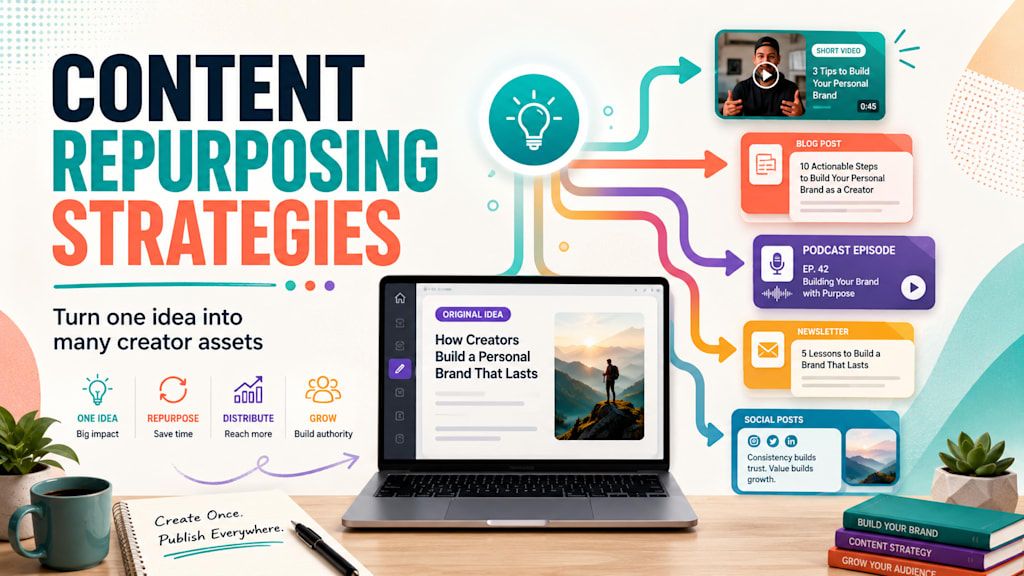
Content repurposing allows creators to extract more value from work they have already completed. It turns one source asset into several focused pieces that can be used across video, social media, newsletters, blogs, podcasts, carousels, and other formats. The creator does not need to repeat the same post everywhere. Instead, they can identify the strongest parts of the original content and adapt each one for a different purpose.
This approach makes content production more sustainable. It reduces the pressure to invent something completely new every day while helping strong ideas reach people who may never consume the original format.
Why good content often gets underused
Creators are encouraged to stay active, publish frequently, and keep producing. That pressure can make each content asset feel disposable. Once something has been uploaded, attention quickly shifts toward the next deadline.
The result is a growing archive filled with unused value.
A long interview may contain a clear answer to a common question, a personal lesson, a strong opinion, a practical process, and several useful examples. A tutorial may contain smaller sections that could each work as an independent explanation. A newsletter may include an idea that deserves to become a full video or article.
When these moments remain inside the original asset, the creator depends on the audience finding and consuming the complete version. That may work for existing followers, but it limits discovery.
People consume content in different ways. Some prefer short video. Others would rather read. Some discover creators through search. Others respond to a thoughtful social post or a useful newsletter. Repurposing gives the same idea more than one route to the audience.
A better way to plan repurposed content
The strongest Content Repurposing Strategies for Creators begin with one useful source asset and a clear understanding of the ideas inside it. The source might be a podcast, long-form video, interview, livestream, article, newsletter, webinar, or recorded conversation.
The first step should be review, not editing.
Creators need to identify which sections can stand on their own. A moment may be interesting inside the full discussion but confusing when removed from it. Another section may contain a complete lesson that makes immediate sense to someone who has never seen the original.
A strong repurposing candidate usually does at least one of the following:
- Answers a real question
- Explains a subject clearly
- Shares a useful personal lesson
- Offers a process or framework
- Challenges a familiar assumption
- Shows proof, experience, or results
- Tells a meaningful story
- Reveals personality
- Encourages discussion
- Solves a specific problem
Once those moments have been identified, they can be matched with suitable formats. A concise answer may become a short video. A deeper explanation may work better as an article. A practical process could become a carousel. A personal lesson may be ideal for a newsletter.
The idea should determine the format.
One source can support several different angles
Repurposing works best when creators develop a subject rather than repeat one statement.
Imagine a creator publishes a long video about building an online audience. That source could include ideas about consistency, positioning, storytelling, email lists, audience research, collaborations, and analytics. Each of these ideas could support a separate piece of content.
The original video might later become:
- A short clip about choosing a clear topic
- A written post about a mistake made early on
- A carousel showing the stages of audience trust
- A newsletter about staying consistent
- A blog article about finding the right audience
- A discussion post about what followers value most
- A podcast follow-up based on audience questions
The content remains connected, but each piece offers a different entry point.
This helps creators build authority because the audience sees depth around a subject. Instead of publishing unrelated ideas, the creator develops a recognizable body of work.
The theme creates consistency. The angle creates variety.
Repurposing is not the same as reposting
Reposting is usually a direct repeat. Repurposing requires adaptation.
A podcast transcript copied into a blog post will often feel awkward. A section from an article pasted into a social caption may take too long to reach the point. A video clip may require additional context before it makes sense to a new viewer.
Each platform has its own expectations.
A short-video audience needs the subject quickly. A blog reader may want a complete answer. Newsletter subscribers may appreciate a more personal explanation. Social media users may respond better to one clear observation, question, or story.
The central idea can remain the same, but the structure should change.
Before publishing a repurposed asset, creators should ask:
- Does this version work independently?
- Is the opening suitable for the platform?
- Does the audience need more context?
- Is the length appropriate?
- Does this version add anything useful?
- Is there a clear reason to watch, read, save, share, or respond?
These questions help the content feel native rather than copied.
Short-form video should focus on one complete point
Short-form video is one of the most useful repurposing formats because it gives new viewers a quick introduction to a creator’s work.
A person may not watch an entire podcast or webinar immediately, but they may watch a short clip that answers a relevant question. That clip can introduce the creator’s voice, point of view, and expertise.
However, not every moment from a long recording works as a short video.
The clip may begin halfway through a thought. The speaker may refer to something discussed earlier. The conclusion may feel abrupt. The main point may take too long to become clear.
A useful short clip generally needs:
- A clear first sentence
- One focused idea
- Enough context for a new viewer
- Natural pacing
- Readable captions
- A practical or memorable takeaway
- An ending that feels complete
Editing should improve clarity without removing personality.
Fast cuts, sound effects, and animated captions can be helpful, but they should suit the creator’s style. A business educator may benefit from cleaner editing. A storyteller may need more space. A comedian may depend on timing. A coach may need examples and text on screen.
The edit should support the message rather than compete with it.
Spoken content can become strong written material
Creators who record regularly often have a large amount of written content hidden inside their audio and video files.
A podcast answer can become a social post. A tutorial can become an article. A livestream conversation can become a newsletter. A list of recommendations can become a carousel or checklist.
The written version should not be a raw transcript.
People naturally repeat themselves when speaking. They use filler words, change direction, and explain ideas in an uneven order. Written content needs a clearer structure.
A spoken section can be improved by:
- Removing repetition
- Moving the main idea forward
- Grouping related points
- Adding headings
- Including examples
- Improving transitions
- Ending with a clear conclusion
- Preserving the creator’s natural voice
Spoken content can be developed into:
- Blog articles
- Newsletter sections
- Social posts
- Threads
- Carousels
- Checklists
- FAQ answers
- Downloadable guides
- Resource pages
- Future video scripts
This also helps creators reach people who prefer reading and gives useful ideas a longer lifespan than a fast-moving video feed.
A content library makes the process easier
A content calendar shows what needs to be published next. A content library shows what the creator already has available.
The library can include:
- Long-form source assets
- Useful timestamps
- Strong quotations
- Audience questions
- Personal stories
- Statistics
- Case studies
- Unfinished ideas
- High-performing posts
- Topics worth revisiting
- Content that could become a larger guide
The library can be organized by topic, format, date, audience problem, or production stage. A spreadsheet, project board, database, document, or folder system can all work.
The important thing is being able to find useful material again.
Without a searchable archive, creators often forget what they have already produced. A strong idea may remain hidden inside an old recording simply because nobody remembers where it appeared.
A content library turns previous work into an active creative resource.
A repeatable workflow reduces pressure
Repurposing becomes most useful when it is included in the normal publishing process.
A practical workflow may look like this:
- Create one strong source asset around a clear subject.
- Review it and mark the best moments.
- Group those moments by topic or purpose.
- Select only the strongest ideas.
- Match each idea with the most suitable format.
- Edit or rewrite the piece so it works independently.
- Adapt it for the platform.
- Schedule related content with enough space between each piece.
- Track the audience response.
- Use those results to guide future source content.
This process creates a loop.
The original content produces smaller assets. The performance of those assets reveals what the audience cares about. Those signals can then shape the next podcast, article, livestream, newsletter, or video.
The creator is no longer starting from an empty page every time.
Do not turn every sentence into content
Repurposing can become less effective when the goal becomes maximum output.
Not every moment deserves to become a clip, post, carousel, or article. Some sections are too weak. Others need too much context. Some repeat what has already been said. A few may simply belong inside the original asset.
A repurposed piece should do at least one meaningful job. It should teach, entertain, explain, challenge, inspire, prove, or connect.
If it only exists to fill a gap in the calendar, it may not be worth publishing.
Creators should also avoid exhausting a topic. One strong idea can support several angles, but similar pieces should be spread across the content schedule. A short clip, article, carousel, and newsletter can all come from the same source without being published within the same day.
Spacing gives each version room to perform.
Measure more than views
Views are useful, but they are not the only sign of successful repurposing.
A short clip with modest reach may generate several profile visits. A written post may create thoughtful comments. A newsletter may receive replies. A carousel may earn saves. A blog article may continue attracting readers months after publication.
Creators should also pay attention to:
- Watch time
- Completion rate
- Shares
- Saves
- Comment quality
- Profile visits
- Link clicks
- Newsletter signups
- Enquiries
- Sales
- Topics that repeatedly perform well
These signals reveal which ideas deserve further development.
A strong short clip may become a full video. A newsletter topic may become a podcast episode. A saved carousel may become a guide. A question in the comments may reveal the next subject worth exploring.
Repurposing can guide future content, not only extend previous work.
Final thoughts
Creators do not need a completely new idea for every platform, every day.
A podcast, video, article, interview, livestream, or newsletter can provide enough material for several useful pieces when the strongest moments are selected and adapted properly. The original asset creates depth. The repurposed versions make that depth easier to discover.
The goal is not to copy the same message everywhere. It is to develop one useful subject through several formats and angles, each with its own purpose.
When creators build a system around their strongest work, content becomes easier to manage, consistency becomes more sustainable, and valuable ideas continue working long after the original publish date.
About the Creator
Clipping Agency
Clipping Agency drives creator growth through clipping services, clipping campaigns, and clipping marketing, turning long-form content into short-form momentum at scale.
Enjoyed the story? Support the Creator.
Subscribe for free to receive all their stories in your feed.
Comments
There are no comments for this story
Be the first to respond and start the conversation.