
Forget AI: use Scrivener!
Scrivener is the writing programme I couldn't live without: get it for a discount with Vocal. You won't be sorry...



I was in despair. I was quite a long way in to researching Chief Engineer, my biography of Washington Roebling, builder of the Brooklyn Bridge. It was a big undertaking: I had to learn about, and gather material on... oh, let's see, shall we? 19th century engineering. The Civil War. The history of immigration to the United States from Europe. Iron and steel manufacture. The history of women's education. I could go on — you get the idea. Now, bear in mind too: I'd written a few books, but nothing on this scale, and the question of how I would organize and order my material was starting to give me sleepless nights. I had a zillion Word documents which I named and renamed, put in this folder or that folder... yikes. I stared at my screen, my heart pounding.
And then one fortunate day, I found myself sitting in the kitchen of a beloved friend, the wonderful novelist Min Jin Lee, whose book Pachinko — then, not yet published — has been such a hit. I was sharing my struggles with her as we sat with our cups of tea.
"Have you tried Scrivener?" she asked me. She began to sing the praises of the writing software that — she said — had been instrumental in helping her to gather and organize her research and her thoughts. Check it out, she said.
Advice from Min is not to be ignored, so I downloaded the programme — not expensive, created by a small, independent British company — and did the tutorial provided. An important note: I do NOT think of myself as a computer-literate person! I am not naturally drawn to organizational software or other products. I find them... well, scary. I like a pencil and paper, a box of index cards, a pinboard, Post-It notes. And yet, as I went through the clear and helpful tutorial provided, I could see how Scrivener was going to unlock my potential.
As I would say to my writing students, using an old-skool metaphor: Scrivener is the difference between having a giant pile of papers on your desk and owning a filing cabinet. Okay, like I say: old-skool. You may never use paper to write and — what's a "filing cabinet"? I'm teasing, I know you know. Simply put: Scrivener saved my writing life, and I'm never working without it again.
It works for fiction and non-fiction, for essays and scriptwriting. It offers different templates for each form, but always there's the "binder", the big overarching document that holds your work. It's divided into two: the top half for the work itself, the bottom half for your research. In the latter you can easily import web pages, PDFs, images, anything, really, that's useful to you. It's simple to see how your work is ordered and to experiment with changes in a way that's not scary ("Eeek... what did I call that draft again???"). In the fiction template you can create character studies, and you can easily track the progress of your characters and the developments in your plot.
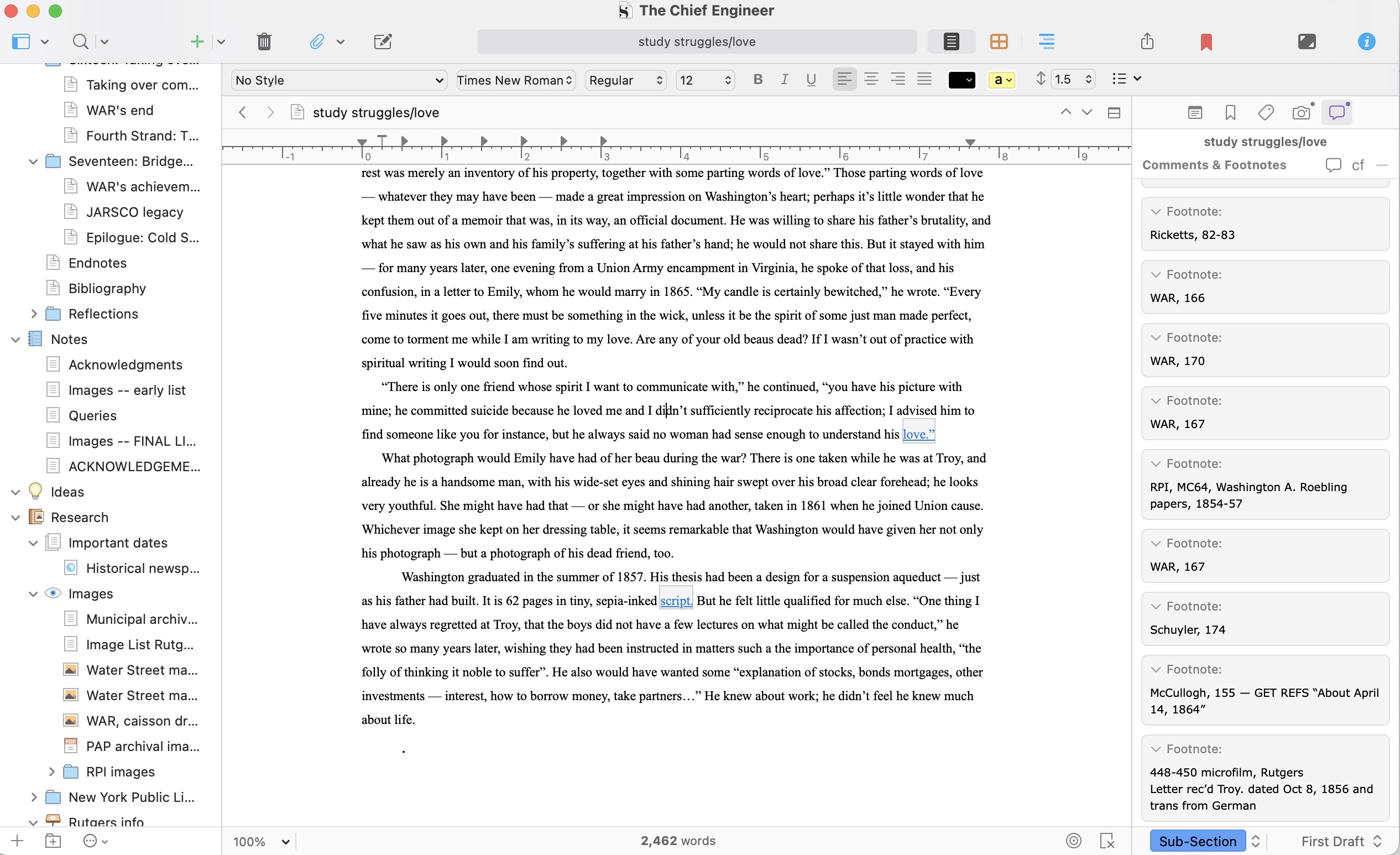
Above, a little screenshot of a draft of Chief Engineer. To the left you can see the binder, with my draft and my research; on the right are my footnotes. This is a non-fiction book, of course; but the principle applies whatever you're writing.
And you know what else? It's fun. Let's get serious: writing is hard. It's just you and your work — but Scrivener is a helpful companion, always ready to give you a boost. I love the look of it, the sense I have that things are somehow in control, even when they may not be... because that's also the joy of writing.
Because writing means creating what's new — and Scrivener will help you do that. Sure, these days you can bang out an outline, or a whole story, with ChatGPT... but why would you want to do that? AI can only "create" from work already available: in fact, that's not creation at all, just regurgitation. You know it, I know it. We are, on the other hand, in the business of surprising our readers, of real creation: if you need a tool to help you, Scrivener is the one to choose.
Thanks to our partnership with Scrivener — which I sought out personally, because the software means so much to me — users of Vocal can get a 20% discount on Scrivener for macOS or Windows when you buy it through our store: just use the coupon code VOCAL. Let's get started!
I can't wait to read what you write with Scrivener — post it on Vocal, and I'll check it out!
About the Creator
Erica Wagner
Lead Editorial Innovator, Vocal. Author, critic, friend, parent, cook. New book: Chief Engineer: Washington Roebling, The Man Who Built the Brooklyn Bridge. Twitter: @EricaWgnr, Insta: @ericawgnr
Enjoyed the story? Support the Creator.
Subscribe for free to receive all their stories in your feed. You could also become a paid subscriber, letting them know you appreciate their work.
Comments
There are no comments for this story
Be the first to respond and start the conversation.