
Brand Clipping Campaign: The Content Engine Brands Ignore
How brands can turn webinars, podcasts, demos, and customer stories into short clips that keep strong ideas moving across every channel

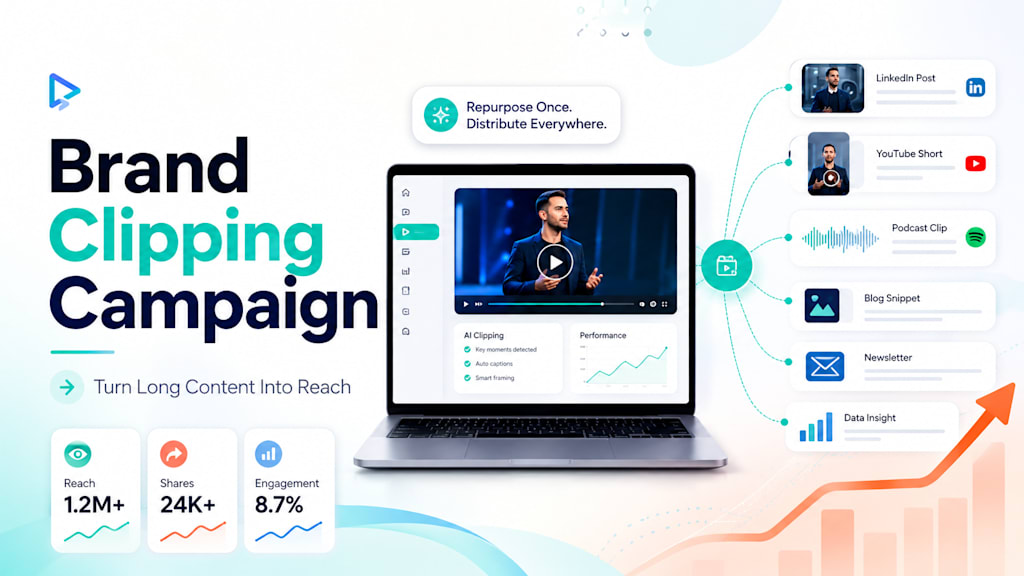
A brand can record a strong webinar, publish a podcast with useful ideas, film a product demo, or capture a customer story, and still get very little lasting value from it. Not because the content is weak, but because the best moments are often trapped inside long recordings that only a small audience ever sees.
This is where many brands quietly lose reach. They keep creating new assets while older content still contains insights, proof, explanations, and stories that could be working across social, email, sales, and campaign channels.
A brand clipping campaign changes that. It takes the most useful parts of long-form content and turns them into short, focused clips that can move across platforms with a clear purpose. The goal is not to create more noise. The goal is to build a repeatable content engine from the material the brand has already invested in.
For brands that produce webinars, podcasts, founder interviews, customer stories, product demos, event recordings, or educational videos, this approach can unlock a lot of value. It helps strong ideas travel further instead of disappearing after one post.
The problem is not content volume, it is content movement
Most brands are producing something. They may not publish every day, but they usually have more content than they think. The real issue is that the content does not move far enough after it is created.
A webinar may be promoted before it happens, shared once after it ends, and then added to a resource page. A podcast may get one social post and one newsletter mention. A customer story may be used in a case study but never turned into short proof clips. A product demo may answer several important questions, but only people who watch the full video ever see those answers.
This creates a gap between content creation and content distribution.
The brand has already done the hard work. It has recorded the video, captured the idea, edited the asset, and published the main piece. But if the content is not broken down and shared in smaller ways, most of its value remains locked inside the original format.
A strong clipping campaign helps solve this by giving content more movement. It turns one long asset into several shorter pieces that can be used across different platforms and stages of the customer journey.
Why long-form content usually has more value than one post can capture
Long-form content often contains multiple ideas. A single webinar can answer customer questions, explain a product, address objections, share market insight, and show expertise. A podcast can include founder opinions, industry commentary, practical lessons, and personal stories. A product demo can show use cases, workflows, features, and common pain points.
The problem is that long-form content usually gets treated as one asset. It gets one title, one thumbnail, one post, and one link. That approach misses the smaller moments inside it.
A long-form asset can contain:
- A strong opinion that could work well on LinkedIn
- A customer problem that could become an awareness clip
- A product explanation that could support sales
- A proof point that could be used on a landing page
- A practical tip that could work as a short video
- A founder insight that could build trust
- A short story that could make the brand feel more human
When brands only promote the full piece, many of these moments are never seen by the people who would find them useful.
Clipping helps the brand separate those moments and give each one a purpose.
What a clipping campaign does differently from basic repurposing
Basic repurposing often means taking one asset and putting it somewhere else. A blog becomes a social post. A webinar becomes a replay link. A podcast becomes a quote graphic. That can help, but it is usually limited.
A clipping campaign is more intentional. It looks at a long-form asset and asks how the best moments can be turned into short-form pieces that support a broader goal.
That goal might be:
- Building awareness
- Educating the audience
- Supporting a product launch
- Helping sales conversations
- Building founder visibility
- Showing customer proof
- Explaining a complex idea
- Keeping the brand active across platforms
The campaign mindset changes the quality of the work. The team is not clipping just because there is a video available. It is selecting moments because they support the message the brand wants to spread.
A proper campaign also thinks about sequence. One clip might introduce the problem. Another might explain why it matters. Another might show the solution. Another might provide proof. Together, these clips help the audience understand the brand from different angles.
That is very different from posting random snippets and hoping one of them performs.
The moments worth clipping are usually hidden in plain sight
The best clips are not always the most polished parts of a video. They are often the moments where someone explains something clearly, says what the audience is already thinking, answers a common objection, or shares a simple story that makes the topic easier to understand.
These moments are easy to miss if the team is only looking for obvious highlights. A loud line or energetic section may seem like the best clip, but a quieter explanation can often be more useful.
Good clipping moments might include:
- A founder explaining why the company exists
- A customer describing the problem before using the product
- A product expert answering a common question
- A speaker challenging a common belief
- A team member simplifying a complex topic
- A short story that shows the brand’s point of view
- A practical lesson from a webinar or podcast
The key is whether the moment can stand alone. A clip should make sense to someone who has never watched the full video. It should give the viewer enough context to understand the point and enough value to keep watching.
How one recording can support awareness, trust, and sales
One strong recording can support different parts of the customer journey when it is clipped properly. This is where a brand clipping campaign becomes more than a social media tactic.
A webinar, for example, can produce awareness clips, trust-building clips, and sales support clips from the same source material.
Awareness clips may focus on:
- Industry problems
- Market shifts
- Common mistakes
- Short educational lessons
- Founder opinions
- Simple explanations
Trust-building clips may focus on:
- Customer stories
- Expert advice
- Product clarity
- Behind-the-scenes thinking
- Honest answers
- Proof points
Sales support clips may focus on:
- Common objections
- Feature explanations
- Use cases
- Product walkthroughs
- Customer results
- Comparison points
This makes clipping practical. The same long-form content can work for different teams and different channels. Marketing can use clips for awareness. Sales can use clips in follow-ups. The website can use clips for proof. Email can use clips to keep leads engaged.
When the campaign is planned properly, one recording becomes a library of useful assets.
Why short clips help brands explain complex ideas faster
Many brands sell products or services that need explanation. They cannot always rely on a single tagline or landing page section to communicate the full value. The audience may need to understand the problem, the process, the difference, the use case, and the proof before they are ready to take action.
Short clips help because they reduce the friction. A viewer may not be ready to watch a full demo or attend a full webinar, but they may watch a short clip that answers one question.
This works especially well for:
- SaaS companies
- Agencies
- Consultants
- B2B service providers
- Coaches
- Education brands
- Creator-led businesses
- Product-led companies
- Founder-led brands
Short clips make complex ideas easier to absorb because each clip focuses on one point. Instead of asking the audience to understand everything at once, the brand teaches one idea at a time.
That makes the content easier to watch, easier to remember, and easier to share.
Using clipped content across social, email, landing pages, and sales
A good clipping campaign does not stop at social media. Short clips can support many parts of marketing and sales.
A brand can use clipped content on:
- Instagram Reels
- TikTok
- YouTube Shorts
- X
- Email newsletters
- Landing pages
- Blog posts
- Paid retargeting
- Sales follow-ups
- Community posts
- Internal enablement materials
For example, a founder insight clip can work well on LinkedIn. A customer proof clip can improve a landing page. A short product explanation can be added to a sales follow-up email. A webinar clip can be used in a newsletter. A practical tip can become a Reel or Short.
The same idea can often be adapted for different channels, but the format should fit the platform. A LinkedIn clip may need a more thoughtful caption. A Reel may need a faster opening. A sales follow-up clip may need less branding and more direct clarity.
The point is not to paste the same thing everywhere. The point is to make one useful idea work in multiple places.
How to avoid turning good content into forgettable clips
Clipping can make strong content more visible, but poor clipping can also make good content look average. This happens when brands focus on output instead of judgment.
Forgettable clips usually have the same issues. They start slowly, lack context, feel too promotional, or end before the idea lands. They may look polished but still fail to give the viewer a reason to care.
Brands should avoid:
- Cutting clips only because the footage exists
- Choosing moments without a clear purpose
- Starting too far before the main point
- Removing so much context that the clip feels confusing
- Making every clip sound like a sales pitch
- Using captions that are hard to read
- Posting without a schedule
- Ignoring platform differences
- Repeating the same format too often
- Failing to track what performs
A strong clip should have one clear idea, a useful opening, enough context, clean pacing, readable captions, and a complete ending. It should feel like a finished piece of content, not a random section of a longer video.
Good clipping is not just editing. It is selection, structure, and distribution.
Building a repeatable clipping workflow instead of posting randomly
A strong clipping campaign needs a process. Without a process, the team may clip content only when someone remembers, or when the social calendar feels empty. That leads to inconsistent output and weaker results.
A repeatable workflow makes clipping easier to manage.
A practical workflow can look like this:
- Choose the long-form source content
- Define the audience and campaign goal
- Select the main content themes
- Review the full recording
- Identify moments with standalone value
- Group clips by purpose
- Edit each clip around one clear idea
- Add readable captions
- Format clips for each platform
- Write platform-specific captions
- Schedule the clips
- Track performance
- Use results to guide the next batch
This gives the team a system. Every time the brand records a webinar, podcast, demo, interview, or customer story, it knows how to turn that asset into short-form content.
Over time, the brand starts building a content engine instead of relying on one-off posts.
Where a Brand Clipping Campaign fits into a wider content strategy
A clipping campaign works best when it is connected to the wider content strategy. It should support the brand’s main themes, audience needs, campaign goals, and customer journey.
For example, if a brand wants to build authority around a specific topic, clips should reinforce that topic repeatedly from different angles. If the goal is lead nurturing, clips should answer questions and objections. If the goal is founder-led visibility, clips should highlight point of view, experience, and personality.
A structured Brand Clipping Campaign helps turn existing videos into repeatable short-form content that supports visibility, education, trust, and distribution across platforms.
This is important because clipping should not feel separate from the rest of the marketing. It should connect to the brand’s messaging, sales process, campaigns, and audience education.
When clipping is connected to strategy, every clip has a job.
What a good clipping partner should actually bring to the table
A clipping partner should do more than cut videos into smaller pieces. Basic editing is useful, but it is not enough. The real value comes from understanding what should be clipped, how it should be shaped, and where it should be used.
A good clipping partner should bring:
- Content judgment
- Audience understanding
- Platform awareness
- Strong editing fundamentals
- Clear caption styling
- Campaign thinking
- Brand voice awareness
- Consistent delivery
- Performance learning
- A repeatable workflow
The best partner can look at a long recording and find the moments that matter. They can tell which clips are useful for awareness, which ones support trust, and which ones may help sales. They can also avoid generic edits that make every brand look the same.
A good clipping partner does not just deliver files. They help the brand turn content into distribution.
Final thoughts: make every strong idea travel further
A brand clipping campaign is valuable because it gives strong ideas more life. It helps brands stop treating long-form content as a one-time asset and start using it as a source of ongoing distribution.
The best moments inside a webinar, podcast, demo, interview, or customer story should not be buried after one post. They should be turned into clips that help the audience understand the brand, trust the message, and remember the value.
For brands already investing in content, clipping is one of the most practical ways to increase reach without starting from zero every week. It makes existing content work harder. It supports awareness, trust, education, campaigns, and sales.
When planned properly, a brand clipping campaign becomes more than repurposing. It becomes the hidden content engine that helps every strong idea travel further.
About the Creator
Clipping Agency
Clipping Agency drives creator growth through clipping services, clipping campaigns, and clipping marketing, turning long-form content into short-form momentum at scale.
Enjoyed the story? Support the Creator.
Subscribe for free to receive all their stories in your feed.
Comments
There are no comments for this story
Be the first to respond and start the conversation.