
AI Clipping vs Human Clipping: A Practical Guide
How creators and brands can choose the right mix of automation, human judgment, context, and quality for better short-form clips

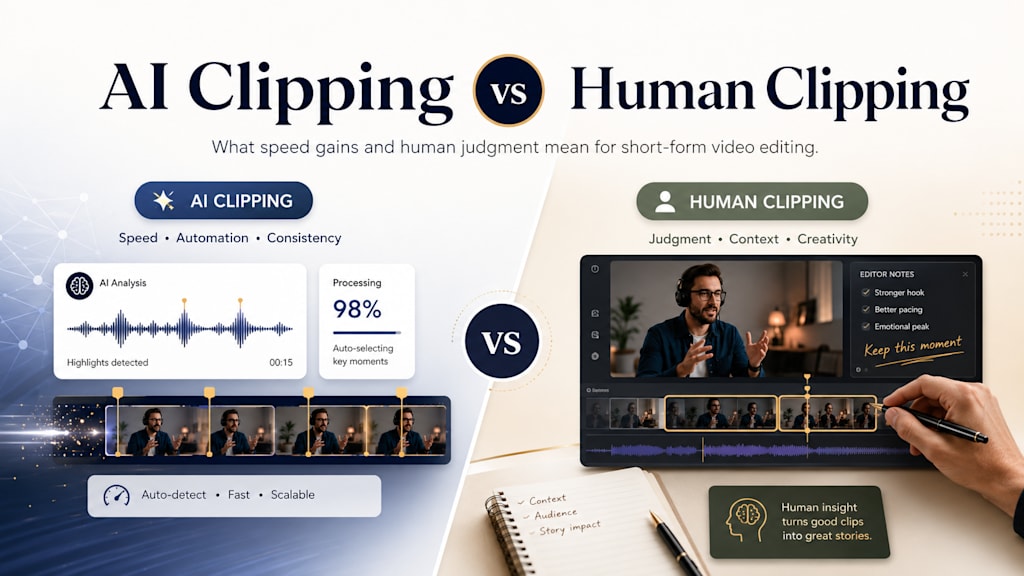
AI clipping tools have made short-form video production feel easier than ever. A creator can upload a podcast, webinar, livestream, YouTube video, founder interview, or product demo and receive a set of short clips in minutes. The tool can detect possible highlights, add captions, crop the video for vertical platforms, and prepare clips for TikTok, Instagram Reels, YouTube Shorts, LinkedIn, and other channels.
That sounds useful because the demand for short-form video is high. Creators want more clips from their long videos. Brands want more content from webinars, podcasts, events, customer stories, and product demos. Agencies want faster workflows. Founders want their ideas distributed without spending hours in editing timelines. In that sense, AI clipping solves a real problem. It helps turn long-form content into something easier to process and repurpose.
But a strong short-form clip is not only a smaller part of a longer video. It has to work on its own. It needs a strong opening, enough context, clean pacing, readable captions, and a clear reason for someone to keep watching. It should also represent the creator or brand properly. If a clip feels random, confusing, flat, or unfinished, the speed of production does not matter much.
That is why this guide looks at AI clipping vs human clipping in a practical way. The goal is not to say that one is always better than the other. The goal is to understand what each approach does well, where each one struggles, and how creators and brands can choose the right workflow for better short-form content.
What AI clipping actually means
AI clipping is the use of software to scan long-form video and identify moments that could work as short clips. Depending on the tool, it may use transcripts, audio patterns, speaker detection, facial movement, keywords, pacing, or other signals to choose sections of the video. It may also generate captions, crop the video into vertical format, and export clips for social media.
In simple terms, AI clipping helps with the first layer of short-form video production. It can review long content faster than a human, suggest moments, and handle repetitive formatting tasks. For anyone dealing with a large volume of video, that can be a big help.
AI clipping can be useful for:
- Long podcasts
- Webinars
- Livestreams
- Interviews
- Educational videos
- Talking-head content
- Product demos
- Event recordings
- Founder videos
- Coaching or training sessions
The main benefit is efficiency. A creator or brand does not have to start from zero. Instead of manually watching a full recording, they can use AI to create draft clips and then decide what deserves more attention.
What AI clipping does well
AI clipping is best at speed and repetition. It can process a long video quickly, create multiple draft clips, generate captions, and make the content easier to review. This is helpful when a team has many recordings but limited editing time.
AI clipping does well with:
- Finding possible highlights quickly
- Creating rough cuts from long videos
- Adding basic captions
- Reframing horizontal videos into vertical format
- Detecting speaker changes
- Sorting through large content libraries
- Producing several clip options
- Reducing repetitive editing work
This makes AI especially useful for simple, structured videos. If a speaker gives direct answers, the audio is clean, and the topic is easy to follow, AI can often find usable sections. A clear educational video, for example, may produce several decent draft clips because the ideas are already separated and easy to understand.
AI can also help teams move faster when they need volume. If a brand records multiple webinars each month, or a creator publishes long videos every week, AI can help create the first batch of possible clips without slowing down the entire content process.
The key phrase here is “first batch.” AI can help find options, but not every option should be published.
Where AI clipping falls short
The biggest limitation of AI clipping is judgment. AI can detect a moment that looks strong from a technical point of view, but it may not understand whether the clip actually works for a viewer.
A short-form clip has to make sense to someone who has not watched the full video. The viewer may not know the speaker, the topic, or the context of the conversation. If the clip starts too late, it may feel confusing. If it starts too early, it may feel slow. If it ends before the point lands, it may feel incomplete.
AI can struggle with:
- Choosing the best starting point
- Knowing how much context is needed
- Understanding humour or irony
- Recognising emotional tone
- Protecting brand voice
- Preserving a creator’s natural style
- Knowing whether a clip feels complete
- Avoiding repetitive clip choices
- Deciding whether the audience will care
This is why AI-generated clips can sometimes look polished but still feel weak. The captions may be accurate. The video may be cropped properly. The timeline may look clean. Still, the clip may not have a strong reason to exist.
A clip is not valuable only because it contains a sentence from a long video. It is valuable when that sentence, story, explanation, or moment gives the viewer something clear and useful.
What human clipping means
Human clipping is when a person reviews the content, chooses the best moments, and edits them with context, pacing, audience, and brand voice in mind. A human editor is not only cutting footage. They are deciding what should be turned into a clip and why.
That difference matters.
A good editor watches for meaning. They look for moments that can stand alone. They notice when a clip needs one more sentence before the main point. They know when a slow opening should be removed. They can tell when a technically clean clip is still too boring or too vague to publish.
Human clipping brings:
- Story sense
- Audience understanding
- Better hook selection
- Context management
- Cleaner pacing
- Emotional judgment
- Brand awareness
- Creative decision-making
- Quality control
This is why human clipping often produces stronger final content. It is not only about making the video look better. It is about making the clip feel more complete, more useful, and more aligned with the reason it is being published.
Why context matters so much
Context is one of the most important parts of short-form video. A good clip gives the viewer enough information to understand the point, but not so much that the clip becomes slow.
This balance is difficult. Too much setup makes people leave. Too little setup makes the clip confusing. The editor has to decide where the real clip begins.
A strong clip should answer these questions:
- What is being discussed?
- Why should the viewer care?
- What is the main idea?
- Does the clip make sense without the full video?
- Does the ending feel complete?
- Does the clip fit the creator or brand?
AI can identify speech patterns, but context requires editorial judgment. A human editor can understand the conversation before and after the clip. They can decide whether the viewer needs more setup or whether the clip should start closer to the main idea.
This is one of the biggest reasons human clipping still matters.
Why the best clips are not always obvious
Many people think the best clips are always the loudest, funniest, or most energetic parts of a video. Sometimes they are, but often the best moments are more subtle.
A founder may explain a customer problem in a simple way. A podcast guest may tell a short story that makes a topic easier to understand. A creator may share a small observation that the audience immediately relates to. A product expert may answer one common question better than a full sales page.
These moments may not always stand out to AI because they do not always have dramatic delivery or obvious keywords. But they can be powerful because they create clarity, trust, or recognition.
Strong clips often create:
- Curiosity
- Clarity
- Trust
- Practical value
- Emotional connection
- Recognition
- A reason to watch more
A human editor is better at recognising these qualities because they can think like the audience. They can ask whether the clip would make someone pause, save, share, comment, or continue watching.
AI clipping vs human clipping for creators
For creators, clips are part of personal branding. They show the creator’s tone, humour, timing, opinions, expertise, and relationship with the audience. A weak clip can make a good creator look less interesting than they really are.
AI clipping can help creators when they need:
- Fast rough drafts
- Basic captioned clips
- Quick highlight suggestions
- More output from long videos
- First-pass review of podcasts or livestreams
- Simple clips for regular posting
Human clipping is better when creators need:
- Stronger hooks
- Better storytelling
- Natural pacing
- Personality preserved
- Better brand deal clips
- Stronger audience connection
- Clips that support long-term growth
If a creator is posting casually, AI may be enough for some clips. If the creator is building a serious audience, selling products, working with sponsors, or trying to build authority, human editing usually adds more value.
AI clipping vs human clipping for brands
Brands need to be even more careful because every clip shapes perception. A weak clip can make a company sound unclear, generic, or too promotional. This matters when the content features founders, executives, customers, product experts, or team members.
A brand clip needs to support trust. It should explain something clearly, show expertise, build credibility, or help the audience understand the company’s point of view. It should not feel like a random highlight pulled from a long video.
For brands, AI clipping can help with:
- Reviewing long recordings
- Finding possible moments
- Creating draft clips
- Generating captions
- Speeding up production
Human clipping helps with:
- Choosing clips that support the message
- Protecting brand voice
- Avoiding confusing edits
- Improving pacing
- Making clips useful instead of promotional
- Supporting campaigns
- Keeping the final output credible
A practical approach to AI Clipping vs Human Clipping is about understanding when automation saves time and when human judgment is needed to protect quality, context, and trust.
For brands, this difference is important. The goal is not simply to publish more short-form videos. The goal is to publish clips that make the brand easier to understand and remember.
When AI clipping may be enough
AI clipping may be enough when the content is simple, the stakes are low, and the goal is speed. If the source video is clean and direct, AI can often produce usable draft clips.
AI clipping can work well for:
- Simple talking-head videos
- Basic educational content
- Internal review
- Quick rough drafts
- Basic captioned clips
- Large content libraries
- Testing topics
- Fast highlight extraction
Even in these cases, someone should still review the clips before publishing. A clip can look finished and still be weak. A quick human review can help remove awkward starts, confusing endings, or low-value moments.
When human clipping is the better choice
Human clipping is better when the content needs strategy, context, taste, or careful handling. If the clip represents a brand, founder, expert, customer, or sponsored campaign, the final edit should not be left entirely to automation.
Human clipping is usually better for:
- Founder-led content
- Thought leadership
- Brand campaigns
- Customer stories
- Sponsored creator content
- Complex podcast conversations
- Clips that need strong hooks
- Content that must preserve personality
- Short-form assets tied to growth goals
The more important the content is, the more human judgment matters.
Why the hybrid approach often works best
The strongest workflow is often not AI or human. It is both.
AI can handle the first pass. It can scan the video, create transcripts, suggest possible clips, and generate captions. A human editor can then review the suggestions, remove weak options, improve the opening, shape the pacing, clean up the captions, and make sure the final clip is worth publishing.
A hybrid workflow may look like this:
- AI scans the long-form video
- Possible clips are suggested
- Captions are generated
- Draft clips are created
- A human editor reviews the options
- Weak clips are removed
- Strong clips are refined
- Openings and endings are improved
- Captions are cleaned up
- Final clips are checked for tone and purpose
This gives creators and brands the benefit of speed without losing the value of human judgment. AI reduces manual work. Humans protect the final result.
What makes a clip worth publishing
Whether a clip starts with AI, a human editor, or both, it should pass a quality check before it goes live.
A strong clip should have:
- One clear idea
- A strong opening
- Enough context for new viewers
- Clean pacing
- Captions that are easy to read
- A natural ending
- A tone that fits the creator or brand
- A reason for the viewer to care
- A purpose beyond filling the content calendar
This matters because more clips are not always better. Weak clips can make an audience ignore future posts. Random clips can make a brand feel unfocused. Good clipping should turn strong moments into useful short-form assets.
Final thoughts
AI clipping has made short-form content faster to produce. That is useful. It helps creators, brands, and agencies process long videos, create drafts, and reduce repetitive editing work.
But speed is not the same as strategy. A strong clip still needs context, timing, clarity, tone, and purpose. It needs to work for someone who may know nothing about the original video.
Human clipping remains valuable because it brings judgment, story sense, and audience understanding. It helps turn raw moments into clips that feel intentional and worth watching.
For many creators and brands, the best answer is not AI or human. It is AI for speed and humans for quality. That balance creates short-form content that is faster to produce, but still clear, useful, and strong enough to publish.
About the Creator
Clipping Agency
Clipping Agency drives creator growth through clipping services, clipping campaigns, and clipping marketing, turning long-form content into short-form momentum at scale.
Enjoyed the story? Support the Creator.
Subscribe for free to receive all their stories in your feed.
Comments
There are no comments for this story
Be the first to respond and start the conversation.