
Your New EV Has No Spare Tire. Here’s How to Decide Before Your Road Trip
I watched a driver wait four hours in Qinghai for a tow. The answer depends on where you’re going.
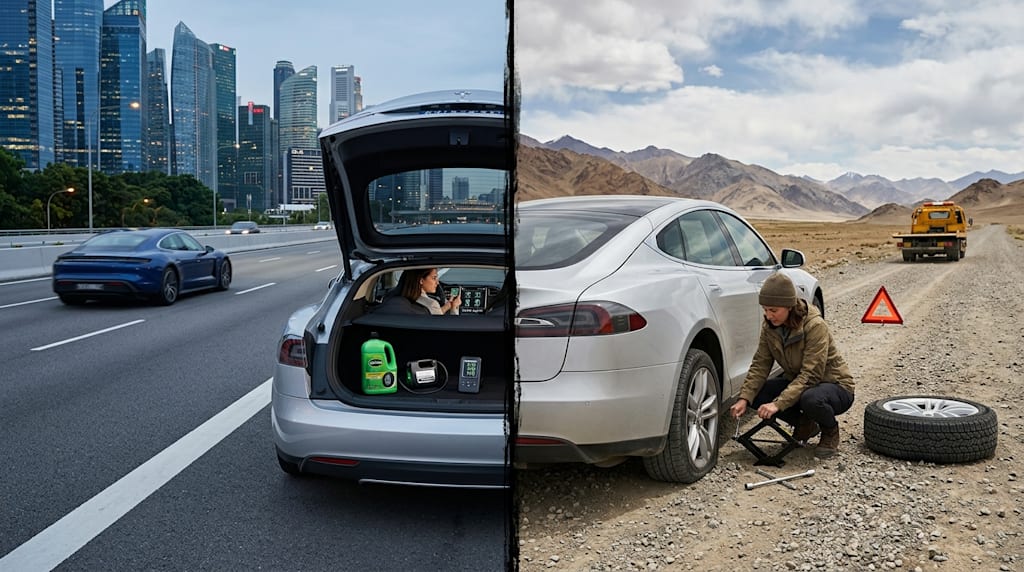
Last year in Lenghu, Qinghai, I saw a new energy vehicle parked on the roadside. Its right rear tire was flat. A gash ran down the sidewall, as if someone had cut it with a knife. The owner stood in the wind making phone calls. The signal kept cutting out. In his trunk was a bottle of tire sealant. It was empty. White goo was smeared on the wheel. He said he had called roadside assistance. They told him the nearest vehicle was three hundred kilometers away. It would take at least four hours.
He asked me if I had a spare tire.
I did not.
That was the moment I stopped thinking of a spare tire as a spec-sheet item. It is a question your route asks you.
Supercars and off-road vehicles already wrote the answer
Supercars do not carry spare tires. They only drive on paved roads, and usually good ones. The chassis is so low it struggles over a speed bump, let alone gravel, gobi, or no man’s land. Within their normal range, tire shops and tow trucks are within reach. No spare tire is a design premise.
Off-road vehicles must carry a spare. They are built to leave paved roads. Gravel, mud, desert, and no man’s land are their daily routine. If you get a flat out there, rescue may be hours or days away. No spare tire means handing your life to luck.
New energy vehicles follow the supercar logic. By default, you drive on paved roads. Rescue is reachable. Tire sealant and an air pump can get you to a tire shop.
That default holds in the city. It does not hold in the wilderness.
Why new energy vehicles can delete the spare tire
Three reasons.
First, space. The battery pack sits across the chassis. The rear motor and power electronics take up room. There is no spare-tire well under the trunk. Force one in, and it either eats cargo space or hangs under the car.
Second, weight. A spare tire, jack, and wrench add tens of kilograms. In a new energy vehicle, weight directly affects power consumption and range. Carmakers hide door handles to gain a few dozen kilometers of range. They are not going to carry a spare tire year-round.
Third, cost. Tire sealant and an air pump are much cheaper and lighter than a full-size spare and a jack.
Then there is rescue. Insurance usually includes roadside assistance. Many NEV brands offer free rescue themselves. In cities and along highways, calling a tow truck is safer than changing a tire on the shoulder.
So deleting the spare tire is understandable.
Understanding it does not mean accepting it everywhere.
What tire sealant, an air pump, TPMS, and roadside assistance can actually do
These four things are often treated as spare-tire substitutes. Their limits are different.
Tire sealant handles small punctures in the tread. It can temporarily plug the leak and get you to a tire shop. It is basically useless for sidewall damage, large tears, or blowouts. Sealant can dirty the wheel and corrode tire-pressure sensors. Some tire shops will recommend replacement as soon as they see it. It is an emergency measure, not a repair.
An electric air pump earns its space. For a slow leak from a nail, if pressure drops to 2.0 or 1.8 bar, inflating the tire may get you dozens of kilometers to a tire shop. On long trips and remote routes, an air pump is lighter and more convenient than a spare. You will use it more often. Choose a high-power model with a tire-pressure display that plugs into a cigarette lighter or battery.
TPMS is the most critical item. Many blowouts do not happen instantly. They start as a slow leak, with pressure gradually falling. Direct TPMS can catch the problem early. If you deal with it in time, you likely will not reach a blowout. If your NEV does not have TPMS, install one.
Roadside assistance is the backstop in cities, on highways, and along national roads. But rescue has preconditions: signal, road access, reachability, and acceptable time. In no man’s land, rescue is not a backstop. It is a fantasy.
Tire sealant and an air pump can solve 70% of common nail punctures. TPMS can help you catch 80% of slow leaks early. Rescue can cover 90% of paved-road scenarios.
The remaining 10% is remote country. That is the spare tire’s job.
When you must buy a spare tire
If you meet any of these conditions, buy one, or at least rent or borrow one.
You are going to remote regions such as Xinjiang, Tibet, Qinghai, Inner Mongolia, or western Sichuan. Not every place has a tire shop. Not every place has signal. Not every place has rescue that can arrive within hours.
You are driving unpaved roads, gravel roads, gobi, desert, or crossing routes. These conditions raise the odds of a flat and make rescue harder. A spare is a second chance.
You are driving a long single day through stretches with no service areas. Hundreds of kilometers without people. If you get a flat, waiting for rescue may mean waiting until dark.
Your tire specification is unusual and unavailable locally. Large-diameter, low-profile, NEV-specific tires may not be in stock in small towns.
A convoy requires you to bring a full-size spare. In a convoy, the pace is shared. You cannot hold everyone up because you did not bring a spare.
You cannot change a tire, but someone with you can. If the spare is in the car, at least someone can change it. If you cannot change it and do not bring one, you are gambling.
If you are only driving around the city, to mature scenic spots, mainly on highways and national roads, with dense lodging, good signal, and reliable insurance and brand rescue, then skipping the spare is reasonable.
If you buy one, what should you buy, how should you store it, and how do you change it?
What to buy? Prioritize a full-size spare of the same specification. A temporary compact spare can only be used at low speed for short distances. It is usually limited to 80 km/h and cannot be run long-term. NEVs are heavy, so a compact spare faces even more stress.
How to store it? Many NEVs have no spare-tire well, so it can only go in the trunk. Secure it with straps. Do not just toss it in. In a collision, an unsecured spare tire becomes a projectile.
How to change it? NEVs are heavy. The jack’s load rating must be sufficient. The lift points must follow the manual. Jack in the wrong place, hit the battery pack, and the repair bill may be enough to buy dozens of tires.
Spare tires need maintenance too. Rubber ages. Pressure drops. Check the spare’s pressure before departure. Do not wait until you need it to discover the spare is flat too.
If you do not know how to change a tire, learn. At least learn once. Know where the jack goes, how the wrench works, how to loosen the lug nuts, and how far to place the warning triangle. On the highway, do not change it yourself. Place the triangle, move behind the barrier, call the police and rescue. In remote, low-speed, safe conditions, do it yourself.
Highway and wilderness are two different logics
For a highway blowout, the first rule is simple: do not slam the brakes. Hold the wheel steady. Brake in pulses. Slow down. Pull over. Turn on hazard lights. Place the warning triangle. Move people behind the barrier. Call the police.
On the highway, a spare gives you options before rescue arrives. In most cases, highway rescue is safer than changing the tire yourself.
A wilderness blowout follows the opposite logic.
In the wilderness, rescue may not arrive for hours. You must change it yourself. At that point, the spare tire, jack, wrench, air pump, and tire repair tools are your entire foundation.
The same road trip, to a Moganshan guesthouse or to Hoh Xil, requires completely different equipment.
You cannot use the experience of city outskirts to judge the risk of no man’s land.
Finally
Back to the question: your new energy vehicle has no spare tire. Should you buy one for a road trip?
There is no single yes or no. It depends on where you drive, whether you can change a tire, and whether you have alternatives.
For an ordinary road trip, mainly paved roads, with rescue reachable, bring an electric air pump and tire repair plugs. Use TPMS and roadside assistance well. Skipping the spare is fine.
For hardcore road trips to remote areas, unpaved roads, or no man’s land, a spare tire is a necessity. Best full-size. Best if you can change it. Best if you are with a convoy.
Some people skip the spare because they understand their route. Others skip it because they have never had a flat.
Do not ask others whether to buy. Ask yourself:
Does my route allow me to be without a spare tire?
If the answer is no, buy one.
If the answer is yes, prepare the air pump, TPMS, and rescue phone number.
Pack the spare if your route requires it. If it does not, pack a pump, a TPMS, and a charged phone.
About the Creator
Jin
Writer of reamstories
https://reamstories.com/jin
Enjoyed the story? Support the Creator.
Subscribe for free to receive all their stories in your feed. You could also become a paid subscriber, letting them know you appreciate their work.
Comments
There are no comments for this story
Be the first to respond and start the conversation.