
Why BYD Wants to Build a Factory in Renault’s Backyard
France’s cheap nuclear power got BYD’s attention. The EU’s local-content rules sealed the deal. Now Renault and Stellantis face a competitor at their doorstep.
I
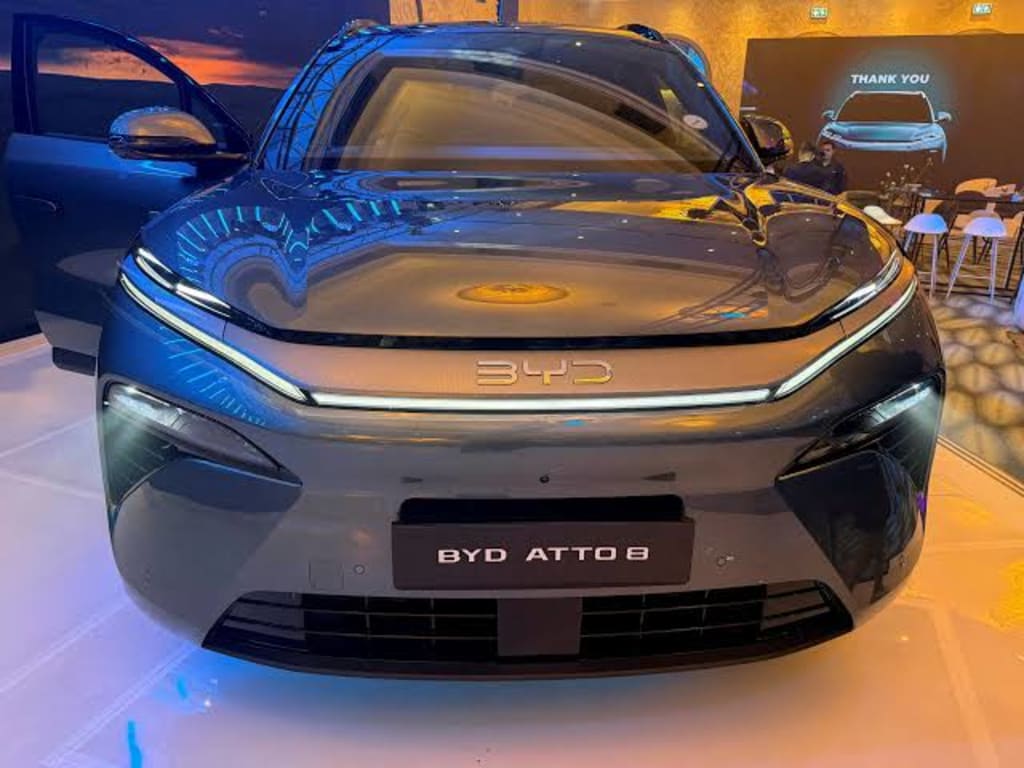
At the 2026 Paris Motor Show in October, the BYD booth was surrounded three layers deep.
Stella Li stood on stage with the Seal, Dolphin, and Denza D9 lined up behind her. She laid out the plan for the Hungarian plant to begin production in the fourth quarter. Then she paused and added in an even tone: “France entered the shortlist because your energy prices are very competitive.”
The sentence did not cause an uproar in the hall. French reporters took notes. Industry peers exchanged glances. Three days later, French automotive media quoted the line repeatedly. Headlines grew more direct by the day: BYD Says It Is Coming to France Because Electricity Is Cheap; Renault’s Homeland, and the Reason a Chinese Carmaker Has Its Eye on It.
The French did not take it well. France was once the pride of Europe’s auto industry. Renault, Peugeot, and Citroën dominated their home market in a way few countries have seen. Today a Chinese carmaker is choosing France for its electricity prices. The market and supply chain matter less.
That was the least flattering compliment the French auto industry had heard in more than a century.
II
But BYD was telling the truth.
France’s electricity advantage is unique in Europe. Eighteen nuclear plants and fifty-seven reactors form the base of the French power system. For years, French industrial electricity prices have been much lower than Germany’s and the European average. Industry estimates put France’s wholesale electricity price in 2026 at around €55 per megawatt-hour, the lowest in Western Europe. Two years earlier, France had some of the most expensive electricity in Europe.
The reversal came from nuclear capacity recovering. Fault repairs and routine maintenance ended. French nuclear plants returned to normal operation. Renewable capacity also kept expanding. France began running a surplus of low-carbon electricity. Prices settled at the lowest level in Europe, and that situation is expected to last another two to three years.
For a company planning a battery factory in Europe, that matters. Battery manufacturing uses a lot of energy. Electricity costs make up a large share of total battery costs. French nuclear power offers stable low-carbon electricity at a low price. BYD would struggle to match that in Spain or other European candidates.
Energy prices are only the start. BYD is also watching a structural change in the French market.
III
In June 2026, battery-electric vehicles took 30% of France’s new-car market for the first time. By September, the share had climbed to 41.7%. Including plug-in hybrids, electrified vehicles reached 48.1%. In three months, the BEV share rose 12 percentage points.
The French market is crossing a critical threshold. Once BEV penetration passes 40%, consumer decisions change. The question shifts from “Should I buy an EV?” to “Whose EV should I buy?” Brand inertia weakens. Product strength and price matter more.
That is the window BYD can pry open.
In the first half of 2026, BYD sold about 14,000 cars in France, nearly triple the year before. By September, monthly registrations hit 3,972 units, up 281.9% year-on-year. The brand ranked 11th among all brands in France. Chinese brands as a group held 8.1% of the French market and were moving from the margins toward the mainstream.
Behind the sales growth is a rapidly expanding dealer network. BYD entered France in 2023 with about 20 dealerships. It now has 115 and plans to expand faster in the coming months. By the end of 2026, BYD expects 2,000 European sales outlets, double the number at the end of 2025.
Those numbers point to one conclusion. BYD’s growth in France comes from systematic positioning.
IV
To understand why BYD chose France, look beyond its own calculations. A hand is pushing from behind.
In March 2026, the EU released the Industrial Accelerator Act. The law set local-content rules for batteries and electric vehicles. Six months after it takes effect, 70% of vehicle components other than the battery must be produced in the EU. Three key battery components, including cells, must be produced in Europe. Three years after it takes effect, batteries must contain five EU-made components to qualify as “made in the EU.”
The EU also charges anti-subsidy duties on Chinese-made EVs, ranging from 7.8% to 35.3%. A model based only on vehicle assembly with imported batteries can no longer obtain the “made in the EU” passport. If BYD does not build battery capacity in Europe, it cannot benefit from EU public procurement and subsidy policies. It cannot enter the core consumer scenarios of the French market.
Building a European battery factory has gone from optional to mandatory.
France combines energy-cost advantages, market scale, and policy capacity.
V
Entering France is not only about product competition.
The French brand landscape is the most competitive in Europe. In September 2026, the top three passenger-car sellers in France were still Renault, Peugeot, and Citroën. Dacia was close behind. The top four were all French or deeply localized brands. Renault and Stellantis together controlled more than half of the French market.
French consumers’ loyalty to domestic brands is ingrained. The Renault Clio, Peugeot 208, and Dacia Sandero have long occupied the top three best-selling models. Price matters, but consumer habit matters more. The French buy a car by first asking whether it fits into their lives, not by asking whose technical specifications are strongest.
That brand moat does not exist in China or the United States. In those markets, consumers are more willing to pay for new brands and new technology. In France, BYD must persuade a consumer who has been accompanied by domestic brands for decades.
France also elevates corporate competition into rule competition. The French government owns about 15% of Renault and controls 30% of voting rights. Its sense of sovereignty over the auto industry is second to none in Europe. The most protectionist clauses in the EU’s Industrial Accelerator Act were actively promoted by France. By building a factory in France, BYD gains market access and sustained policy scrutiny. France will watch closely how far this Chinese company integrates into “made in France.”
VI
For Renault, the threat of a BYD plant in France is already here.
In the first half of 2026, Renault Group’s global sales were 1.17 million units, down 0.4% year-on-year. The Renault brand grew 2.6% in Europe against the trend, driven by the electric R5. Behind that steady report card, one signal stands out: in June 2026, Renault announced it would cut 800 engineering positions in France. The cuts are part of a restructuring of its engineering division, aimed at responding to competition from Chinese carmakers.
Layoffs are not a small matter. Renault is a symbol of the French auto industry. Cutting engineering jobs in the Île-de-France region means cost pressure from Chinese brands has reached the core R&D system of this century-old carmaker. Renault has chosen to protect profit over volume. It is reducing low-margin short-term rental channels and refusing to follow Chinese brands into a price war. Renault executive Ivan Segal said: “We don’t want to do what some brands, Chinese brands, do, with huge discounts, because a few years later you pay for it in residual values.”
That is a dignified defensive posture. Dignity has a cost. Refusing a price war means giving up market share. Once BYD builds a factory in France, it will become eligible for French purchase subsidies. Its terminal price competitiveness will rise further. Renault’s “no price war” position will be hard to maintain.
VII
Stellantis faces a harder situation.
As the group most heavily hit by Chinese brands in Europe, Stellantis has been under continuous pressure on market share. In its French home market, it remains the undisputed leader. In January 2026, Stellantis ranked first in French passenger cars, light commercial vehicles, and the combined market, with a total share of 33.2% and a 29.5% share in electrified vehicles.
Stellantis is not standing still. In June 2026, the group announced more than €1 billion of investment in France. About €400 million will go to its Mulhouse plant, which will produce three next-generation Peugeot EV and hybrid models based on the STLA One platform starting in 2029.
That timetable exposes the problem. BYD’s Hungarian plant will begin production in the fourth quarter of 2026. If the French plant lands, its timeline will be earlier. Stellantis’s Mulhouse investment will not form production capacity until 2029. A three-year gap is enough for BYD to move from new entrant to mainstream choice in France.
Stellantis is not incapable of using Chinese companies. Leapmotor has expanded rapidly in France through Stellantis’s dealer network and now has 138 sales outlets. It is a subtle coexistence. Stellantis uses its own channels to sell Leapmotor cars while using the long-term Mulhouse investment to stabilize its base. But Leapmotor is not BYD. Leapmotor is a partner. BYD is a competitor. When a competitor builds a factory at your doorstep, a partner’s channel advantage is no longer a moat.
VIII
Pull the lens back. BYD’s layout in France is part of a larger game.
Hungary is BYD’s rule-testing ground in Europe. It hired former Hungarian Foreign Minister Péter Szijjártó full-time. With more than a decade of diplomatic negotiation experience, he knows EU carbon border tariffs, rules of origin, and new-energy subsidy regulations. His task is to help BYD open government and corporate channels across Europe and clear barriers around plant construction, supply-chain localization, and access to official vehicle fleets.
After the Hungarian plant proves out the supply chain and compliance system, the model will be copied to France, Germany, and Spain. BYD’s strategy in Europe is not a single-point breakthrough. It is the building of a complete localized new-energy industrial chain: vehicle plants, battery plants, a fast-charging network, and a supporting compliance and government-relations system.
The model applies beyond vehicles. Battery, solar, and other industries constrained by EU localization rules can follow the same path. Europe’s idle industrial capacity is becoming a breakthrough point for Chinese companies going global.
IX
Back to France.
Whether BYD’s French plant will land is still undecided. Spain is also on the shortlist, and its energy costs are competitive. BYD’s team is evaluating all dimensions of the various landing plans for a French plant.
Regardless of the final location, BYD putting France on the shortlist sends a clear signal. Chinese carmakers’ competition in Europe is moving from selling cars to building cars. Product exports are giving way to system exports.
For Renault and Stellantis, the main pressure is structural. A competitor which masters battery, electronics manufacturing, and vehicle manufacturing is building a factory at their doorstep. This competitor’s R&D system produces 52 patents every working day. It holds about one-third of global smartphone contract manufacturing capacity and 80% of tablet contract manufacturing capacity. This competitor is a vertically integrated entity with batteries and electronics manufacturing as its base and vehicles as its terminal product. It does not operate like a traditional car company.
The French market has its resilience. Brand loyalty and policy barriers help. So does cultural identity. BEV penetration is rising by double digits every quarter. As more French consumers walk into an EV showroom for the first time, their choices will no longer be determined by brand memories of the past.
Stella Li, BYD’s executive vice president, once said: “BYD is several companies put together.”
The combined force of those companies is approaching the heart of the French auto industry. The French now have to decide what their auto industry is choosing for its future, given that a Chinese company chose France for its electricity prices.
About the Creator
Jin
Writer of reamstories
https://reamstories.com/jin
Enjoyed the story? Support the Creator.
Subscribe for free to receive all their stories in your feed. You could also become a paid subscriber, letting them know you appreciate their work.
Comments
There are no comments for this story
Be the first to respond and start the conversation.