
Who Pays When the Steering Wheel Disappears?
Tesla’s Cybercab is finally on the road – but the real question isn’t technology. It’s liability.
0%: A Question That Must Be Answered
On September 4, 2026, Tesla's official website updated a document called the Cybercab Occupant Guide. This document may matter more than any technical white paper—because for the first time, it formally describes a scenario: you get into a car, there is no steering wheel, no pedals, you have no room for intervention, you are merely a passenger.
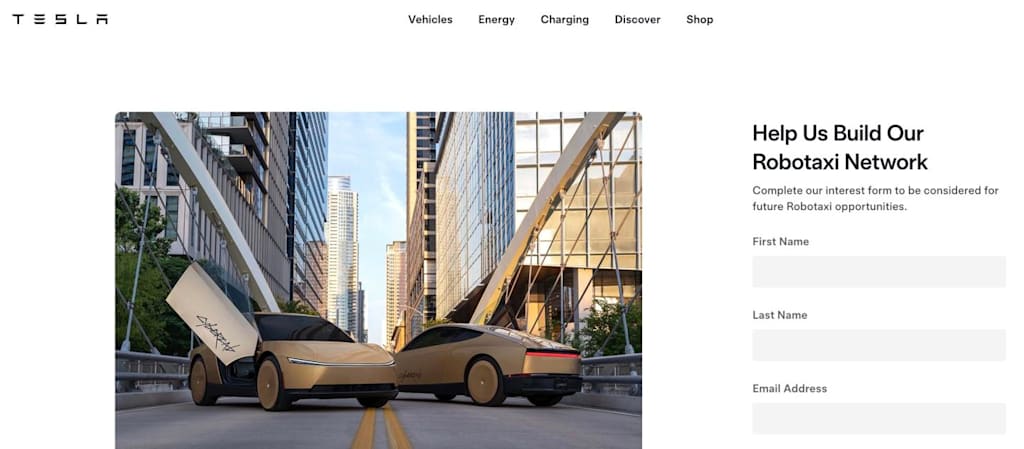
That same day, Tesla officially launched Cybercab ride-hailing operations in Austin. Forty-five vehicles, a limited service area, no steering wheel, pure vision. At the same time, the website quietly posted an intent registration form, open to businesses and individuals interested in purchasing Cybercab fleets. This signals that Cybercab's ambition extends beyond Tesla's own self-operated robotaxi service—it wants to become a product that can be bought, deployed, and operated by others.
But before discussing whether this will "disrupt the ride-hailing industry," there is a more fundamental question to answer. This question has nothing to do with technical roadmaps, cost models, or sensor suites—yet it determines whether any of the above discussion holds water.
If this car gets into an accident, who is responsible?
That question has been raised repeatedly over the past decade, and repeatedly sidestepped. This time, Tesla has removed the steering wheel. It can no longer be sidestepped.
10%: The Meta-Problem That Was Sidestepped for a Decade
Over the past ten years, consumers have paid for autonomous driving in two ways: first, by spending real money on optional packages, and second, by feeding their driving data into training algorithms. But when accidents happen, liability has always been clear—the driver, meaning you, bears the legal consequences.
This system created an asymmetrical exchange: manufacturers gained benefits while vanishing when it came to bearing consequences. When nothing goes wrong, everyone celebrates; when something does, the consumer becomes the cost of R&D.
We call this the "meta-problem" of autonomous driving. Its core logic is extremely simple, even a bit crude, but remarkably effective in critical decision-making: see who gains the benefit, and who bears the cost. Then ask yourself: where do you stand?
If you are a consumer, what you should care about is this: manufacturers use my data to train their models—if something goes wrong, do they compensate me or not?
The current silence from tech manufacturers on this point is telling. It means they know the technology isn't ready. If they truly had confidence, they would have put "we will cover it" in the contract already. Not writing it means not paying. Not paying means not mature enough.
So assessing whether autonomous driving is ready can be reduced to one sentence: when manufacturers are willing to bear the consequences, that's when autonomous driving is mature.
Anyone who dazzles you with technical specs, algorithm iterations, and sensor fusion—just ask one counter-question: So if something goes wrong, will you pay?
25%: Cybercab's Rupture and Restructuring
Cybercab has done something fundamentally different from every previous "autonomous driving" product: it actively cuts off the possibility of human intervention.
No steering wheel means no "driver." No pedals means no option to "take over." The person inside the vehicle cannot legally be identified as the driver—because the physical means of driving have been stripped away.
The significance of this design lies not in technology, but in liability. When a car has no human driver, responsibility for accidents points inevitably to the manufacturer and the operator. You cannot blame the passenger for "failing to take over in time"—because there is no way for them to take over. You can only ask: why did this car make a mistake?
This is Cybercab's true rupture. It pushes autonomous driving from "assistance" into the realm of product liability. It is no longer a tool that "helps you drive but you still have to watch." It is a product that "drives for you and takes responsibility for it."
Notably, just days before Cybercab's production launch, a U.S. court upheld a $243 million verdict in a case related to Tesla's assisted-driving features. That ruling is an early warning bell: when the legal system is ready to impose severe financial penalties for defects in autonomous systems, how much can you bear?
40%: The Low-Cost Model and Its Cracks
Cybercab's business logic rests on two numbers: operating cost of $0.20 per mile**, and manufacturing cost of roughly $23,000–$25,000 per vehicle. In comparison, traditional ride-hailing costs about **$1.00 per mile, while Waymo's per-vehicle cost ranges from $70,000 to $150,000.
What do these numbers mean? They mean that if Cybercab can scale, it can price itself as low as half of Uber's rates while remaining profitable. Netizens have tested the same routes and found Cybercab's fare to be roughly half of Uber's. This is not incremental improvement—it's an order‑of‑magnitude disruption.
But the premise of scaling is scale itself. At present, in Austin's limited service area, Cybercab has only 45 vehicles. Waymo, by contrast, operates approximately 4,000 autonomous vehicles across 14 cities. 45 versus 4,000—this is not competition; it is a preview versus the full release.
On the technology front, Tesla insists on a pure vision approach, abandoning lidar and radar. The advantage is extremely low hardware cost and easy mass production. The trade‑off is that the algorithm must handle every edge case—and edge cases are precisely when accidents happen. The industry mainstream leans toward multi‑sensor fusion for redundancy—the more sensors, the more layers of safety. Tesla is betting that its vast training data (from millions of vehicles worldwide) can compensate for the lack of hardware diversity.
Whether that bet pays off depends on a question that cannot be answered by numbers alone: how reliable is a purely vision‑based car in heavy rain, dense fog, glare, or faded road markings? This question may never be fully tested in a restricted service area—but once the car ventures beyond, it will be tested countless times.
55%: The "Almost‑Kiss" Moment—When Cybercab Meets Regulation
The "almost‑kiss" moment for the autonomous driving industry is not the instant of technological breakthrough—it is the moment when, upon first large‑scale approach to public life, regulation and public opinion simultaneously put a stop to it.
A February 2026 survey found that 70% of U.S. adults said they felt "uncomfortable" or "very uncomfortable" with riding in a driverless car. The reason behind that number is simple: people can rationally accept the statistic that "autonomous driving is safer than human driving," but when they sit in a car without a steering wheel, staring at an empty driver's seat, their bodies are more honest than their brains.
Regulation is no different. U.S. states have inconsistent autonomous‑vehicle laws. Because Cybercab removes manual controls like the steering wheel, it must obtain a federal safety‑standard exemption before it can be sold to consumers. Currently, it operates only in a taxi service model—expanding to private ownership would require clearing a burdensome compliance process.
Behind every "yes" there is a string of "buts." Austin says yes, but within limits. Texas says yes, but other states may not. The U.S. says yes, but regulatory frameworks in Europe and Asia follow entirely different logics. The farther Cybercab reaches, the higher these "buts" pile up.
72%: Pre‑Breakup Stress—Who Will Bow Out First
The "dark moment" for the autonomous driving industry is not a single crash—it's how all parties react after the first serious incident involving Cybercab.
This time, there is no driver to blame. You can't say "he wasn't watching the road" or "he should have taken over." Responsibility falls squarely on Tesla and the operator. At that moment, what we need to see is: has Tesla prepared solid compensation mechanisms? Is there an independent accident investigation process? Is there a clear disclosure of liability to passengers?
If the answer is no—or if the answer is an evasive PR statement like "we will cooperate with the investigation"—then Cybercab's trust foundation will collapse overnight. Because consumers will realize that the removal of the steering wheel only took responsibility away from themselves, but didn't clearly assign it to anyone else. So where did it go? It went into a fuzzy, legally gray space.
This is precisely the "pre‑breakup stress" facing all autonomous driving products today: before a major incident actually happens, everyone says they're ready; but the real question is—how much are you prepared to bear? $243 million, or more?
85%: The Empty Everyday—When Driverless Becomes Routine
If Cybercab truly crosses all the above hurdles, what kind of everyday reality will it usher in?
Imagine a scene: you book a Cybercab. It arrives on time. You get in. It takes you to your destination. You get out. Throughout the entire trip, there is no conversation, no tip, no waiting for the driver to make change. It operates like a quiet conveyor belt, compressing the act of getting from A to B to its bare minimum.
What does this everyday reality mean for the ride‑hailing industry? It means Uber and Lyft's business models will face a fundamental challenge. They cannot compete on cost with $0.20 per mile—because labor is their single largest expense. But the more profound shift is this: when mobility becomes cheap enough, the economic logic of private car ownership will be shaken. Why spend tens of thousands of dollars on a car that sits idle for 23 hours a day?
Meanwhile, new questions arise: Who will handle maintenance, charging, cleaning, and dispatch for those 45 Cybercabs? What is the insurance claims process after an accident? Will remote or underserved areas be "actively ignored" by the system? None of these are technical problems—they are the specific details that fill the "empty everyday."
100%: Back to the Beginning, but Everything Has Changed
Let's return to the opening question: if this car gets into an accident, who is responsible?
Cybercab's answer is: the operator.
This answer is not perfect. It has not yet been tested by large‑scale accidents, refined through litigation, or tempered by public trust. But at least it is a clear answer—and compared to the decade of silence from manufacturers, that is a qualitative change.
We can understand this change through two numbers. The first is 45: Cybercab's current operational fleet size. The second is 243 million: the dollar amount upheld by a U.S. court in a Tesla assisted‑driving case.
A pilot of 45 vehicles cannot upend the entire ride‑hailing industry. But the $243 million verdict has already drawn a line: when a machine makes a mistake on the road, someone will pay a heavy price. Cybercab's design logic—removing the steering wheel, removing the driver, removing any space for intervention—is precisely about drawing that line more clearly: if someone must bear the cost, it should be the one who gains the benefit.
This article will not end with a "the future is here" exclamation. Too many such sentences have already been written. We need only remember one scene: September 2026, Austin, a car without a steering wheel carries a passenger through the streets of a restricted service area. The passenger does not know how the car's algorithms make decisions—but he does know one thing: if something goes wrong, it's not his responsibility.
That is Cybercab's true significance. It is not the terminus of autonomous driving, but it has drawn a dividing line. On one side of the line is "if something happens, you're responsible." On the other side is "if something happens, I'm responsible." As to which side represents the more mature business model, the answer does not need to be declared.
It will emerge on its own—in the $243 million verdict, in the operational data from 45 vehicles, in the breathing rate of passengers as they sit in that empty driver's seat.
About the Creator
Jin
Writer of reamstories
https://reamstories.com/jin
Enjoyed the story? Support the Creator.
Subscribe for free to receive all their stories in your feed. You could also become a paid subscriber, letting them know you appreciate their work.
Comments
There are no comments for this story
Be the first to respond and start the conversation.