
The King Is Wounded — BYD Loses Its Crown to Geely
30,000 units separate them. The PHEV boom is over. And the real war is now global.
Opening: A Gap That Is No Longer Vast
In July 2026, China's new energy vehicle (NEV) retail penetration reached a record 65.1%. In the same month, passenger car export growth nearly doubled.
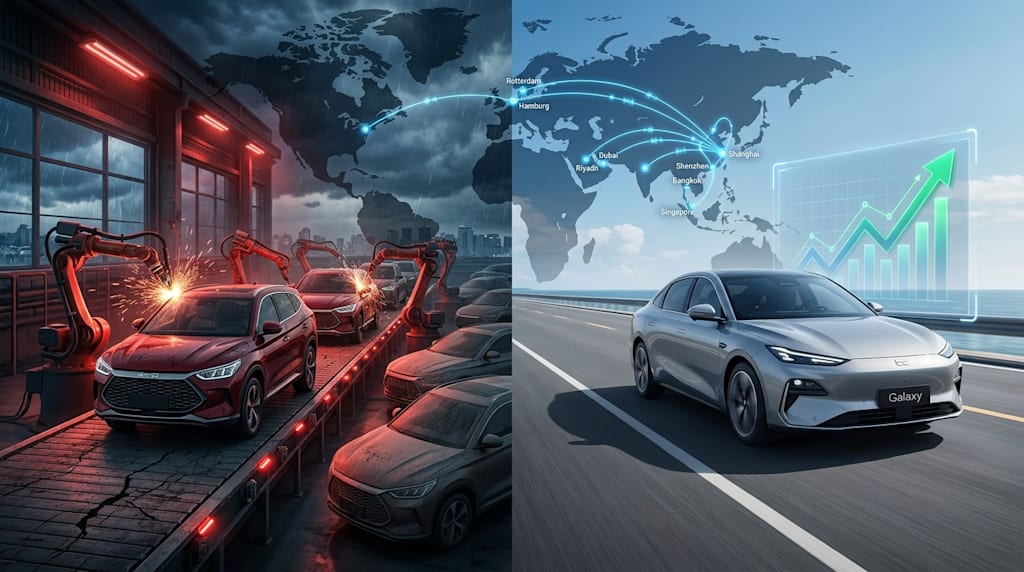
But behind these two striking figures, a more telling change unfolded in the domestic passenger car market: the cumulative sales gap between BYD and Geely shrank to about 30,000 units.
Based on retail data from the China Passenger Car Association (CPCA) for the first seven months of 2026, BYD accumulated approximately 1.214 million retail sales, down 35.6% year‑on‑year, while Geely posted about 1.182 million units, a decline of 17.3%.
Just two years ago, BYD's annual sales of 4.6 million vehicles left all rivals far behind. Now, what was once a lead of hundreds of thousands of units has narrowed to a neck‑and‑neck race.
This is not a retreat of new energy vehicles, but a structural fragmentation of the market itself — China's NEV competition has moved from the "BYD unipolar era" into a new phase of "multi‑power rivalry."
I. Plug‑In Hybrids Hit the Brakes — What Did BYD Step Into?
BYD's sharp domestic sales drop does not reflect weakening product strength. It reflects hitting a structural inflection point.
In the first seven months of 2026, a clear divergence emerged within the NEV market: cumulative retail sales of pure electric vehicles (BEVs) fell 4.7% year‑on‑year, plug‑in hybrids (PHEVs) dropped 26.6%, and range‑extended electric vehicles (EREVs) declined 18.9%. In July alone, BEVs resumed growth at +6%, while PHEVs and EREVs still contracted by 21.1% and 16.5%, respectively.
The PHEV segment, once a growth engine, has become a growth drag — and BYD, as the segment's dominant player, felt the brunt most acutely.
Over the past few years, BYD built a near‑monopoly in the PHEV market with its DM‑i super‑hybrid technology. Models like the Qin PLUS DM‑i and Song PLUS DM‑i became national bestsellers, accounting for half of BYD's sales. When the entire PHEV segment began to shrink, the largest player naturally suffered the most.
Policy tailwinds are also fading. Starting in 2026, the NEV purchase tax was adjusted from full exemption to a 50% reduction, with a cap of 15,000 yuan per vehicle. At the same time, the minimum all‑electric range for PHEVs and EREVs to qualify for the exemption list was raised from 43 km to 100 km. This policy shift directly cut into BYD's short‑range PHEV offerings.
Meanwhile, public charging infrastructure continues to expand, fast‑charging efficiency improves, and BEV products in mainstream price brackets grow more compelling. In July, A00‑class BEV wholesale sales fell 50% year‑on‑year, while A0‑ and B‑class BEVs performed notably stronger — indicating that the BEV recovery is not driven by cheap micro‑cars, but is moving into more mainstream family‑buying territory.
Consumers are re‑evaluating their choices: as range anxiety fades, the "transitional" appeal of PHEVs begins to wane.
For BYD, this shift strikes directly at its core growth territory of recent years. PHEVs no longer guarantee incremental sales, and mainstream buyers are now weighing more BEV and hybrid options than before.
II. Where Does Geely's Resilience Come From?
In contrast to BYD's sharp swings, Geely's 17.3% decline over the first seven months was 3 percentage points better than the overall market's 20.3% drop, and 18.3 points better than BYD's.
The difference does not stem from a single blockbuster model, but from structural diversification.
Geely did not bet everything on one powertrain path. It maintains parallel tracks — gasoline, hybrid, and pure electric. While the gasoline segment is shrinking overall, it still provides a sizable sales base. Its Galaxy new energy sub‑brand competes head‑on with BYD's Dynasty and Ocean series in the critical ¥100,000–¥200,000 price band. And as the BEV market warms up, Geely's BEV sales in July grew 17% year‑on‑year.
Multiple legs provide a buffer when the PHEV market suddenly cools.
More noteworthy is Geely's product strategy. Industry wags say "Geely crosses the river by feeling BYD's stones" — and not without reason. From product definition to pricing, Geely adopts a close‑following approach: wherever a rival model sells well, Geely launches a competitor that is slightly larger, slightly better equipped, and slightly cheaper. The Xingyuan, which surpassed BYD's Seagull to become the top seller in the A0‑segment sedan market, is a textbook example of this strategy.
This raises a seemingly paradoxical question: Given BYD's full‑industry‑chain cost advantage, how can Geely offer higher specs and lower prices on comparable models?
BYD has built a closed‑loop chain from lithium mining to batteries, motors, electronic controls, chips, and vehicle assembly, with a core component self‑manufacturing rate of 75‑85%. Industry estimates suggest this gives BYD an overall cost advantage of about 20%. But Geely's response is not to compete head‑on in cost, but to play the product‑definition game.
Cost advantage does not equal market advantage. When a competitor offers a vehicle that is half a size larger, has more features, and is several thousand yuan cheaper, consumers will not pay extra just because your battery is made in‑house. Geely offsets BYD's cost edge through more precise segmentation, more attractive feature combinations, and more aggressive pricing.
Moreover, Geely has managed its dealer inventory more prudently. Over the past year, BYD's push for sales targets has built up mounting inventory pressure at the terminal level, straining its dealer network. Geely avoided the price chaos and brand dilution that can result from massive channel stuffing. This is a less visible but deeply consequential difference in channel management.
III. Overseas: The Real Variable Hidden Behind "Cold at Home, Hot Abroad"
The fierce domestic battle can easily overshadow another dimension — the overseas market.
In the first seven months, BYD's domestic retail fell 35.6%, but its total sales (including exports) fell far less. Overseas sales surged 79% year‑on‑year, with July exports reaching 180,500 units, accounting for about 43% of total monthly sales. Overseas sales command much higher per‑vehicle margins, and BYD's PHEVs face few comparable rivals globally in the same price range.
Geely's export performance is also accelerating, with July exports up 202% year‑on‑year.
This "cold at home, hot abroad" pattern reveals a deeper shift: competition has expanded from a domestic market‑share battle to a global footprint capability contest.
BYD has broken into the European premium market by sponsoring the UEFA European Championship, signing a partnership with Manchester City, and entering government procurement lists in multiple countries. The Denza Z is priced at 1.3‑1.58 million yuan in Europe, on par with a Porsche 911, and still finds buyers on‑site. Geely, through its global synergy network with Volvo, Polestar, and Lotus, has built unique channel and technology advantages overseas.
Wang Chuanfu, BYD's chairman, once said: "Even if we completely give up the U.S. market, relying on steady expansion in Europe, Southeast Asia, Latin America, the Middle East, and other global markets, we still have the ability to surpass Toyota."
The outcome of this globalization race may prove more decisive than who wins the monthly domestic sales crown.
IV. From "Unipolar" to "Multi‑Power": The Changing Name of the Game
Looking back at the evolution of China's NEV market, three phases emerge: Phase I was "all contenders" — numerous new players and traditional automakers exploring the direction; Phase II was "BYD unipolar" — leveraging its full‑chain advantage and PHEV technology to build a lead of hundreds of thousands of units; now, the market is entering Phase III — "multi‑power rivalry."
The core change in this new landscape is the upgrade from a "single‑advantage" contest to a "systemic capability" contest.
BYD's full‑industry‑chain cost advantage remains intact, its scale effects are still formidable, and its R&D spending is massive. But as competitors gradually close the technology gap, sharpen their product definitions, and improve their global layouts, cost control alone is no longer sufficient to sustain absolute dominance.
Geely's pursuit proves the point. Instead of confronting BYD head‑on in its strongest areas, Geely exploited a more balanced powertrain mix, more precise product positioning, and healthier channel management to carve out a gap in BYD's "home turf."
At the same time, the market environment itself is rewriting the rules of competition. The PHEV windfall is fading, policy barriers are rising, and BEVs are resurging — any bet on a single technological pathway is now exposed to risk. The winners of the future will be those companies that demonstrate flexibility and adaptability across technology routes, product portfolios, regional markets, and channel strategies.
V. Footprints in the Sand
This sales‑leadership tug‑of‑war in August 2026 is far from over.
BYD regained the monthly top spot in July, and its year‑to‑date cumulative lead, though narrow, still stands; Geely, with its steadier rhythm, has proven itself a long‑term contender rather than a flash‑in‑the‑pan challenger.
But more important than who takes the annual crown is what this contest itself reveals: China's NEV market has matured enough to accommodate multiple strong players competing on the same stage.
Wang Chuanfu's words — "Together, we are China's automotive industry" — take on new meaning in 2026. They apply not only to Chinese brands presenting a united front overseas, but also to healthy competition at home. It is precisely this fierce rivalry among BYD, Geely, Chery, Changan, and others that is rapidly lifting the overall capability of China's automotive industry.
In the fossil‑fuel era, China was a follower; in the NEV era, China is becoming a definer. And this battle for the sales crown is a rite of passage for China's auto industry, moving from "adolescence" to "adulthood."
The final outcome is yet unknown. But regardless of who stands atop the annual sales podium, China's automotive industry as a whole has already won.
About the Creator
Jin
Writer of reamstories
https://reamstories.com/jin
Enjoyed the story? Support the Creator.
Subscribe for free to receive all their stories in your feed. You could also become a paid subscriber, letting them know you appreciate their work.
Comments
There are no comments for this story
Be the first to respond and start the conversation.