
The $1,000 Check That Named a $2.4 Million Supercar
Pagani built 20 Huayra BCs. One has 30 miles on it. Another may never have been driven.
In 1999, New York car collector Benny Caiola bought the first Pagani sports car. After delivery, he sent a letter to founder Horacio Pagani thanking the engineers. He enclosed a $1,000 check.
For Pagani at the time, the check was useful money. The team used it to move more designs from drawings to real cars. Seventeen years later, Pagani launched a high-performance Huayra with the suffix “BC,” Benny Caiola’s initials. The name did not say “Performance Edition” or “Track Edition.” It used the first customer’s name.
The Huayra BC debuted at the 2016 Geneva Motor Show. Compared with the standard Huayra, it was aimed more at track use: more power, less weight, revised aerodynamics. Those three goals appear in every performance-car upgrade. What Pagani actually did is more specific.
Body: carbon fiber and titanium fiber, 132 kg removed
The Huayra BC’s body was the first to use a monocoque combining carbon fiber and titanium fiber. The titanium fiber was there to restore strength while reducing weight. Pagani also optimized the forged wheels, titanium exhaust, all-aluminum suspension, and carbon-fiber chassis tie rods. Curb weight fell by 132 kg from the standard Huayra to 1,218 kg. The chassis alone lost 50% of its weight and gained 20% in strength.
For a car with a 6.0L twin-turbo V12, 1,218 kg needs a reference point. A Porsche 911 Carrera weighs around 1,500 kg. The BC is nearly 300 kg lighter and makes 750 hp. The benefit shows up in corners: the front end turns in more willingly, the braking point can be later, and the tires carry less lateral load.
Power: M158, 750 hp, 1,000 Nm
The engine remained the M158 6.0L twin-turbocharged V12. It had served in the Mercedes SL65 AMG Black Series, and Mercedes’ motorsport division tuned and strengthened it before it went into the Pagani Huayra. Pagani engineers upgraded it again for the BC to 750 hp and 1,000 Nm, with 0 to 100 km/h in under 3 seconds.
At low-speed corner exit, 1,000 Nm means the driver does not need high revs. Press the right foot and the nose lifts. Displacement and tuning keep turbo lag small. Power arrives closer to the linear feel of a large naturally aspirated engine, but the peak is far higher.
Transmission: seven-speed single-clutch sequential, 40% lighter than dual-clutch
The drivetrain used a seven-speed single-clutch sequential transmission. Pagani redesigned the system with electro-hydraulic actuation and carbon-fiber synchronizers. Shift speed was twice the previous generation, and weight was 40% lower than today’s dual-clutch systems.
Dual-clutch gearboxes are now standard in supercars. Pagani stayed with a single-clutch sequential unit. The shift shock is more direct, and the driver feels every upshift. In a comfort test that is a drawback. On track it is information: the car tells you which gear it has engaged and when.
Exterior: rear wing, quad exhaust, Le Mans-style diffuser
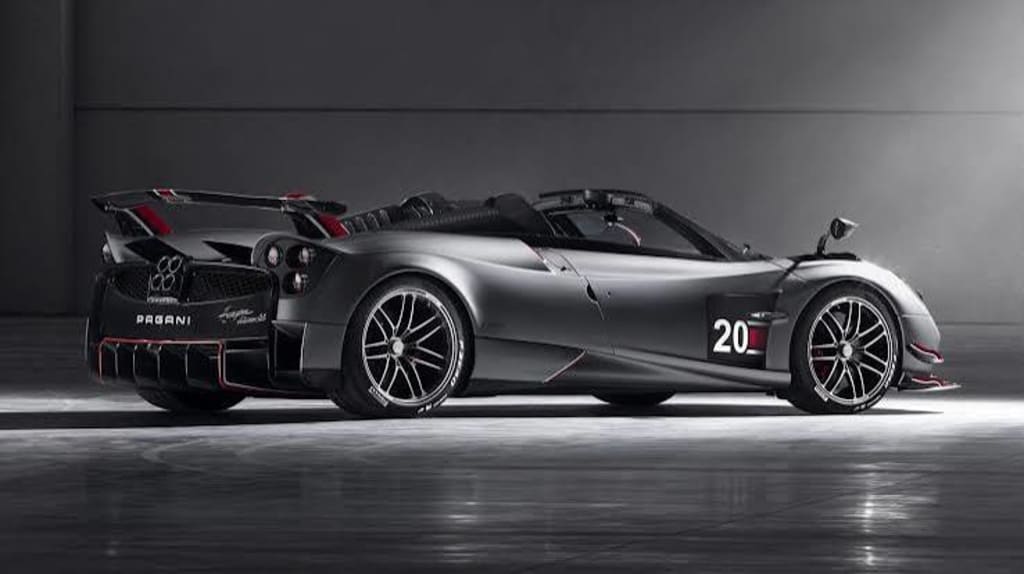
The BC’s exterior is more aggressive than the standard Huayra. Beneath the large carbon-fiber rear wing sits Pagani’s quad exhaust. Below the exhaust is an aggressive diffuser that looks closer to a Le Mans racer.
The tires are Pirelli P Zero Trofeo Rs developed for the car. Most tire makers promote grip figures. Pagani’s discussions with Pirelli focused on a tire that improves traction and keeps driving feel. Grip and feel often pull against each other. The BC needed both.
An aluminum key
The key is carved from one block of aluminum into a 1:43 model of the Huayra. It is a miniature body shell, not a branded key. Holding it and sitting in the cockpit use the same design language.
20 cars, €2.4 million, No. 0 not for sale
Pagani built 20 Huayra BCs, each hand-built. The price was €2.4 million, about RMB 18.8 million. All 20 sold after launch. Pagani keeps the No. 0 prototype and does not sell it. It travels to exhibitions.
At this volume, almost every car was tailored to its owner. Color, carbon-fiber finish, and interior materials could differ. Twenty cars meant twenty specifications, with no two exactly alike.
The 30-mile car
One Huayra BC was listed for sale. It is one of the 20. The exterior is a green and brown carbon-fiber two-tone. The interior is saddle brown and green. The car was built in 2017 and had 30 miles on it when listed. Thirty miles is about 48 km, less than a round trip from central London to Heathrow. The owner did not buy it to drive.
The original list price was €2.4 million. The later listing did not state a price. Buyers could contact the Pagani dealer in Greenwich, UK.
Of the 20 owners, one drove his car to 30 miles. Some may never have driven theirs. Pagani built 20 color and finish combinations, carved a 1:43 model for a key, consulted Pirelli over tire feel, and added back 20% strength for the 50% weight removed from the chassis. None of that was required. When Benny Caiola mailed his letter in 1999, he was thanking engineers for a car. Seventeen years later, his initials were on a 20-car run. One of those cars, green and brown, sat in a Greenwich showroom with 30 miles on it, waiting for the next owner.
About the Creator
Jin
Writer of reamstories
https://reamstories.com/jin
Enjoyed the story? Support the Creator.
Subscribe for free to receive all their stories in your feed. You could also become a paid subscriber, letting them know you appreciate their work.
Comments
There are no comments for this story
Be the first to respond and start the conversation.