
Tesla's Flying Roadster Is a Rocket Testbed With License Plates
The cold gas thrusters and fan suction system borrow from Falcon 9, F1, and sixty years of spacecraft engineering.
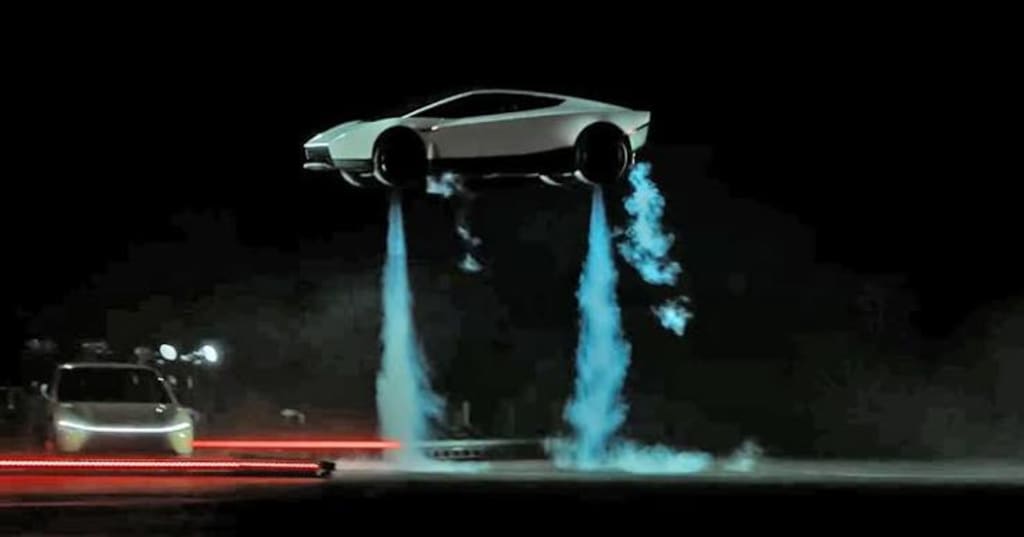
The car drove up a curved ramp, kept going until its wheels were above its roof, and stopped. It hung there, upside down, twenty meters above the ground. Then it pushed off.
At SpaceX's McGregor test facility in Texas on October 15, 2026, a silver Roadster left the ramp, rotated 170 degrees in the air, and fired a burst of compressed air from nozzles above its rear bumper. The white plume condensed into a visible cloud. The car settled onto the pavement below.
Elon Musk walked onstage and said four words: "Well, it worked."
The audience watched a road car perform a maneuver that no road car should be able to perform. The propulsion system came from rocket engineering. Rocket engineers have trusted it for sixty years because it is too weak to do anything dramatic.
The simplest engine in the room
Cold gas thrusters work like this. A tank holds gas at extreme pressure. A valve opens. The gas escapes through a nozzle. The escaping gas pushes the car the other way.
There is no combustion. No flame. No propellant chemistry. The gas is nitrogen, or simply air, depending on the configuration. The nozzle throat narrows, the gas accelerates past the speed of sound, and Newton's third law does the rest.
Specific impulse measures how efficiently a propulsion system uses its propellant. A cold gas thruster sits between 30 and 70 seconds. A Merlin engine on Falcon 9 runs above 300 seconds. The cold gas thruster is roughly an order of magnitude less efficient. It cannot push a rocket into orbit. It cannot push a car very far either. Lars Moravy, Tesla's vice president of vehicle engineering, confirmed at the event that the Thrust version delivers roughly five seconds of boost before the tank needs refilling.
Five seconds. That is the entire performance window for a system that produces more than 80 kilonewtons of thrust.
That number, 80 kN, deserves a moment. A single Merlin engine produces around 845 kN at sea level. The Roadster's rear thrusters put out roughly one tenth of that. An F-16 in full afterburner produces about 127 kN. The Roadster comes in at about six-tenths of a fighter jet's thrust. For a machine that weighs roughly two tons and drives on public roads, 80 kN is substantial. It is simply brief.
The briefness is the point. Cold gas thrusters were never designed for sustained thrust. Their job, since the 1960s, has been the smallest, most precise movements a spacecraft needs to make.
A sixty-year-old solution to a very modern problem
Vostok 1, the capsule that carried Yuri Gagarin into orbit in 1961, used cold nitrogen thrusters for attitude control. The satellite buses of the 1960s, including Discoverer, Transit, and the early Nimbus weather satellites, used them too. Liquid rocket engines were still unreliable for the kind of millimeter-precision pointing that a satellite needs to keep its antenna aimed at Earth. Cold gas thrusters were simple, safe, and did not contaminate solar panels with exhaust residue.
SpaceX revived the technology for Falcon 9 because the first stage needs to flip 180 degrees after stage separation, before the main engines can relight for the landing burn. The flip happens in vacuum, with the engines off. Eight nitrogen cold gas thrusters, mounted near the top of the first stage, fire in pulses to rotate the booster into the correct orientation. The white puffs visible in Falcon 9 landing videos are those thrusters doing their job.
The Roadster's system is a direct descendant. Ten nozzles sit around the car's body. Four point rearward, above the rear bumper. The others handle attitude control during the airborne portion of a maneuver. All-electric actuators, borrowed from the ankle joints of Tesla's Optimus robot, control the valves. They can adjust thrust in milliseconds.
The valves and nozzles are straightforward. The software that decides when to fire which thruster for how long is the difficult part. That software is flight control software. It has more in common with the code that lands a Falcon 9 booster than with the traction control in a Model S.
The tank behind the seats
Open the butterfly door of a Rocket-trim Roadster and you will not find a passenger seat. You will find a black sphere roughly the size of a gym exercise ball, wrapped in the shiny woven texture of carbon fiber.
That sphere is a composite overwrapped pressure vessel. The name describes the construction. A thin metal liner is wrapped in continuous carbon fiber composite. The liner keeps the gas inside. The carbon fiber keeps the liner from bursting. Together they hold nitrogen at up to 10,000 psi, roughly the pressure inside a hydrogen fuel cell vehicle's tank, or about three times the pressure in a scuba cylinder.
Two of these vessels sit in the Rocket version, one behind the seats and one where the passenger seat would be, for a combined 600 liters of capacity and about 250 kilograms of compressed air. The Thrust version uses a single 200-liter tank behind the passenger compartment, occupying space that would otherwise hold luggage.
COPVs have a complicated history at SpaceX. The company has used them for years to store helium pressurant for Falcon 9's propellant tanks. In September 2016, one of those COPVs failed during a pre-launch test, destroying the rocket and its AMOS-6 satellite payload. The investigation found that sub-chilled liquid oxygen had seeped between the carbon fiber overwrap and the aluminum liner, frozen, and then ignited when the tank flexed during pressurization.
SpaceX redesigned the COPVs. The new versions have burst pressures more than double their operating pressure. They have flown on every Falcon 9 since. The Roadster's tanks are built to the same standard, though the operating environment is different. There is no liquid oxygen, no cryogenic temperatures, no flight vibrations measured in thousands of gs. The challenge on a car is weight. Every usable void in the Roadster is packed with these vessels, according to Tesla's own post on X, precisely because they offer the highest strength-to-weight ratio available for a pressure vessel.
Suction as a substitute for gravity
The ramp demonstration relied on a second system that has nothing to do with rockets.
Beneath the Roadster's floor, electric fans spin. They pull air out from under the car, creating a low-pressure zone between the chassis and the ground. The pressure difference pushes the car downward, toward the road, or toward the ceiling if the car is upside down. Tesla claims the system generates up to 2 g of downforce, even when the car is stationary.
Traditional downforce comes from speed. A rear wing works only when air is moving over it fast enough to create a pressure difference. At low speed, a conventional supercar has no aerodynamic downforce, which means its acceleration and cornering are limited by tire grip alone. The Roadster's fans do not care about speed. They run on battery power. They generate suction whether the car is moving at 200 mph or sitting still.
The technology traces back to 1977, when Colin Chapman's Lotus team built the Type 78 with wing-shaped sidepods and sliding skirts that sealed the underside of the car. The low-pressure zone beneath the Lotus produced so much downforce that the car could corner 20 to 40 mph faster than its competitors. Other teams protested. The skirts were eventually banned.
The Roadster's system is an active version of the same idea. Instead of relying on speed to drive airflow through venturi tunnels, it uses electric fans. The sound resembles a jet engine spooling up.
Three cars, one platform
Tesla will sell the Roadster in three configurations. The differences between them define how far the car departs from being a car at all.
The Performance version is road ready. Two seats, active aerodynamics, the multi-mode suction system, no thrusters. Zero to sixty in under 1.6 seconds. It is a very fast electric supercar with a party trick it can perform in a parking lot: stick itself to a wall.
The Thrust version is race ready. Two seats, rear-mounted cold gas thrusters, zero to sixty in under 0.9 seconds. Tesla's demonstration car hit 0.81 seconds. It carries a 200-liter nitrogen tank behind the passenger compartment. Refilling that tank from an external high-pressure supply currently takes two to six hours. Tesla says it is working to bring that down to under thirty minutes. The car has an onboard compressor, but the company has not said how long it takes to refill using vehicle power alone.
The Rocket version is air ready. One seat, ten thrusters, full flight system. Zero to sixty in under 0.59 seconds. It is not approved for public road use. It is invite-only. Musk has said the Rocket version is the one that can "fly like a rocket," perform rolls, and do what he called "crazy gymnastics."
All three share the same battery architecture: 300 miles of range, 230 mph top speed. The differences live in the tanks, the nozzles, and the software that coordinates them.
What the demonstration actually proved
The Roadster hovered at 68 feet. It pitched to 170 degrees. It landed on pavement without a scratch.
What it did not do was fly for any meaningful duration. The cold gas supply lasts seconds, not minutes. The fans hold the car against gravity, but they cannot lift it against gravity. Every airborne maneuver is a ballistic arc with a controlled landing, not sustained flight.
The more interesting question is whether the technologies packed into it will migrate to vehicles that are not halo cars.
The cold gas thruster is a solved problem in spacecraft engineering. The COPV is a mature aerospace component. The flight control software is a simplified version of what lands boosters. None of these technologies needed to be invented for the Roadster. They needed to be miniaturized, hardened against road vibrations, and certified for a consumer product.
That integration work is where the engineering effort went. Making sixty-year-old rocket technology reliable enough to sit behind the seats of a car that someone will eventually drive to a grocery store is difficult. It is also where the technology becomes transferable. A cold gas thruster system small enough for a car could fit in a drone. A COPV light enough for a two-ton sports car could serve a hydrogen aircraft. Flight control software tuned for a car's mass and aerodynamics could stabilize a VTOL air taxi.
Musk has said he is "not sure it moves the needle massively from a revenue standpoint." He has also said, when asked about safety: "If safety is your number one goal, do not buy the Roadster."
That is a candid framing. The Roadster is a testbed that happens to be shaped like a car. Practicality was not the design goal.
About the Creator
Jin
Writer of reamstories
https://reamstories.com/jin
Enjoyed the story? Support the Creator.
Subscribe for free to receive all their stories in your feed. You could also become a paid subscriber, letting them know you appreciate their work.
Comments
There are no comments for this story
Be the first to respond and start the conversation.