
Tesla’s Flying Car Got Applause. Its Shareholders Got a $93 Billion Bill.
The Roadster jumped over five cars. The stock could not clear one week. What the stunt revealed about cash flow, regulators, and a flagship that keeps missing its deadline.
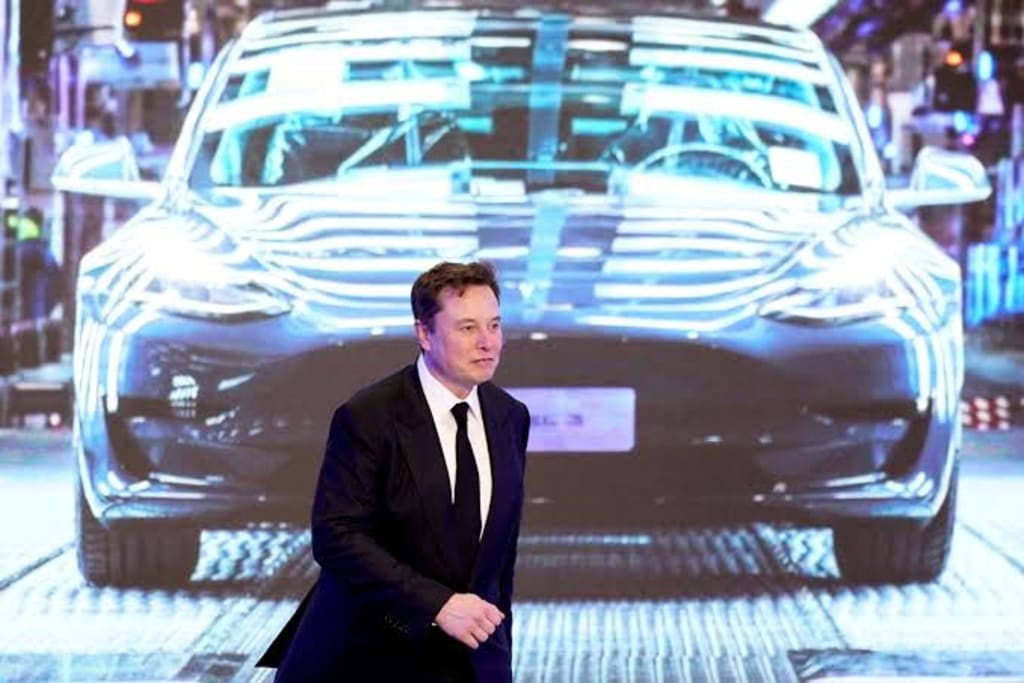
At the SpaceX test site in Texas, the white Roadster drove up a curved ramp with the body inverted. The tires clung to the wall, the roof pointed toward the ground, and then the car went airborne, rolled, cleared five Teslas parked on the ground, and came back down under thruster control. The applause in the livestream was loud. Musk stood nearby and said something, but the cheering covered it.
More than ten hours later, the U.S. market opened. Tesla rose more than 5% in premarket trading, turned negative during the session, and fell nearly 3%. By the close on October 16, the stock had dropped more than 7% over five trading sessions. Market value slid from $1.493 trillion to $1.4 trillion, a loss of about $93 billion, or more than 620 billion yuan.
When the white Roadster landed, it kicked up some dust. It is hard to see clearly in the footage, but the test-site surface was dry. At the moment the tires touched down, small particles bounced up and flashed in the afternoon sun. Then the camera cut away.
In an early-October report, JPMorgan put Tesla’s 2026 adjusted earnings per share at $1.43. The Bloomberg consensus was $1.65. A gap of twenty-two cents. The bank also projected that the profit inflection point would not arrive until 2028, when annual compound growth above 50% could begin. The report contained a less-quoted line: free cash flow would swing from positive $7.2 billion in 2025 to negative $10 billion in 2026, then negative $11.9 billion in 2027 and negative $9.5 billion in 2028. Capital expenditure would run at $23 billion to $25 billion a year over the same period. Morgan Stanley’s forecast differed in detail but pointed the same way: free cash flow burn of about $11.7 billion in 2026 and capital expenditure of about $26.4 billion, above the company’s own guidance.
Third-quarter deliveries of 486,500 vehicles did beat the consensus by about 5%. But energy-storage deployment missed expectations, and automotive gross margin excluding credits was about 16.4%, below the consensus. Delivery growth did not translate into profit improvement. Money was going out faster than it was coming in.
The stock rose more than 5% in premarket trading before the launch. It turned negative during the session. The market was briefly moved by the images, then went back to its calculators.
The Roadster was split into three versions. The Performance version is the only road-legal model open to ordinary customers, with a domestic intent deposit of 332,000 yuan and a North American starting price anchored at $200,000. It does not carry the full flight-thruster system. The Thrust version carries cold-gas thrusters at the rear, accelerates from 0 to 97 km/h in under 0.9 seconds, and requires a $250,000 intent deposit. The Rocket version, the one that actually performed the airborne roll at the launch, is a single-seat layout, has no public purchase channel, is open only to invited customers, has not been approved for public-road driving, and has not received Federal Aviation Administration airworthiness certification.
The version that can fly is not road legal. The version that is road legal cannot fly. The most eye-catching image from the launch corresponds to a crewed demonstration device for closed courses, invitation-only, and no contribution to scaled revenue. In commercial terms, the Performance version is an extremely quick electric supercar. Its competitors are the Porsche Taycan, the Audi e-tron GT, and the Lotus Emeya.
The European Union Aviation Safety Agency said in response to related questions that any vehicle intended to operate as an aircraft must meet applicable aviation safety requirements, which may include the operator holding appropriate pilot qualifications. Rico Luman, senior economist at ING, noted that for flying cars to reach large-scale use, they must comply not only with airspace rules but also with EASA aircraft certification, while existing airspace is already crowded with increased drone activity. “Regulators are unlikely to allow large numbers of uncontrolled flying cars to operate in the air.” Major aviation regulators have built relatively clear airworthiness paths for eVTOL and powered-lift aircraft, but the cold-gas-thruster and short-hop capability shown by the Roadster does not correspond to the aircraft categories those frameworks presuppose. It is neither a car that can be certified under automotive rules nor an aircraft that can be certified under aviation rules. It sits in the blank space between two rule systems. Filling that blank requires legislative pace, not engineering pace.
Michael Tyndall, senior global automotive analyst at HSBC, put it with restraint and precision: “This reveal is more a demonstration of engineering prowess than a proof of profitability, and consumers will still have to wait before they can get the car.” Mamta Valechha, analyst at Quilter Cheviot, called the demonstration “an engineering moment that grabs headlines,” said its purpose was “to build heat for the brand,” and said the Roadster’s commercial value “will likely mainly lie in reinforcing Tesla’s innovation image rather than generating meaningful profit.” Gene Munster, managing partner at Deepwater Asset Management, was more direct: apart from making traditional automakers look outclassed, the demonstration had “no other commercial value.”
The Roadster first appeared in 2017 with a promise of delivery in 2020. It has since gone through at least four schedule changes. The latest target is production starting in 2028. From first reveal to production, the span is about eleven years. JPMorgan analyst Rajat Gupta noted that the production timing “remains years later than the original plan.” Valechha’s summary: “Tesla still faces high credibility risk in meeting promises and executing plans.”
Seth Goldstein, analyst at Morningstar, offered a different angle in an earlier report: “Tesla does not yet have a flagship model that can showcase the brand’s strength, nor a high-performance luxury car specifically meant to display the automaker’s most advanced engineering and technology. The Roadster will become Tesla’s new brand flagship.” The traditional function of a supercar in the auto industry is not volume. It is the top of the brand’s price ladder. Concentrating the best engineering in a small number of expensive cars directly affects few people, but the goodwill can trickle down to family-vehicle choices. The discontinuation of the Model S and Model X in 2026 further weakened Tesla’s brand anchor in the high-end market, so the Roadster’s flagship-reset function has strategic meaning. But a brand flagship is built when the product reaches customers. A flagship that keeps slipping and whose core demonstration capability cannot legally go on public roads can generate conversation, but the halo effect does not reach cheaper cars.
Over the past two years, Ferrari cut its 2030 pure-electric sales target from 40% to 20%, and its first EV, the Luce, was positioned as a technology symbol rather than a volume driver. Porsche halted development of the all-electric 718 line, canceled the electric flagship SUV project, and returned to combustion and hybrid power. Lamborghini canceled its electric GT production plan. Aston Martin terminated its EV project and began layoffs. In the ultra-luxury segment, emotional value, sound, and mechanical complexity remain core to willingness to pay. Electric powertrains offer limited incremental value on those dimensions. Ferrari’s CEO said after the Luce launch: “Emotion is the core.”
Tesla chose this moment to launch a pure-electric supercar sold on flight and rocket propulsion, running against the industry’s direction. That can be read as a differentiated brand strategy: as traditional supercar brands retreat into the comfort zone of emotion and mechanics, Tesla uses aerospace-grade engineering stunts to occupy the position of the future-facing brand. But the strategy has an implicit condition: the stunt must eventually become a deliverable, usable product that the regulatory framework can accommodate. If it cannot, it is only an expensive brand advertisement staged repeatedly. Shareholders pay for the advertising.
On the weekend after the launch, workers at the test site began dismantling the ramp. The white Roadster was loaded into a transport truck. Where it would go next was not announced. Near the end of the launch, Musk said something to the effect that the car represented Tesla’s commitment to extreme engineering, and that the pursuit would not stop. Another round of applause. After the livestream cut off, the feed returned to the studio, and the host began reading stock data. The stock was down 1.7% after hours. The host said the market seemed to still be digesting what the launch meant. Then came a commercial break. It was an ad for an antacid.
About the Creator
Jin
Writer of reamstories
https://reamstories.com/jin
Enjoyed the story? Support the Creator.
Subscribe for free to receive all their stories in your feed. You could also become a paid subscriber, letting them know you appreciate their work.
Comments
There are no comments for this story
Be the first to respond and start the conversation.