
Tesla’s 66% Plunge in China Looks Like a Crash. The Export Data Says Otherwise.
The Shanghai factory shipped nearly nine in ten cars overseas in October. The numbers behind that decision are less reassuring than they first appear.
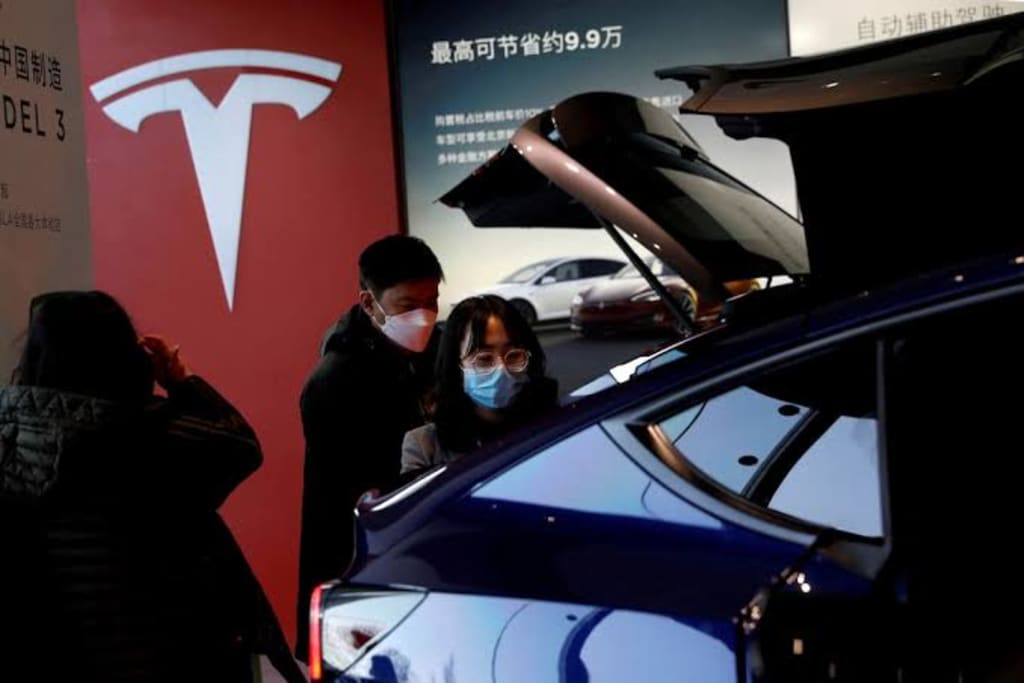
In the last week of October, at a Tesla delivery center in Pudong, Shanghai, a salesperson leaned against a display car and scrolled through his phone. He had three delivery orders scheduled for the day. Two were carried over from late September. In the body shop next door, there were more technicians than cars. “It’s not that nobody’s buying,” he said. “There just aren’t any cars in the lot.”
That same month, at the Shanghai factory’s docks, roll-on/roll-off ships arrived one after another. Of 67,829 wholesale vehicles, 59,012 were loaded for overseas shipment. That is 87% of output, the highest export share since the plant began production. Domestic retail sales were 8,817, down about 66% year on year.
The two figures are not contradictory. They describe the same priority shift: this factory is no longer optimizing for Chinese buyers.
I
Giving export priority at the start of a quarter and concentrating domestic supply at the end is a production rhythm Shanghai has run for years. October is the first month of the fourth quarter, which makes it an export window. Fewer cars for the domestic market is normal. At the end of September, Tesla introduced its first significant cash incentive in nearly two years. Model 3 was cut by 5,000 yuan and Model Y by 10,000 yuan, pushing starting prices to historic lows of 222,500 and 253,500 yuan. Orders that could be converted were converted in September. What was left for stores in October was never going to be much.
Taking the 8,817 figure by itself and calling it a collapse is a misreading. Tesla knows this. It does not need to explain. Wholesale sales were still up 10.3% year on year, and the global delivery base has not fallen apart.
A month that can be explained by production scheduling is still worth watching closely. It temporarily covers something slower-moving. What it covers looks much worse than 8,817.
II
Stretch the timeline out. Before October, Model Y’s domestic retail sales had already fallen year on year for five consecutive months. In the past, each quarter also began with capacity flowing to exports, yet domestic monthly deliveries could still hold at 10,000 to 20,000. This time they fell below 10,000. Cyclical scheduling can explain one month’s anomaly. It cannot explain five months of slope.
The comparison inside showrooms is more direct. In October, among new-energy vehicles priced above 200,000 yuan, all four Xiaomi models made the top ten. Together they sold more than 50,000 units. The YU7 alone sold 10,037 in the month. One model’s domestic retail sales exceeded Model Y’s for the same month. Li Auto’s L6 and AITO’s M6 each held steady above 9,000.
What matters is that the reason consumers open their wallets has shifted to a different track. Li Auto sells “a mobile home.” AITO sells the Huawei ecosystem. Xiaomi sells person-car-home connectivity. NIO sells battery swapping and community. These brands offer scenario, belonging, and the sense that the car understands how the buyer lives. Tesla is still selling driving feel and a sense of technology. In 2019 that pitch was crushing. By 2026, domestic brands have caught up on chassis tuning, cabin responsiveness, and usable driver assistance. An ordinary consumer who sits in the car and drives for ten minutes cannot tell who is higher and who is lower. Once the spec sheet is level, a car whose underlying platform has not been replaced in seven years cannot hold share on badge alone.
One detail: in one store’s sales training material, Model Y’s competitor script changed from “compare with BBA” last year to “compare with Xiaomi YU7 and Li Auto L6.” The script changed because the people walking in changed.
III
If the story stopped in China, one could still say Tesla is deliberately contracting. It is giving capacity to more profitable export orders and selling less at home. The export data makes that explanation hard to sustain.
Shanghai’s main export destination is Europe. In the first nine months of 2026, BYD’s cumulative European sales reached 283,997, up 134.6% year on year. That put BYD in Europe’s top ten passenger-car brands. Tesla sold 260,575 over the same period, up 50%, ranking thirteenth. Geely is also in the top ten. Chinese brands’ share in Europe approached 12% in the first three quarters and topped 12% in the third quarter alone. In some individual months, BYD’s European registrations were more than double Tesla’s.
Tesla ships cars to Europe and finds the same group of competitors unloading on the opposite dock. Shanghai’s export reallocation has not quarantined the China problem. It has changed the venue. The opponents did not change. Set 50% growth next to 134.6%: the absolute number is still rising; the relative position is sliding.
Globally, the pattern repeats. In the first half of 2026, BYD delivered 1.496 million new-energy vehicles worldwide. Tesla delivered 838,000. Tesla’s share edged up from 7.7% to 8.5%, but the absolute gap between the two remains. Tesla still sells globally. Its role is changing: from the one who sets the rules to the one running to keep up in a market where others are accelerating the rule-making.
IV
There is another squeeze, and it is in a policy document. China’s Ministry of Finance has announced that from April 2027, the export tax rebate for new-energy vehicles will be cut from 13% to 9%. Based on an average export value of about 220,000 yuan per Model 3 or Model Y, a four-percentage-point cut adds roughly 8,800 yuan in export cost per vehicle. For a factory sending nearly 90% of output overseas, this changes the economics of made-in-China, sold-globally.
Separately, neither of Tesla’s two long-term cards has been played. Approval for full FSD entry into China still has no timeline. On the fiscal Q3 2026 earnings call, Musk still could not give a new date. Mainland China currently offers only a one-time 64,000-yuan buyout option, with no subscription. Chinese automakers have already completed mass user education on driver assistance. Huawei, XPeng, and Li Auto have far more vehicles running urban NOA on the road than FSD has test miles in China. Even if FSD were approved tomorrow, it would not be entering a blank market.
On low-cost models, rumors of Model 2/Q have risen and fallen. Strategic focus has clearly tilted toward Robotaxi and Cybercab. That means Tesla will, for the foreseeable future, still use the aging Model 3 and Model Y platform to meet Chinese brands’ full price-band coverage from 150,000 to 300,000 yuan. One car’s life cycle against a full matrix is structurally asymmetric.
Shanghai’s shift from “Tesla’s China factory” to “Tesla’s global supply base” is tactically shrewd. It also shows something else: Tesla’s offensive in the Chinese market is retreating, and it is relying on exports to absorb capacity and keep utilization up. The export channel is being tightened by the rebate cut. The export destination is being penetrated by the same competitors. The domestic base is being sliced away by a faster product cadence.
October’s 8,817 came from a schedule. The risk is the slope underneath it. Production scheduling can explain one month. It cannot explain what is left when the relief valve’s outlet starts to narrow and the new growth engine has not yet ignited.
About the Creator
Jin
Writer of reamstories
https://reamstories.com/jin
Enjoyed the story? Support the Creator.
Subscribe for free to receive all their stories in your feed. You could also become a paid subscriber, letting them know you appreciate their work.
Comments
There are no comments for this story
Be the first to respond and start the conversation.