
Tesla Cut Prices Twice in One Month. New Owners Say They Got Played.
Tesla says the discounts can’t be stacked and delivered cars can’t get the new deal. Buyers who just took the keys say the sales pitch told a different story.
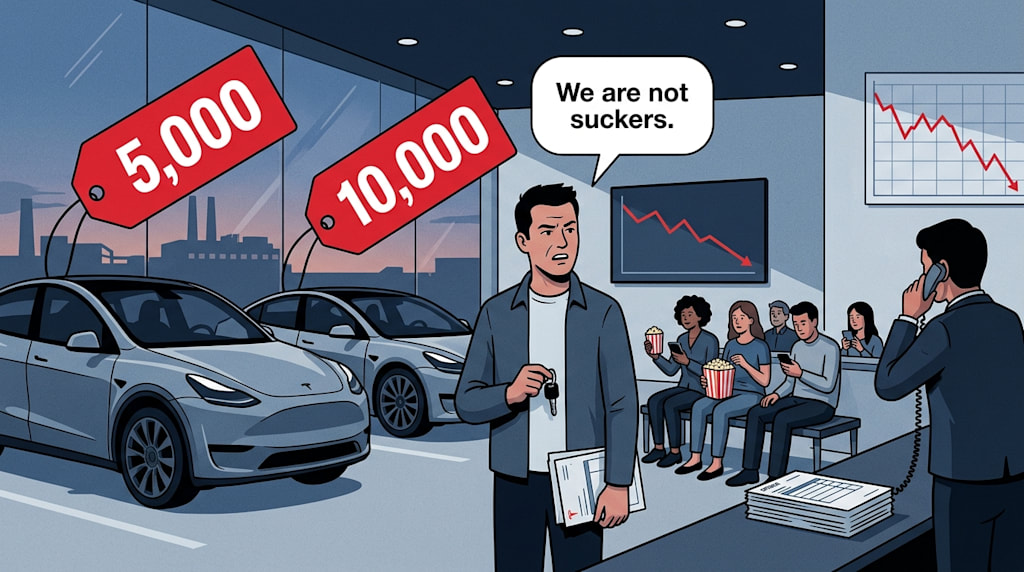
On September 25, Tesla China said customers who order by October 31, 2026, will get 5,000 yuan off the final payment on every Model 3 and 7,000 yuan off some Model Y trims.
It was the second discount in a month.
On September 7, Tesla China had already offered a cash incentive of 5,000 yuan on all Model 3 trims, including the Performance version, and 10,000 yuan on all Model Y trims, including the Model Y L. That deal applied to customers who ordered and took delivery of an in-stock car by September 30.
For people still shopping, the message was easy: wait, and pay less.
For people who had just taken delivery, the same message felt like a bill they had already paid.
“Just took delivery of a Model Y,” one owner wrote.
“Malicious price cut.”
“We are not suckers.”
Those comments spread among Tesla owners in China. Some filed complaints on Black Cat Complaint, a consumer grievance platform. One owner wrote that he ordered a 2026 Model Y on August 25 and took delivery on September 4. Before he ordered, a Tesla salesperson called him repeatedly and pushed him to buy. The salesperson promised 800 yuan for ordering and another 200 yuan if he later walked away, for a total of 1,000 yuan. That offer helped close the sale.
He had one worry. He asked whether the car might get cheaper in September. The salesperson did not warn him that a large price change could come within days. Three days after delivery, Tesla announced a 10,000 yuan cash incentive on the same Model Y.
“I just took delivery of a new car and immediately ran into a major price cut,” he wrote. “My purchasing rights have been harmed. I want Tesla to compensate me.”
His request was specific. He wanted 10,000 yuan to cover the difference. If Tesla would not pay cash, he asked for free Supercharging credits or official store points worth the same amount.
Tesla’s customer service was just as specific. The two policies were completely independent, the company said. They could not be stacked. Delivered vehicles could not retroactively use the latest offer. Earlier owners would not get compensation.
A discount by another name
Tesla has not changed its official sticker prices in China. It has used “limited-time final-payment reductions” and “cash incentives for in-stock cars” instead. The language avoids the phrase “official price cut.” A buyer’s bank account sees no difference.
That distinction matters to Tesla. An official price cut would reset the reference point for every car on the road. A limited-time incentive lets the company move inventory while keeping the official number intact. It does not change what recent buyers see when they check the latest offer.
A car is not a phone case. It is a high-value, low-frequency purchase with heavy depreciation. Buyers do not just buy the product. They buy an expectation that the price will not collapse the week after delivery. When that expectation breaks, the feeling is not abstract. It is a 10,000 yuan hole in a household budget. It is a monthly payment that now looks larger than it did. It is a decision that friends and family can second-guess.
The owners who complained accepted that prices can change. Their complaint was about the sales process. One owner said the salesperson told him he could “place the deposit now” even after he raised the possibility of a September price cut. Another said the salesperson pushed him to buy instead of explaining the options.
Tesla’s direct-sales model was built on the promise of transparent pricing. No dealer haggling. No hidden discounts. One price for everyone. That promise is harder to keep when the price changes by the week, and when the company offers no compensation mechanism for people who bought at the wrong moment.
The sales pressure behind the discounts
Tesla’s discounting is a response to pressure.
China Passenger Car Association data show that Tesla’s domestic retail sales fell year-on-year for three consecutive months from June to August. June was down 13.9 percent. July was down 32.9 percent. August was down 12.4 percent. In the first eight months of 2026, Tesla’s domestic retail sales totaled 316,251 vehicles, down 12.4 percent from the same period a year earlier.
The market share numbers are sharper. Tesla’s share of China’s battery-electric vehicle market has fallen from more than 15 percent in 2020 to 6.6 percent in the second quarter of 2026. China’s share of Tesla’s global deliveries fell below 30 percent for the first time, to 26.28 percent.
Profit is under pressure too. Tesla’s second-quarter 2026 financial report showed that vehicle sales and revenue grew year-on-year, but profit did not follow. Net income attributable to common shareholders was $1.114 billion, down 5 percent. Operating income was $398 million, down 57 percent. Operating margin fell from 4.1 percent a year earlier to 1.4 percent. Automotive gross margin dropped from 21.1 percent in the first quarter to 16.9 percent.
Fu Yifu, a special researcher at Suzhou Commercial Bank, said the two discounts in one month were most likely driven by sales pressure rather than a deliberate marketing campaign. Under a direct-sales model, prices adjust quickly with supply and demand. If orders were plentiful and capacity tight, Tesla would have no reason to keep giving up margin. Two rounds of discounts in quick succession point to weak domestic demand and rising inventory and delivery pressure.
The timing supports that reading. The September 25 policy applies to orders placed by October 31. The September 7 policy applied to orders and deliveries completed by September 30. Both were designed to pull forward demand and push cars out the door before the quarter closed.
Why buyers are waiting
Tesla’s problem is competition as much as price.
Local Chinese brands have filled the mainstream price bands with models that offer more advanced smart-cabin features, richer configurations, and stronger value for money. Tesla’s main products, the Model 3 and Model Y, have gone years without a major redesign. The freshness and differentiation that once made them stand out have weakened. Policy changes and cautious economic expectations have also made some consumers delay large purchases.
The deeper shift is that Tesla has gone from being the only choice to being one option among many. That change erodes brand premium. Discounts become a passive tool to protect share, keep factories utilized, and steady capital-market expectations.
The competition data make the shift visible. In August, the retail penetration rate of new energy passenger vehicles reached a record 65.2 percent. Among the top ten retail models that month, only two were Teslas: the Model Y with 29,260 vehicles and the Model 3 with 20,787. The other eight places went to domestic brands. In the January-to-August new energy manufacturer retail ranking, Tesla China placed sixth with 316,251 vehicles, behind BYD, Geely, Changan, Leapmotor, and HarmonyOS Smart Mobility.
That is not a position from which a company can simply cut its way back to dominance.
The cost of a moving price tag
Discounts can lift sales in the short term. They also carry a structural cost.
Fu Yifu said frequent price changes and owner complaints damage brand image and reputation. Cars are high-value, low-frequency, heavy-depreciation durable goods. Consumers buy a product and a stable price expectation. An unannounced price cut makes recent buyers feel deprived of value. Potential buyers learn to wait for the next discount, which weakens the promotion itself.
Tesla’s direct-sales model was supposed to make pricing transparent. But unilateral price changes and the absence of a compensation mechanism can turn ordinary business decisions into a trust crisis. Using “limited-time final-payment reductions” may soften the label of an official price cut. It does not change the fact of the cut. Complaints and negative reviews remain difficult to avoid.
The longer-term risk is price credibility. If buyers believe Tesla will always be cheaper next month, some will delay. If owners believe their car will lose value within days, repeat purchases and referrals become harder. Word of mouth shifts from “innovation leader” to “unstable pricing.” The “one-price” and “high resale value” reputation takes years to build. A few months of pulse discounts can put it under strain.
Short term, new buyers benefit. Sales may rebound. Long term, the brand’s pricing power may be consumed. That is a different kind of loss from a quarterly delivery miss.
The waiters win. Then what?
The “wait-and-see” crowd won this round. They did not have to negotiate, protest, or file complaints. They simply waited, and Tesla came to them with a lower price.
But if everyone learns to wait, Tesla loses more than a few orders. It loses the ability to set the terms. The question is no longer how much more Tesla can cut. The question is what else Tesla can offer to make someone buy now.
That question is harder than three consecutive months of declining domestic sales.
About the Creator
Jin
Writer of reamstories
https://reamstories.com/jin
Enjoyed the story? Support the Creator.
Subscribe for free to receive all their stories in your feed. You could also become a paid subscriber, letting them know you appreciate their work.
Comments
There are no comments for this story
Be the first to respond and start the conversation.