
My Car Fits the Parking Space. I Still Can’t Get Out.
China’s new EVs are two meters wide. Its parking spaces are still built for 1.8-meter cars. Every night, millions of drivers pay the price.
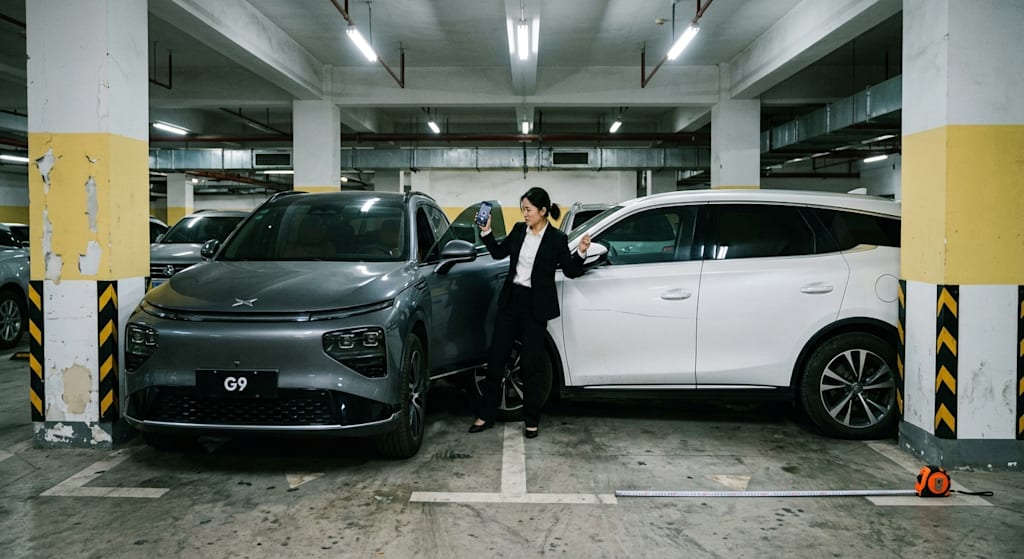
At 6:40 p.m. in the underground garage of Bairuijing community in Wuchang District, Wuhan, Ms. Liu parks her Li L7 and kills the engine. Then she does something she could not have imagined three years ago when she bought the car. She pulls out her phone, opens the app, and taps “remote park out.”
The car backs out by itself. She helps the elderly family members and the child out first. Then she lets the car park itself back in.
This is how she comes home every day.
I
She measured the inside of the white lines with a tape measure. 2.2 meters.
Her car is 1.998 meters wide.
That leaves eleven centimeters on each side. Once the mirrors fold and the door starts to open, the left side is so close to the concrete pillar that she turns sideways, sucks in her stomach, and folds herself like paper. She inches out through the gap. The leg of her suit trousers scrapes the door sill and leaves a gray-white mark. On the neighboring car’s paint, a faint scratch glints under the fluorescent light. She does not know whether she made it, whether someone else did, or whether another enormous car left it on some earlier night.
She has tried getting out normally. The door opens fifteen degrees and hits the concrete pillar. She pushes again. The side mirror touches the neighbor’s side mirror. She sits back in the driver’s seat, takes a deep breath, and tries again. After three attempts, she gives up.
Remote parking was a feature the car company discussed for forty minutes at the launch event. Lidar, millimeter-wave radar, twelve ultrasonic sensors, 200 TOPS of computing power. At the time, she thought all of it was far away from her. Now she uses it every day.
II
He Zhiqi is an executive vice president of BYD. In August 2026, he spoke at an industry forum. “In 2018, models 1.9 meters and wider accounted for only 10 percent of the market,” he said. “From January to July this year, that figure has already reached 40 percent. In the past, the ‘532’ size was for luxury cars. Now, if you don’t have a ‘532’ size, you don’t even dare sell a car for 200,000 yuan.”
“532” means over 5 meters long, over a 3-meter wheelbase, and over 1.997 meters wide.
Data from the China Passenger Car Association supports his point. In the first five months of 2026, 31 all-new or facelifted models met this standard. In all of 2025, the number was eight.
The car companies’ math is simple. Pure electric vehicles have no displacement tax, no consumption tax, and zero vehicle and vessel tax per year. With the same chassis, widening the body by five centimeters can push the model up one class. The price can go up by fifty thousand yuan. Two more rows of battery cells stuffed sideways into the pack can push the range figure from six hundred kilometers to seven hundred. The marketing department can write “goodbye to range anxiety” on the PowerPoint slide.
Whether the door can open is not the car company’s problem.
III
The Code for Design of Parking Garages (JGJ 100-2015), issued by the Ministry of Housing and Urban-Rural Development, sets the minimum clear width of a perpendicular rear-in parking space for a small car at 2.4 meters. The design vehicle’s outer width is 1.8 meters.
The geometry works. A 1.8-meter car parked in the middle of a 2.4-meter space leaves thirty centimeters on each side. If the neighboring car is also 1.8 meters, the gap between them is sixty centimeters. Another provision in the same code requires a lateral clear distance of at least 0.6 meters between motor vehicles.
0.6 meters. Just enough for an adult to pass sideways.
That was the logic of 2015. At the time, the average width of a Chinese passenger car was 1.75 meters. The Santana, the Jetta, the Sylphy, the Lavida, the Corolla. Not one exceeded 1.8 meters.
Now the Li L9 is 1.998 meters wide. The AITO M9 is 1.999. The NIO ES8 is 2.01. The Zeekr 009 is 2.024. The BYD Yangwang U8 is 2.05.
A 1.998-meter car parked in a 2.4-meter space leaves twenty centimeters on each side. If the neighboring car is also two meters wide, the gap between them is forty centimeters. Unfold the side mirrors, and each takes up fifteen to twenty centimeters. The clear distance drops to zero.
The flaw sits in the standards. One set governs cars. It permits a passenger vehicle up to 2.55 meters wide. Another set governs parking spaces. It assumes a design vehicle width of 1.8 meters. The 0.75 meters in between can be manufactured, registered, and driven on the road. It cannot fit into a parking space drawn according to the old standard.
IV
The more hidden problem sits below the surface.
Reporters from Hubei Daily measured several residential compounds in Wuhan. In a high-end compound near Jiedaokou in Wuchang, most parking spaces had an effective width inside the white lines of about 2.2 meters. In a compound in Changqing Huayuan in Hankou, even counting both white lines, the total width was 2.35 meters. The national lower limit is 2.4 meters.
Why is it five centimeters short?
A cost engineer who had worked for nearly twenty years at a major real estate developer in central China explained the math. The civil engineering and excavation costs of an underground garage are extremely high. Under a fixed column grid, reducing each parking space by fifteen to twenty centimeters can squeeze out an extra space on the drawings. In first- and second-tier cities, where parking spaces sell for hundreds of thousands of yuan, a thousand-space garage can gain nearly a hundred extra spaces through this “millimeter-level operation.” That adds tens of millions of yuan in value.
At acceptance inspections, the code does not say tightly enough whether the 2.4-meter measurement is based on the inside edge of the white line, the centerline distance, or the outer contour. “Axis dimensions” became common practice. That means the distance between the geometric centerlines of two concrete columns. The volume of the columns is counted into the parking space area. The space the owner can actually use is one ring smaller than the drawings.
V
Mechanical stack parking is worse.
Under early design codes, the effective width of a lift-and-slide mechanical parking space was no more than 1.85 meters. The maximum load was 1.7 to 2.0 tons. Today’s mainstream mid-to-large pure electric SUVs start at 2.3 tons in curb weight and easily exceed 2.8 tons when fully loaded. Their width generally exceeds 1.95 meters.
At the underground garage of the Fanyuehui · Tanhualin commercial area in Wuchang, Wuhan, rows of mechanical parking spaces sit without power. The steel plates rust. The chains slacken. The indicator lights on the control panels went out long ago. When they were built, they passed planning acceptance and satisfied the required parking ratio. Then they became scrap metal.
Beijing is similar. An investigation by The Beijing News found that many mechanical garages have a weight limit of 2,000 kilograms and a width limit of 1.85 meters. Owners would rather queue for a flat space than drive onto those steel plates. “Hard to park.” “Scrapes the wheels.” “Too heavy to park.” The reasons repeat.
VI
The conflict spreads from the parking space to the people.
In Chengdu, car owner Ms. Wang had her car scraped twice because the neighboring car had long been parked across the line. She installed a protective barrier in her own space. The property management company asked her to remove it because it “affects the neighboring car’s normal ability to get in and out.” She refused. The matter went to court.
The court’s ruling surprised her. In several similar cases, the courts held that an owner installing a barrier in his or her own parking space exceeded the reasonable boundary of exercising rights. It affected the neighboring party’s normal use of the space. The barrier should be removed. As for the rights of the squeezed party, whose door cannot open and who is trapped inside, the court did not provide a clear remedy.
The provisions of the Civil Code on neighboring relations mainly address light, drainage, and passage. In an underground parking space, “the body is within the lines, but the side mirror and the door intrude into the neighboring car’s reasonable use space” is a new type of dispute. There is no quantitative standard. There is no consensus in precedents.
A lawyer at Hubei Huanghe Law Firm wrote a restrained sentence in a research report: “In many disputes, neither side has clearly violated the rules.”
The large-car owner has parked completely within his own space. The neighboring owner cannot normally use his own space because the door cannot open. Neither person is wrong. Both have been hurt.
VII
Property management and the police are also powerless.
Property management has no legal power to forbid an owner from parking a legally purchased vehicle in his or her own parking space. After the police arrive, they usually mediate. “Neither side has exceeded the prescribed boundary,” they say. “This is not a traffic accident.” They suggest the owners negotiate or litigate on their own.
A compound in Nanping, Fujian, tried to solve the problem by a homeowners’ committee vote. With 615 votes in favor and 2 against, it passed a resolution banning new energy vehicles from entering the underground garage. Legal experts generally regarded this as infringing on owners’ legal right to use their exclusive parking spaces. The resolution was ultimately not enforced.
VIII
The Ministry of Housing and Urban-Rural Development has started revising the Code for Design of Parking Garages. The new standard is expected to increase the length and width of parking spaces. It is planned for release next year.
Shandong took a step ahead at the local level. Its 2026 high-quality residential construction standards require parking spaces to be no smaller than 2.5 meters by 5.3 meters. Kunshan’s 2026 allocation standard also increased the design size of parking spaces. In response to a citizen suggestion, the Sichuan Department of Housing and Urban-Rural Development said it would study optimizing the size of small parking spaces when formulating local standards.
Renovation of existing spaces is also being piloted. A mechanical garage built in 2003 at Yindao Commercial Building in Xicheng District, Beijing, was renovated. Its load capacity rose from 1.8 tons to 2.3 tons. Shanghai plans to promote the renovation of old garages during the “15th Five-Year Plan” period, widening parking spaces and upgrading mechanical equipment. Those that cannot be renovated will have their mechanical devices removed and be converted into ground-level spaces.
These changes are still far away from Ms. Liu. Her compound was completed in 2012. The underground column grid has been poured. The white lines have been painted for fourteen years. Every day when she comes home, she still backs the car out, lets her family get out, and uses her phone to remote-park it back in.
IX
Paris did something in 2024. In a referendum, citizens voted overwhelmingly for a policy. Traditional fuel or hybrid SUVs with a curb weight of at least 1.6 tons and pure electric vehicles with a curb weight of at least 2 tons must pay 18 euros per hour to park in the city center. Six hours costs 225 euros. That is three times the rate for ordinary vehicles.
Japan’s approach is older. Strict tax and parking policies cultivated the K-Car culture. Only cars no more than 3.4 meters long and 1.48 meters wide can enjoy purchase tax breaks and simplified parking certificate requirements.
The logic in both countries is the same. When the public space occupied by a vehicle enters the price system, the economic incentive for blind expansion meets real market discipline.
X
Next to Ms. Liu’s parking space is an AITO M9. The owner is a man in his thirties who leaves earlier than she does every morning. A few times she has run into him in the elevator. They nod. They do not speak.
She has noticed a long scratch on the inside of his driver’s-side door. It runs from the handle all the way down to the lower edge. The paint has turned white, revealing the primer. He has not had it repaired.
Her own driver’s-side door has one too. Almost the same position.
The two cars park side by side, mirrors folded, bodies within the lines, looking perfectly well behaved. If you crouch down and look through the gap between them, you find nothing in that forty-centimeter passage. No space. No dignity. No right or wrong.
Only two meters of steel and a twenty-centimeter gap.
Every evening, two people inside their own car doors take a deep breath, suck in their stomachs, turn their shoulders, fold themselves into a sheet of paper, and squeeze out through that gap, bit by bit.
About the Creator
Jin
Writer of reamstories
https://reamstories.com/jin
Enjoyed the story? Support the Creator.
Subscribe for free to receive all their stories in your feed. You could also become a paid subscriber, letting them know you appreciate their work.
Comments
There are no comments for this story
Be the first to respond and start the conversation.