
Lyft and Baidu Enter London’s Robotaxi Battleground as Testing Begins
The strategic partnership leverages Freenow’s local footprint and Baidu’s Apollo Go RT6 platform to challenge Waymo and Uber in Europe’s most competitive autonomous vehicle market, with public rides targeted for 2027.

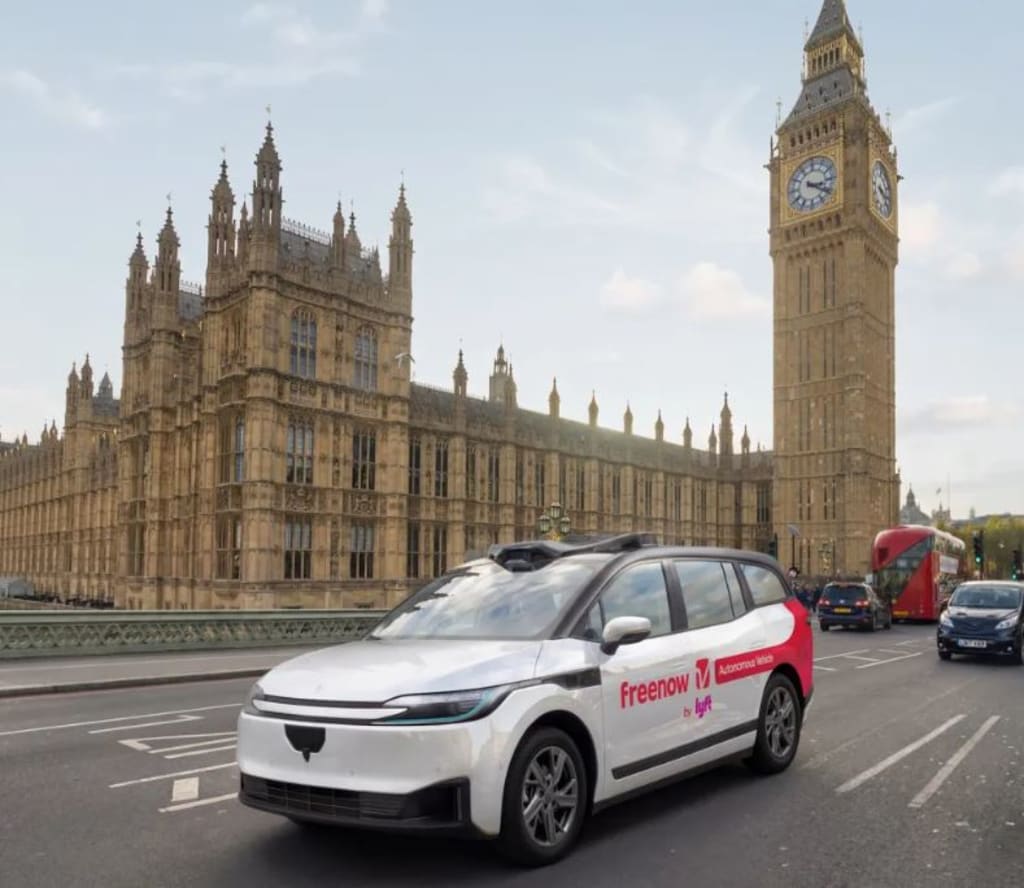
The race to commercialize robotaxis in Europe has intensified as Chinese tech giant Baidu began testing its autonomous vehicles in London this week. The tests, conducted with human safety operators behind the wheel, mark the operational launch of a strategic partnership between Baidu, Lyft, and Freenow, the German multi-mobility app that Lyft acquired in 2025 for approximately $197 million. This move positions the consortium as the third major player to begin on-road validation in the U.K. capital, joining Waymo and the Uber-Wayve alliance in what is rapidly becoming Europe’s premier proving ground for self-driving mobility.
A Strategic Triad: Tech, Platform, and Local Access
The collaboration represents a deliberate division of labor designed to overcome the unique barriers of European market entry. Baidu contributes its purpose-built Apollo Go RT6 robotaxi, a vehicle already accumulating millions of miles in Chinese cities and engineered specifically for ride-hailing economics. Lyft provides the global ride-hailing infrastructure and demand-generation expertise, while Freenow (now branded “Freenow by Lyft”) offers something neither American nor Chinese companies can easily replicate: deep integration with London’s existing taxi ecosystem and established relationships with local regulators.
This tripartite structure addresses a critical lesson from earlier AV deployments: technology alone doesn’t win markets. Regulatory approval, public trust, and driver acceptance are equally decisive. By anchoring the service through Freenow, the partnership signals respect for London’s professional driving community, a contrast to the disruptive “replace drivers” narrative that has fueled backlash in other markets.
London: Europe’s High-Stakes Proving Ground
London’s emergence as a robotaxi battleground reflects both its regulatory openness and its density of demand. In April, Waymo began safety-driver testing in the city, leveraging its U.S. operational playbook. Meanwhile, Uber and British AI firm Wayve announced plans to launch a phased robotaxi service later this year, starting with human operators before transitioning to fully driverless operations. Customers can already join an interest list, signaling imminent public access.
Baidu and Freenow by Lyft have set a more conservative timeline, targeting public hailing in 2027, contingent on regulatory approval. For now, dozens of test vehicles will operate exclusively within the borough of Brent, allowing the team to validate performance in a controlled urban environment while maintaining ongoing dialogue with Transport for London (TfL) and the Centre for Connected and Autonomous Vehicles (CCAV). The U.K. government’s new AV pilot program, which opened applications in May, provides a formal pathway for supervised testing under national oversight a framework designed to accelerate safe deployment without compromising public safety.
The Hybrid Network Model: Coexistence Over Replacement
Perhaps the most strategically significant aspect of the announcement is the commitment to a hybrid network model. When commercial service launches, robotaxis will operate alongside human-driven taxis and private-hire vehicles on the same platform. Thomas Zimmermann, CEO of Freenow by Lyft, framed this explicitly: “As a platform with deep roots in the taxi industry, our priority is ensuring that autonomous technology supports the professional drivers who keep London moving.”
This language mirrors Uber’s recent positioning but carries added weight given Freenow’s heritage as a traditional taxi aggregator. It acknowledges a political reality: London’s licensed drivers wield significant influence, and any perception of automation as a threat could trigger regulatory resistance or public opposition. By positioning robotaxis as complementary capacity filling gaps during peak demand or in underserved areas, the partnership aims to build coalition rather than conflict.
Implications for the Global Robotaxi Race
The London tests represent more than a regional expansion; they’re a stress test for cross-border AV deployment models. Baidu’s participation demonstrates that Chinese AV technology can adapt to Western regulatory environments and left-hand traffic patterns. Lyft’s involvement shows how U.S. platforms can leverage acquisitions to gain European footholds without building from scratch. And Freenow’s role proves that local incumbents remain indispensable gatekeepers, even in an era of technological disruption.
Success in London would validate a template applicable to Paris, Berlin, and beyond. Failure or prolonged regulatory limbo would reinforce skepticism about AV scalability outside controlled Asian markets. With three well-funded consortia now testing simultaneously, the next 18 months will determine whether Europe becomes a second home for robotaxis or a cautionary tale of overambition.
For now, the message from Brent is clear: the robotaxi revolution isn’t arriving as a foreign invasion. It’s being negotiated, one borough at a time, with safety operators at the wheel and professional drivers still very much in the picture.
About the Creator
Mark Lim
Hi I am mark an automotive student and a car, tech and food enthusiast ! Im gonna try and post daily & hope you enjoy what I write and do share my page with people you know. I would gladly appreciate it! Cheers
Enjoyed the story? Support the Creator.
Subscribe for free to receive all their stories in your feed.
Comments
There are no comments for this story
Be the first to respond and start the conversation.