
I Make $20,000 a Month. I Still Can’t Afford to Fix My Electric Car.
The repair bill is the new car payment, and automakers control the price.
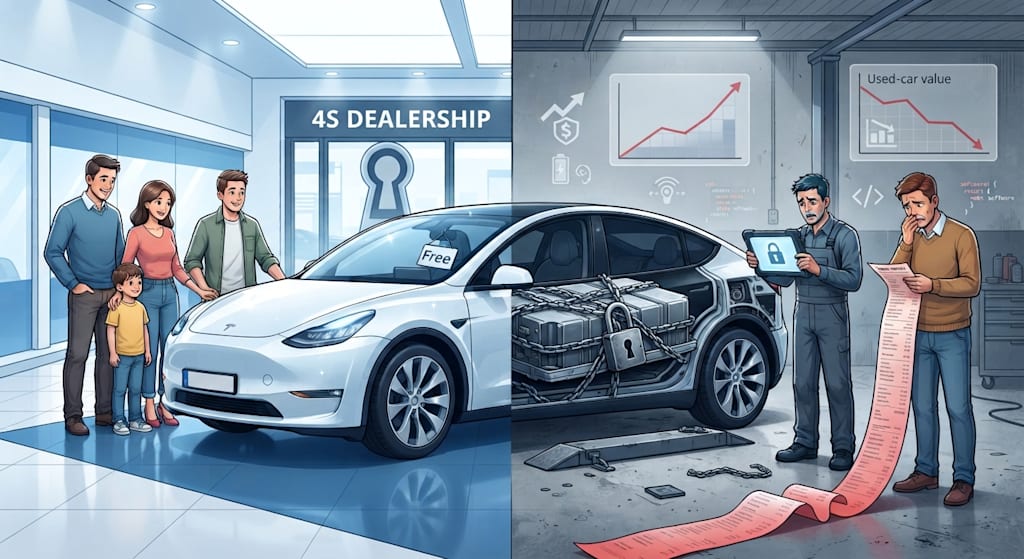
We used to say, “It’s easy to buy a car, but hard to maintain it.” Now that sentence needs a rewrite: It’s easy to buy an electric car, but even harder to repair it.
A monthly salary of 20,000 yuan is not low in many Chinese cities. One minor scrape can wipe out half a month’s pay. One undercarriage impact can erase a year’s savings. One serious collision can push the repair bill close to the price of a new car. This is not a joke. It is a monthly budget line for a growing number of NEV owners.
NEV sales have overtaken fuel vehicles. Smart features, electrification, and price parity between electric and gasoline cars have made NEVs the first choice for more consumers. But as these cars enter the repair cycle, the out-of-warranty period, and the used-car market, a problem hidden by rapid growth is surfacing. NEVs are affordable to buy, but not to repair. Even when you can afford the repair, you cannot afford the wait.
J.D. Power’s 2026 China New Energy Vehicle After-sales Service Satisfaction Study shows that the average accident repair cost for an NEV is about 1.7 times that of a fuel vehicle. The China Automotive Maintenance and Repair Association puts the range even higher: 1.6 to 2.3 times. China Newsweek, Economic Daily, and other outlets have reported that expensive repairs and difficult repairs are becoming a new anxiety for NEV owners. Minor faults often cost thousands of yuan. Major repairs can approach half the price of the car. Some high-voltage system repairs require weeks of waiting.
Where does the problem start?
On the surface, it is high repair prices. Deeper down, the entire NEV after-sales system has not been built. More precisely, NEV makers have copied the efficiency logic of manufacturing into the after-sales side, but these two logics conflict.
1. From repairing parts to replacing assemblies: the logic of expensive repairs
Traditional fuel vehicle repair follows a simple rule: fix what is broken.
If the engine makes noise, take it apart and check the valves and pistons. If the transmission jerks, replace gears or clutch plates. If the body panel is deformed, pull it, hammer it, sand it, and repaint it. Experienced mechanics rely on experience, feel, and sound to diagnose the problem with reasonable accuracy. After decades of development, the repair market has formed a complete system, from roadside shops to chain brands to 4S dealerships, with price tiers and layered choices.
NEVs operate on a different model.
To pursue safety, lower production costs, and higher production efficiency, NEV makers adopt highly integrated designs. The most typical example is the gigacasting trend popularized by Tesla. Rear underbodies, front compartments, and other parts are formed in one shot as huge aluminum castings, turning dozens or hundreds of parts into a single unit. Many domestic new forces followed. Cell-to-chassis integration, centralized domain controllers, and integrated motor-electronic control systems follow the same idea.
From the manufacturing side, this is progress. The body is lighter, stiffer, and more torsionally rigid, with fewer parts, faster production cycles, and lower costs. From the repair side, it is a disaster.
Once a gigacast part is deformed or cracked, it cannot be pulled and repaired like traditional sheet metal. The entire assembly must be cut out and replaced. If a single battery cell fails, in many cases it cannot be replaced individually. The entire pack must be swapped. If a lidar, camera, or millimeter-wave radar is slightly scraped, sensor calibration is involved, and the repair bill jumps to thousands or tens of thousands of yuan.
J.D. Power’s survey shows that in minor scrape accidents, NEV repair costs range from 5,000 to 15,000 yuan, while fuel vehicles cost only 2,000 to 8,000 yuan. In severe collisions, NEV repair costs can approach or exceed the price of a new car, while fuel vehicles cost 50,000 to 150,000 yuan.
This is the price of replace, don’t repair. The cost saved on the manufacturing side does not disappear. It moves to the after-sales side. The discount consumers enjoy when buying the car is paid back with interest when repairing it.
2. Technological monopoly: automakers turn repair into a black box
If it were only a design problem, it would still just be expensive repairs at the physical level. What leaves third-party repair shops helpless is the closed control NEV makers exercise over core technologies.
In the era of traditional fuel vehicles, although automakers controlled original parts, the mechanical structure was open. Third-party repair shops could buy aftermarket parts, disassemble and study them, and diagnose faults through experience. Automakers could not lock down mechanical knowledge.
In the NEV era, the core lies in the three electric systems, battery, motor, and electronic control, plus intelligent driving systems and software algorithms. These are the core competitiveness of automakers and their technological moats. To protect this technology, most automakers strictly control the three electric systems, diagnostic protocols, fault codes, and software calibration permissions. Third-party repair shops cannot get diagnostic access, cannot read fault codes, cannot buy original parts, and dare not touch the high-voltage system.
When an NEV breaks down, only the automaker-authorized 4S dealership network can read fault codes through internal systems and proceed with repairs. Roadside mechanics look at the car full of electronic components and encrypted systems. They want to repair it. They have no way in. No permission to repair, no access to original parts, and no entry point for diagnosis.
This technological barrier is a monopoly. It forces consumers back into the 4S dealership system. Since 4S stores have high operating costs, and automakers have absolute control over original parts, prices remain high. Consumers appear to have choices. In reality they do not. Either accept the high repair bill at the 4S store, or let the car sit dead. The bargaining power is entirely with the automaker, not the owner.
What is more hidden is that NEVs are software-defined. Automakers can use OTA remote upgrades, limit functions, lock the car, or suggest that you return to the store for inspection. Traditional automakers could at most control the circulation of original parts. NEV makers control the gateway to diagnosis rights, software rights, and data rights all at once. Until this black box is opened, the third-party market will never grow.
3. The aftermarket lags behind: they want to repair, but they cannot
Another overlooked reason NEV repairs are so difficult is that the aftermarket lags.
After decades of development, fuel vehicle repair in China has formed a mature industrial system. From tire repair and oil changes to engine overhauls, from bodywork and painting to transmission repairs, the layers are clear and coverage is broad. NEV repair is still new. It integrates electronics, information technology, intelligent control, and other fields, placing high demands on repair personnel. It is no longer simply turning screws and replacing parts. It requires understanding circuits, programming, and intelligent control. This technical threshold blocks most traditional repair shops.
At present, the number of repair shops nationwide with advanced NEV repair capabilities is small, and they are mainly concentrated in first- and second-tier cities. Ordinary maintenance shops can often only do basic work: paint touch-ups, tire changes, windshield wiper replacements. Once the core three electric systems or intelligent driving systems are involved, they are helpless.
The result: consumers who want to repair their cars cannot find reliable repair shops. A large amount of repair demand is backed up in the 4S dealership system. 4S stores have limited capacity and low repair efficiency, so prices rise.
Long repair cycles worsen the pain. Some NEV high-voltage system repairs require weeks of scheduling. For owners who commute daily, pick up children, or run businesses, having the car parked for a week or even weeks costs not only repair money but also time and income.
4. Chain reactions: insurance, residual value, and the used-car market
Expensive repairs are not just a repair industry issue. They trigger a chain reaction.
Insurance. When NEV repairs are expensive, insurance companies pay out more, so premiums rise. Owners complain that premiums are expensive. Insurance companies feel wronged too. They are paying out too much. If repair costs cannot come down, NEV insurance will not become cheap.
Residual value. NEV warranties are often tied to the first owner. Second-hand buyers do not enjoy lifetime warranties. Once a vehicle enters the used-car market, repair costs are fully passed on to the next owner. Since NEV residual values are already not high, if repair costs are absurdly expensive, the used-car market will freeze. No one dares to take on a car that is too expensive to repair.
Battery degradation. After the warranty expires, the cost of replacing the battery is generally estimated at 30% to 50% of the car’s price. If automakers do not open up battery repair and cascading utilization, a large number of out-of-warranty NEVs will become disposable consumer goods. Affordable to drive, unaffordable to repair, and impossible to sell.
When this batch of cars goes out of warranty on a large scale and enters the second-hand circulation market, the problem will explode. A cliff-like drop in residual value will in turn hurt new car sales.
5. Breaking the deadlock: it cannot rely only on automakers’ conscience
The NEV repair deadlock is not a problem in a single link. It is a problem for the entire industrial system. Breaking it requires joint efforts from multiple parties. It cannot rely only on calling on automakers to have a conscience.
First, promote right-to-repair legislation. In recent years, the European Union has promoted right-to-repair legislation, requiring automakers to provide independent repairers with equivalent diagnostic information, tools, and parts at reasonable prices. China can learn from this and, through laws, regulations, or industry associations, force or semi-force automakers to open a certain degree of repair permissions, diagnostic protocols, and core component distribution channels. The three electric systems must not be allowed to become a completely closed black box controlled by automakers.
Second, promote battery standardization and modularization. If battery pack dimensions, interfaces, and communication protocols are standardized, third parties can perform battery repair and cascading utilization. CATL is already promoting its Choco-SEB modular battery swap blocks, but whether automakers are willing to follow is another question. Standardization will sacrifice some differentiation, but it can bring vitality to the entire aftermarket.
Third, develop the remanufacturing industry. Recycle, inspect, refurbish, and recirculate replaced assemblies to form a price gradient of new original parts, remanufactured parts, and salvaged parts. This requires automakers to open parts coding and traceability systems. Remanufacturing is not a synonym for low-end. It is an important part of the circular economy.
Fourth, let the insurance industry apply pressure. Insurance companies are the ones paying the bills directly, so they have the strongest incentive to reduce repair costs. Promote tiered repair pricing: minor accidents can be repaired by third parties, and only major accidents go back to 4S stores. Partner with third-party repair chains to certify NEV repair networks. Offer premium discounts for models that adopt modular design and are easier to repair. If repair economy is included in the insurance pricing model for vehicle models, automakers will face a choice: either open up the repair system to lower premiums, or bear the sales loss caused by rising premiums.
Fifth, accelerate third-party repair chains and technician training. Vocational schools, automakers, and third-party chains should jointly carry out certification training, rather than letting automakers lock training resources inside their own systems. Only with enough qualified technicians can the third-party market absorb repair demand.
Sixth, automakers must change their mindset. After-sales is not simply a profit center. It is also a brand moat. Locking down repairs can bring high short-term profits, but in the long run it erodes consumer trust. In the second half of the NEV race, the competition is not only about range, intelligent driving, and price. It is also about after-sales. Whoever can make repairs affordable, fast, and reliable will win word of mouth in the next round of competition.
6. Conclusion
A monthly salary of 20,000 yuan and still unable to afford car repairs sounds exaggerated. It is becoming reality.
The NEV industry is developing rapidly. It cannot focus only on sales and penetration rates. It must also look at whether the after-sales system can keep up. If the repair deadlock is not broken, when this batch of cars goes out of warranty on a large scale and enters the used-car market, the problem will escalate from owners complaining to an industry crisis.
Only a complete and competitive aftermarket can bring down high repair costs. Only by breaking the monopoly, letting technology flow, and allowing third-party repair shops to make money and be capable of repairing cars can consumers afford to repair their vehicles.
Otherwise, NEVs may become disposable consumer goods: affordable to buy, affordable to drive, but unaffordable to repair and impossible to sell.
The first half of the NEV race was about electrification and intelligence. The second half will be about after-sales and service. Automakers that open their repair systems will earn trust. Automakers that lock them down will pay for it in residual values and repeat sales.
About the Creator
Jin
Writer of reamstories
https://reamstories.com/jin
Enjoyed the story? Support the Creator.
Subscribe for free to receive all their stories in your feed. You could also become a paid subscriber, letting them know you appreciate their work.
Comments
There are no comments for this story
Be the first to respond and start the conversation.