
Hydrogen Is the Cleanest Fuel on Earth. That’s Why It’s Not in Your Engine.
It burns to water, but inside a cylinder it pre-ignites, backfires, and turns a motorcycle into a torpedo. The engineering truth is brutal.
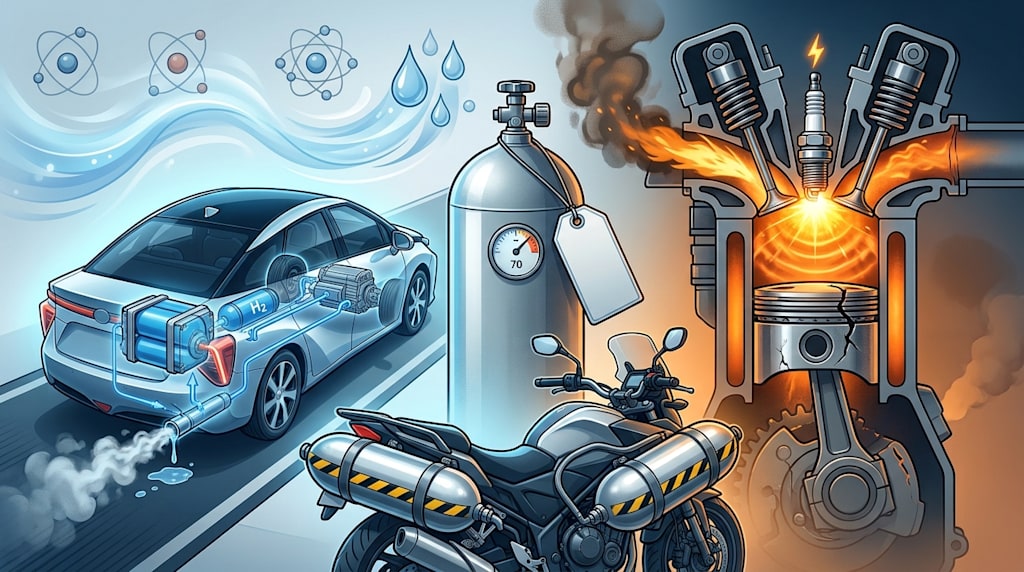
After Hydrogen Burns
Hydrogen combustion produces water. The chemical equation is clean. Put hydrogen into a cylinder, and things stop being clean.
A gasoline engine converted to run on natural gas does not need many parts changed. Hydrogen is different. Its ignition energy, flame speed, and flammability range are not on the same order as gasoline or natural gas. It is more like a tenant with an extreme temper: quiet most of the time, but any spark, any hot spot, can make it go off early.
I. First, distinguish: burning hydrogen and using hydrogen are not the same thing
Hydrogen energy vehicles fall into at least two routes.
One is the hydrogen fuel cell vehicle. Toyota Mirai and Hyundai NEXO take this route. Hydrogen does not burn. It enters the stack, reacts electrochemically with oxygen in the air, produces electricity, and then the motor drives the wheels. There is no flame, no knock, no backfire. Energy conversion efficiency can exceed 60%.
The other is the hydrogen internal combustion engine vehicle. Hydrogen is injected directly into the cylinder, the spark plug ignites it, and the piston does work. It sounds closer to a traditional fuel vehicle, and it can reuse part of the existing internal combustion engine production line. The problem is that hydrogen is not gasoline, nor natural gas. Once it enters the cylinder, the combustion process is extremely difficult to make follow the engineer's will.
II. Ignition energy low enough to be dangerous
Gasoline has an ignition energy of about 0.24 millijoules. Hydrogen has an ignition energy of about 0.02 millijoules. That is an order of magnitude apart.
Any small hot spot in the cylinder (carbon deposits, the exhaust valve, spark plug electrodes) can ignite the hydrogen early. Before the spark plug fires, the mixture has already ignited. Engineers call this "pre-ignition."
Pre-ignition is not a minor fault. It subjects the piston to enormous pressure during the compression stroke. The crankshaft, connecting rod, and bearings all have to bear abnormal loads. In severe cases, the engine can be destroyed within minutes.
III. The flame runs too fast
Hydrogen's laminar flame speed is close to 2.9 meters per second. Gasoline is about 0.4 meters per second.
When the flame runs too fast in the cylinder, the pressure curve rises steeply. When pressure rises to a certain point, the end gas autoignites, producing knock. Knock is a series of pressure waves that can puncture pistons, ruin bearings, and crack cylinder blocks.
To suppress knock, engineers must retard ignition, dilute the mixture, lower the compression ratio, and add exhaust gas recirculation. Every measure works, and every measure also sacrifices power and thermal efficiency. Current hydrogen internal combustion engine demonstration models mostly have thermal efficiency between 35% and 40%, lower than comparable gasoline engines.
IV. Backfire: the flame runs backward
Hydrogen's flammable volume range in air is about 4% to 75%. Gasoline is only about 1% to 7.6%.
A wide flammable range means that after a leak, almost any concentration can ignite. In the cylinder, it brings another problem: backfire. When the intake valve opens, if the hydrogen in the intake port is ignited by residual flame or a hot spot, the flame flows back into the intake manifold. In a gasoline engine, backfire is a fault. In a hydrogen engine, backfire can be a constant threat.
V. Zero carbon does not mean zero pollution
The main product of hydrogen combustion is water vapor. But at high temperatures, nitrogen and oxygen in the air react to form nitrogen oxides, or NOx. Hydrogen's adiabatic flame temperature is very high. When combustion is near the stoichiometric air-fuel ratio, NOx formation can be substantial.
NOx is a precursor to haze and photochemical smog. Hydrogen internal combustion engines need complex aftertreatment systems to control it. Add the small amounts of particulate matter and unburned hydrocarbons produced when lubricating oil enters the combustion chamber, and the hydrogen internal combustion engine is zero-carbon or low-carbon, not zero-pollution.
VI. The CNG experience does not transfer
Compressed natural gas vehicles have already shown that existing internal combustion engines can burn gaseous fuel. But there is a gulf between natural gas and hydrogen.
Natural gas has an ignition energy of about 0.29 millijoules, close to gasoline. Its flammable range is 5% to 15%, much narrower than hydrogen. Its flame speed is about 0.38 meters per second, also much slower than hydrogen. Natural gas can be adapted from a gasoline engine relatively gently. Hydrogen cannot.
More important is volumetric energy density. Gasoline contains about 32 megajoules of energy per liter. 70 MPa high-pressure hydrogen has only about 5 megajoules per liter. Liquid hydrogen has only about 8.5 megajoules per liter. To travel the same 500 kilometers, a hydrogen car must carry a far larger volume of fuel than a gasoline car. Passenger cars have to carry huge high-pressure tanks. Motorcycles have almost nowhere to put a tank.
VII. That "land-based manned hydrogen torpedo"
Japan once introduced a hydrogen-powered motorcycle. Toyota and Yamaha jointly developed it, based on a large-displacement sport motorcycle. The motorcycle world was shocked by the two panniers at the back.
Inside those two panniers were high-pressure hydrogen tanks.
Japanese regulations strictly limit the total capacity of hydrogen tanks on two-wheelers. Total capacity must be kept below 23 liters. The reason: a motorcycle may be parked in a small garage, and if it leaks, it must not become a large bomb.
Engineers could only split the hydrogen into four slender small tanks, lowering the center of gravity and optimizing weight distribution. The cost was a range of only about 100 kilometers. Early tests were reported to support only about 10 minutes of riding, and filling the tank cost about 3,000 yen.
Hydrogen stations were originally designed for large automotive tanks of 50 liters or more. The filling speed is too fast, which is dangerous for a motorcycle's small tank. A slow-fill hydrogen device had to be designed. So someone gave it a nickname: the land-based manned hydrogen torpedo.
The nickname is exaggerated. But it hits on one thing: for hydrogen to be a vehicle fuel, it first has to pass the psychological safety barrier. When the public sees a high-pressure tank, it thinks of an explosion, not water vapor.
VIII. Expensive hydrogen, expensive stations, expensive cars
Even if the technical problems are solved, the hydrogen internal combustion engine still has to face the business math.
Most hydrogen on the market today comes from fossil fuel reforming, that is, gray hydrogen. Green hydrogen accounts for less than 1%. Even for gray hydrogen, the retail hydrogen price at the pump often exceeds 40 yuan per kilogram. Hydrogen internal combustion engines are less efficient than fuel cells, consume more hydrogen per 100 kilometers, and have operating costs that have a hard time competing with diesel and natural gas.
A fixed hydrogen station with a daily refueling capacity of 500 kilograms requires an investment of about 8 to 15 million yuan, with annual operating costs of another 3 to 5 million yuan. Few cars, and the station loses money. Few stations, and users dare not buy a car. This is a dead loop.
Hydrogen fuel cell vehicles need platinum catalysts, proton exchange membranes, and high-pressure hydrogen storage tanks, so costs are high. Hydrogen internal combustion engines can reuse part of the internal combustion engine production line, but high-pressure hydrogen injection systems, anti-pre-ignition designs, high-temperature materials, and special aftertreatment are also not cheap.
Transport is also expensive. Hydrogen density is low, and tube trailers are inefficient for transporting hydrogen. Liquid hydrogen requires minus 253 degrees Celsius, and both energy consumption and boil-off losses are large. Pipeline hydrogen transport requires huge investment and is hard to roll out in the short term.
IX. Why fuel cells win
Industry is more willing to do hydrogen fuel cells, for a direct reason: higher efficiency, fewer combustion problems.
Fuel cells turn hydrogen into electricity through an electrochemical reaction, without combustion. There is no pre-ignition, no backfire, no knock, and no NOx caused by high-temperature oxygen-rich conditions. System efficiency can reach 50% to 60%. On the same kilogram of hydrogen, a fuel cell can go farther.
Fuel cells turn hydrogen into electricity. The electricity industry chain, motor industry chain, and electronic control industry chain are all ready-made. The auto industry is fully electrifying, and fuel cells can embed themselves in this trend. The hydrogen internal combustion engine, by contrast, has to go against the trend and solve a set of combustion problems all over again.
X. Hydrogen internal combustion engines are not a blank space; they are just not in the spotlight
BMW launched a hydrogen 7 Series in the 2000s, powered by a V12 hydrogen internal combustion engine that could burn liquid hydrogen and gasoline. Hydrogen-mode range was limited, power dropped, and it never entered mass production. Mazda built the RX-8 Hydrogen RE, using a rotary engine to burn hydrogen. Toyota and Yamaha collaborated on a hydrogen-fueled V8 and a hydrogen motorcycle. Kawasaki and Suzuki are also exploring hydrogen motorcycles. Cummins and Weichai have invested in hydrogen internal combustion engines for heavy commercial vehicles. China's FAW, Changan, Yuchai, and others have also unveiled hydrogen internal combustion engine prototypes.
These explorations are mostly technology reserves and scenario validation, not large-scale commercialization. In passenger cars, hydrogen internal combustion engines cannot beat fuel cells and pure electric. In commercial vehicles, they must compete with diesel, natural gas, pure electric, and fuel cells.
XI. Hydrogen's future is more electrochemical than combustion
Hydrogen can burn. The cost is too high.
It is the cleanest fuel and the hardest fuel to tame. Low ignition energy, high flame speed, and high gravimetric energy density all become disadvantages in an internal combustion engine. Storage and transport costs, safety anxiety, and infrastructure gaps make commercialization even harder.
In the future, hydrogen is more likely to be tamed electrochemically than burned in an internal combustion engine. Fuel cells turn hydrogen into electricity and avoid the violence of combustion. Green hydrogen must solve the carbon emissions of hydrogen production. High-pressure storage, liquid hydrogen, and solid-state hydrogen storage must solve the storage and transport problem. Only when green hydrogen is cheap enough, hydrogen stations are dense enough, and safety standards are mature enough can hydrogen vehicles enter ordinary people's lives.
Hydrogen internal combustion engines will not disappear completely. They may find a place in specific fields such as racing, heavy trucks, construction machinery, ships, and aviation. In the passenger car market, they will most likely, like that Japanese hydrogen motorcycle, become an eye-catching, much-discussed, but hard-to-popularize "land-based manned hydrogen torpedo."
A layer of water mist will condense at the exhaust outlet. On a cold day, that mist disperses quickly. The remaining problems are all in the tank, at the station, and on the bill.
About the Creator
Jin
Writer of reamstories
https://reamstories.com/jin
Enjoyed the story? Support the Creator.
Subscribe for free to receive all their stories in your feed. You could also become a paid subscriber, letting them know you appreciate their work.
Comments
There are no comments for this story
Be the first to respond and start the conversation.